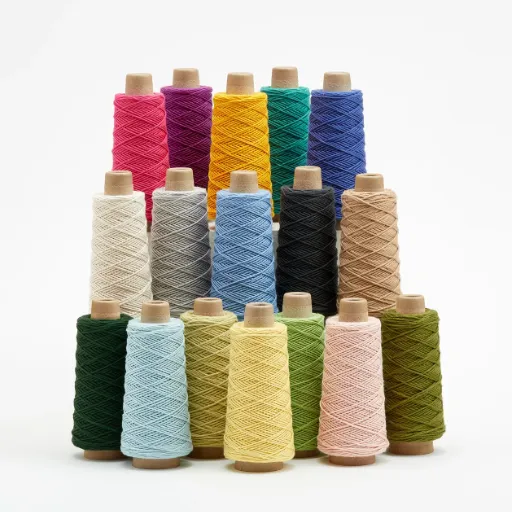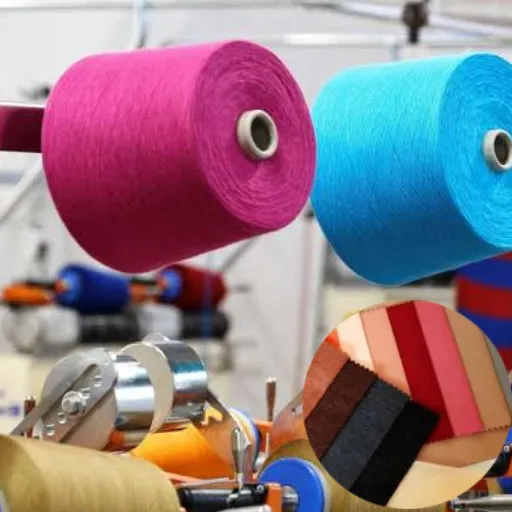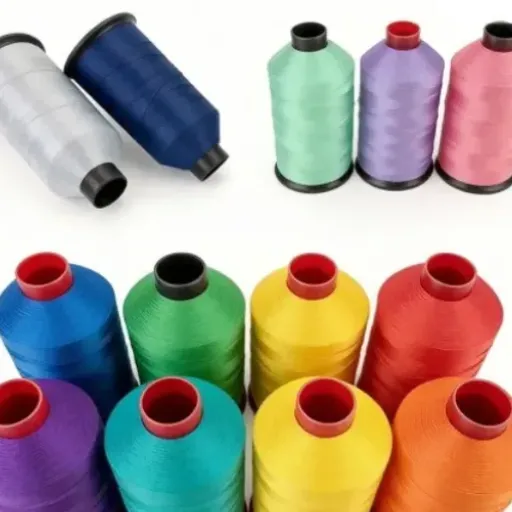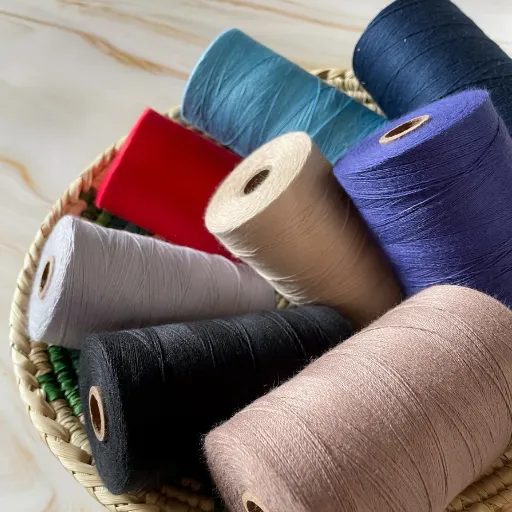
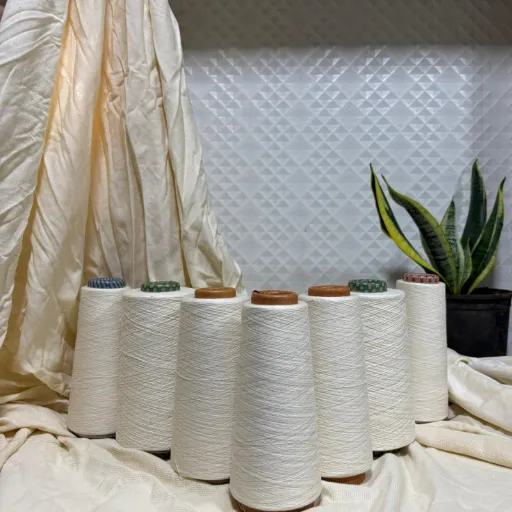

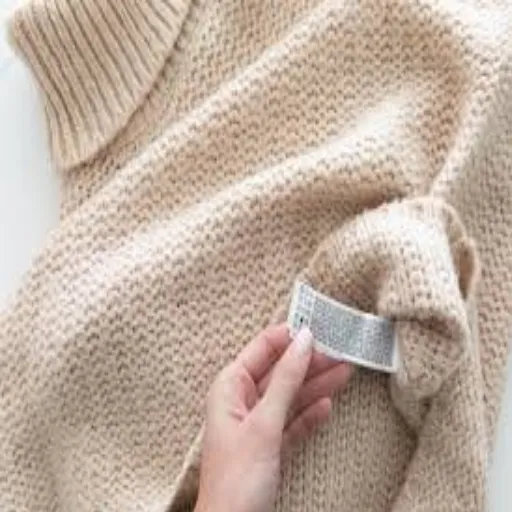


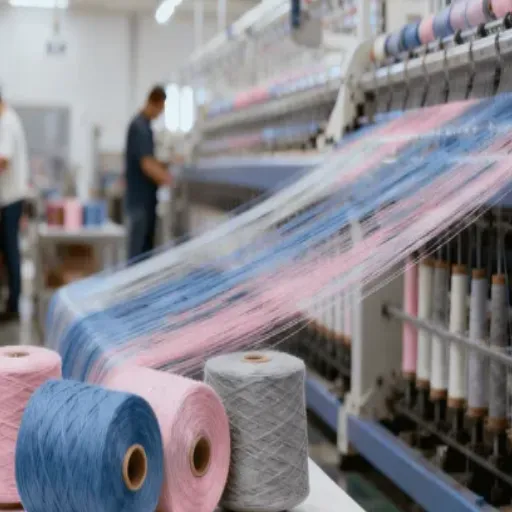
Custom yarn manufacturing is the process of producing yarn to a buyer’s specific requirements, including fiber composition, yarn count, twist, color, and finish. It moves through six defined stages: specification, fiber blending, spinning and twisting, dyeing and color matching, quality control, and packaging. The parameters at every stage change depending on the yarn’s intended use.
If you’ve ever ordered yarn from a catalog, you know the feeling of settling for something close to what you wanted instead of exactly right. The shade is a little off. The hand feel is not quite what you pictured. The strength is fine for most projects but not for the demanding one on your desk. That compromise is the reason custom yarn manufacturing exists.
You may have assumed custom yarn is only for big brands with big budgets. That assumption is worth challenging. The global textile yarn market is worth roughly USD 82 billion in 2025 and is projected to pass USD 127 billion by 2034. A growing share of that volume is customized, not off-the-shelf.
By the end of this guide, you’ll understand how custom yarns are actually made, what the process costs in time and money, and what minimum order quantities you can expect. You’ll also learn how to choose a manufacturing partner who can deliver consistently. Looking for reliable custom yarn manufacturing? Send your specifications to our team.
Key Takeaways
- Custom yarn manufacturing runs through six stages: specification, fiber blending, spinning, dyeing, quality control, and packaging, and the parameters shift for every application.
- The process is more transparent than most buyers realize. Fiber blending, spinning method, and twist level all get engineered to your spec before a single cone is dyed.
- MOQs range from 1 cone for samples to 500 to 1,000 kg per color for package-dyed yarns, and flexible low-MOQ programs exist for small brands.
- Custom work carries a cost premium of roughly 10% for a custom color up to 50% or more for a fully developed new yarn.
- The strongest differentiator you can evaluate is quality control: how a manufacturer proves sample-to-bulk consistency before you commit to a full order.
What Is Custom Yarn Manufacturing?
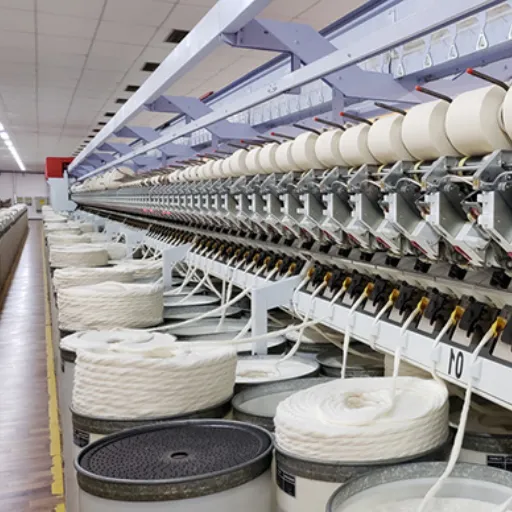
Custom yarn manufacturing means producing yarn according to a buyer’s specification rather than drawing from a manufacturer’s standard stock range. A standard product line is built around what a factory already makes. A custom order is built around what you need: a specific fiber blend, a yarn count, a twist level, a shade, or a functional finish that no stock product offers.
The practical difference shows up in every downstream decision. A custom spec determines which fibers get purchased, how the blend is set up on the machines, how the yarn is spun, what dye recipe is used, and how the finished cones are packaged. That is why custom yarn production costs more per kilogram than stock, and why it can deliver exactly what a project needs. Looking for reliable custom yarn manufacturing? Send your specifications to our team.
Custom vs. Standard Yarn Manufacturing
A quick comparison makes the difference concrete:
| Aspect | Standard (Stock) Yarn | Custom Yarn |
|---|---|---|
| Fiber composition | Fixed by the factory | Specified by the buyer |
| Yarn count and twist | From the existing range | Engineered to spec |
| Color | Stock colors only | Pantone, swatch, or proprietary recipe |
| Minimum order | Low, existing recipe | Depends on customization (see MOQ section) |
| Cost | Base price | +10% to +200% depending on complexity |
| Delivery | From stock or short run | Sampling plus production lead time |
Most buyers start with a clear idea of the finished product they want, not the yarn spec behind it. The job of a good custom yarn manufacturer is to translate one into the other. That translation is where expertise shows, and it’s also where most of the value gets created. Directories such as Yarn Manufacturers list mills that offer custom and OEM production, which helps you compare capability before you make first contact.
Who Should Use Custom Yarn Manufacturing
Custom yarn manufacturing serves a surprisingly wide range of buyers, and bespoke yarn manufacturing is no longer reserved for big brands with big budgets. Who actually uses it?
- Fashion designers who need a signature color, a specific hand feel, or a novelty texture for a collection.
- Home textile brands that need consistent color across curtains, upholstery, and bedding over many seasons.
- Upholstery and curtain producers with performance requirements like abrasion resistance, colorfastness, or fire retardancy.
- Industrial and technical buyers who need yarns that hold up to heat, chemicals, or heavy wear.
- Small brands that want a private-label yarn with their own color identity and packaging.
Take Maya, a knitwear designer who launched her label in 2024. Her first collection used a stock cotton yarn because she assumed custom was out of reach. When a department store buyer asked for an exclusive shade, she contacted a manufacturer with a color swatch and a target count.
The manufacturer came back with two lab dips, and four weeks later she had a small production run in her own color, packaged with her brand label. The exclusive shade became the reason her collection sold through. She learned the most valuable lesson in custom yarn: the process is built for exactly this kind of request. Get custom yarn developed for your required blend, count, color, and application.
The Custom Yarn Manufacturing Process, Step by Step
The custom yarn manufacturing process can be broken into six stages. Here is how custom yarns are made, step by step, and how each stage gives you a map for your own order and a way to evaluate any supplier’s capabilities.
Stage 1: Specification and Design
Every custom order starts with a specification. The buyer defines the fiber composition, the yarn count, the twist, the ply, a color reference, and the intended application. The manufacturer turns that into a technical data sheet that guides production.
The single most important detail is the color reference. Most buyers supply a Pantone number, a physical swatch, a fabric swatch, or a lab dip standard. Pantone is the most common because it is universal, but a physical swatch is more accurate for matching texture and depth. The more precise your reference, the fewer sampling rounds you’ll need.
Stage 2: Fiber Selection and Blending
Fiber selection is where the yarn’s character is set. Cotton gives softness and breathability. Polyester adds strength and durability. Wool brings warmth and resilience. Recycled fibers and organic cotton bring sustainability. Custom yarn manufacturing lets you combine them in any ratio rather than accepting a factory’s default. For a primer on how fiber properties shape the decisions that follow, CottonWorks’ fiber preparation for spinning guide is a solid reference.
Blending changes performance in measurable ways. A 70/30 cotton-polyester blend behaves differently from a 65/35 blend, and the difference shows in strength, softness, and how the yarn dyes. This is one reason custom work costs more: the factory has to source, prepare, and manage fibers it may not stock as a standard product. It is also one reason custom yarns solve problems that stock yarns cannot.
Stage 3: Spinning, Twisting, and Plying
Spinning turns the blended fiber into yarn, and the method shapes the result. Ring spinning produces strong, even, soft yarns. Rotor spinning is faster and cheaper but yields a different hand feel. Fancy spinning creates slubs, boucle, chenille, and other novelty textures. The twist level is set to hit a specific balance of strength and softness, and plying combines two or more single strands for durability or a particular drape.
Twist is one of the most underappreciated custom levers. A low-twist yarn is soft and drapey but less durable. A high-twist yarn is stronger and more crisp but stiffer. In custom yarn manufacturing, the twist is engineered to the application rather than set to a factory standard.
Stage 4: Dyeing and Color Matching
Dyeing is where the color comes to life, and it is the stage where precision matters most. The manufacturer develops a lab dip, a small dyed sample on your actual production fiber, then sends it for your approval. Expect two or three rounds of lab dips before the color is right.
Color is measured scientifically, not just by eye. A color match with a Delta E of under 1.0 is considered excellent. Professional buyers approve lab dips under multiple light sources: D65 for daylight, TL84 for store lighting, and A for home lighting.
A color that matches perfectly in daylight can shift badly under fluorescents. Checking under all three is the difference between a satisfied customer and a costly re-dye.
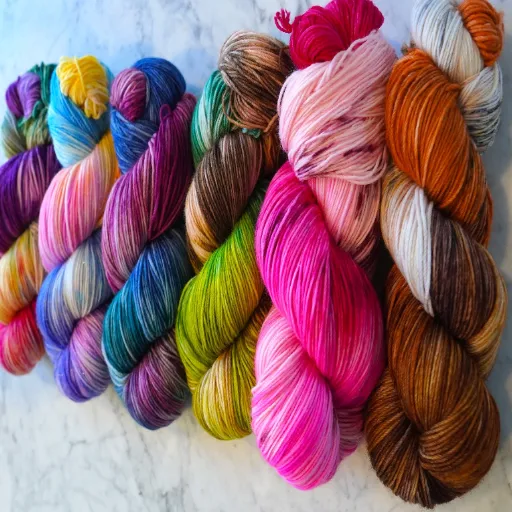
The dyeing method also affects the result and the minimum order. Package dyeing pumps dye through yarn wound on perforated tubes and gives the most consistent color at scale. Skein dyeing suits smaller batches and soft-hand yarns. Space dyeing creates multi-color effects along the yarn. Solution dyeing adds color to the polymer before extrusion and gives the best colorfastness but requires the largest volumes. Need custom yarn for a unique textile project? Talk to Hebei Lida Textile Co., LTD.
Stage 5: Quality Control and Testing
Quality control in custom yarn manufacturing is not a single checkpoint. It runs through the whole order: base yarn verification before dyeing, first-piece inspection when production starts, in-process sampling during the run, and final testing before packaging.
For colored yarns, shade sorting is a step many buyers never hear about until it matters. Because no two dye lots are identical, mills group variations into A, B, and C shades so that a single production run is internally consistent. A manufacturer that sorts shades and reports the results is one you can trust with a large order.
Stage 6: Packaging and Delivery
The final stage is packaging, and it matters more than most buyers expect. A cone of yarn for a textile factory is packaged very differently from a ball for retail or a hank for special presentation. Custom yarn manufacturers handle private labeling, barcode labels, and custom packaging as part of the service.
Confirm the packaging format before you get a final quotation, not after. The format changes the carton size, the shipping weight, and the labeling, all of which affect the price. It is a small detail that can add unexpected cost if left until the end.
[If you want to see how each production stage fits together in a standard mill, our yarn production process guide walks through the full flow from fiber preparation through spinning.]
Custom Yarn Design and Specification
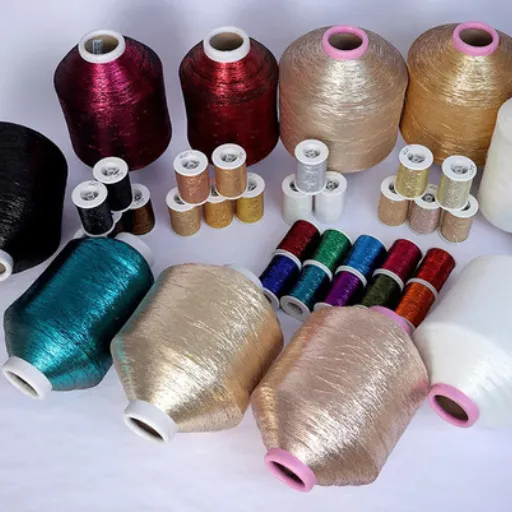
The design phase of custom yarn manufacturing bridges your creative vision and the factory’s machinery. A good manufacturer treats your design as a starting point and helps you turn it into a manufacturable spec.
The core elements of a manufacturable custom yarn spec are:
- Fiber composition: the exact blend and ratio, such as 70/30 cotton-polyester.
- Yarn count: the thickness, expressed in units like Ne or Nm, which affects weight and drape.
- Twist level: how tightly the fibers are twisted, balancing strength and softness.
- Ply: whether the yarn is a single strand, two-ply, three-ply, or more.
- Color reference: Pantone, swatch, or lab dip standard.
- Application: where the yarn will be used, which drives the other decisions.
The most common specification mistakes are the easiest to fix. Vague color references cause extra lab dip rounds. Missing application details lead to yarns that look right but fail in use. And an unrealistic count or twist for the chosen fiber can make the yarn impossible to produce at the intended cost.
A detailed guide to this stage lives in our article on custom yarn design specifications, which covers how to build a technical data sheet and how to avoid the mistakes that cause sampling delays.
Custom Fiber Blending and Spinning: Engineering Performance
Fiber blending is where custom yarn manufacturing earns its keep. You are not limited to the blends a factory already runs. You can engineer a yarn for a specific balance of strength, softness, durability, and sustainability.
Common custom blends include cotton-polyester for durability and cost balance, wool-nylon for resilience in socks and outerwear, and recycled blends for eco-conscious collections. The blend ratio is a precise lever: moving from 70/30 to 65/35 cotton-polyester changes hand feel, strength, and how the yarn accepts dye.
Sustainability is a growing reason buyers go custom. Organic cotton, recycled polyester, and other certified materials can be blended into a custom spec, and a manufacturer with the right certifications can document it. If eco-friendly materials matter to your brand, ask about certified options up front. We cover the material side in more depth in our guide to custom fiber blending, and certified eco-friendly options in our eco-friendly yarn production coverage.
Spinning method is the second engineering decision. Ring-spun yarns are the standard for softness and strength. Rotor-spun yarns are more economical but coarser. Fancy spinning opens up novelty textures. The choice affects not just appearance but cost, since each method has different machinery and speed. If you are ordering yarn for a product that will be touched and washed often, ring spinning is usually worth the premium.
Custom Yarn Dyeing and Color Matching
Color is the most common customization in custom yarn manufacturing, and it is also the most technically demanding. A custom color order is a process, not a single request:
- You provide a color reference, typically a Pantone number or a physical swatch.
- The manufacturer develops a lab dip on your actual production fiber.
- You approve the dip under multiple light sources, D65, TL84, and A.
- The manufacturer produces a small sample lot for final approval.
- Full production begins, with shade sorting across the run.
The timeline is honest about the steps. Lab dip development takes roughly 7 to 10 days, and most orders need two to three rounds. Custom color or packaging samples run 7 to 15 days. Bulk production typically takes 15 to 25 days after specifications and samples are confirmed. Plan for those rounds when you schedule your collection or product launch.
For color consistency at scale, industrial package dyeing is the reliable choice. It produces the most uniform color across a large run and is the standard for brands that need to reorder the same shade season after season. Hand dyeing and small-batch dyeing create character and are fine for limited editions, but they cannot guarantee the batch-to-batch consistency a growing brand needs.
The color journey is detailed in our guide to custom yarn dyeing and color matching, including how to manage approvals and avoid re-dye costs.
Quality Control in Custom Yarn Manufacturing
Custom yarn quality control deserves its own focus because it differs from QC on standard products. A standard product is tested against a fixed spec. A custom product is tested against your spec, and the stakes are higher: the yarn has to match a sample you already approved.
The QC workflow for a custom order should include:
- Pre-production sample approval: you approve the physical sample before bulk starts.
- First-piece inspection: the first production units are checked against the approved sample.
- In-process checkpoints: samples are pulled during the run to catch drift early.
- Shade sorting: variations are grouped into A, B, and C shades for internal consistency.
- Final testing: evenness, strength, twist accuracy, and colorfastness are verified before packaging.
Colorfastness testing deserves attention. Wash, light, and crocking tests confirm that the color survives the product’s real life. A yarn that fades in sunlight or bleeds in the wash will fail no matter how beautiful the original shade is.
Ask any manufacturer for the test data behind their quality claims. A confident supplier will share evenness, strength, and colorfastness results. One that cannot is a risk, because the gap between a lab dip and a full production run is where quality is won or lost. We go deeper on reading test reports and managing deviations in our guide to quality control for custom yarn orders.
Custom Yarn MOQs, Costs, and Lead Times
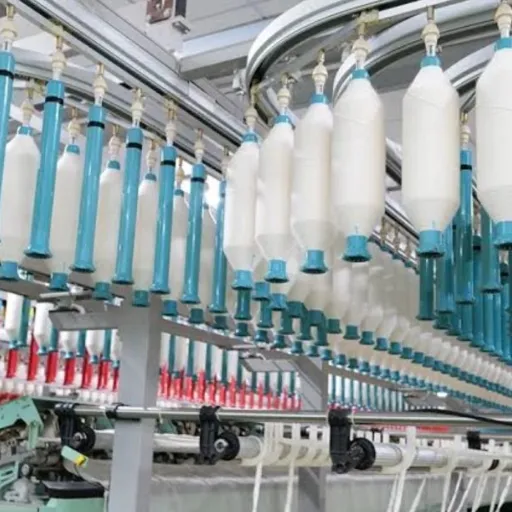
The numbers buyers most want before ordering are the ones most suppliers avoid stating clearly. In custom yarn manufacturing, MOQs vary more by customization type than any other metric. Here is a realistic picture based on current industry practice.
Minimum Order Quantities by Customization Type
| Customization Level | Typical MOQ |
|---|---|
| Stock yarn sample | 1 cone, or 5 to 20 kg for a test run |
| Small-batch / flexible color programs | 50 to 100 kg per color |
| Custom color (package dyed) | 500 to 1,000 kg per color |
| Custom blend or custom-spun yarn | 1,000 to 3,000 kg per specification |
| Solution-dyed custom color | 3,000 to 10,000 kg per color |
The headline for small brands is the second row. Some manufacturers now offer flexible low-MOQ programs specifically so startups and limited collections can access custom production. The trade-off is a higher cost per kilogram, but the access to a proprietary product is often worth it.
Cost Premiums by Customization
| Customization | Typical Premium Over Standard |
|---|---|
| Custom color only | +10% to +25% |
| Custom fiber blend | +15% to +30% |
| Custom twist | +10% to +20% |
| Functional finish (antimicrobial, flame retardant, UV) | +30% to +100% |
| Full custom development (new yarn) | +50% to +200% |
These figures come from GLYarn’s custom yarn guide, which remains one of the most transparent breakdowns of custom yarn economics in the industry.
Budget for the hidden costs too. A one-time color matching fee of 100to100to500 is common. Clean-down between colors adds 5% to 10% to the cost. Rush fees run 20% to 50%. And short-run surcharges can double the per-unit cost if you order below the effective minimum.
Knowing these up front turns a budget surprise into a planned line item.
Lead Times by Customization
| Customization | Additional Lead Time |
|---|---|
| Custom color | +2 to +3 weeks |
| Yarn count | +2 to +4 weeks |
| Twist level | +2 to +4 weeks |
| Ply / construction | +3 to +6 weeks |
| Fiber blend | +4 to +8 weeks |
| Functional finish | +4 to +10 weeks |
A full custom project, from first concept through shipping, typically runs a minimum of four to five months. That timeline includes the lab dips, the sample lot, your approvals, bulk production, and transit. Build the buffer into your schedule and you’ll never have to explain a late collection.
Consider Elena, who founded a small natural-dye yarn brand in 2025 with a budget that assumed custom was unaffordable. She found a manufacturer with a flexible MOQ program and asked about the development-fee route: she paid a higher up-front development fee in exchange for a lower quantity MOQ. Her first run was 80 kg per color instead of the 500 kg she dreaded, and the per-kilogram premium was acceptable because the yarn was a hero product with a proprietary shade. The strategy is worth asking about with any serious supplier.
Custom Yarn Manufacturing for Every Application
The same six-stage process produces very different yarns depending on the end use. This is the part of custom yarn manufacturing that generic suppliers gloss over, and it is where a specialist earns its keep.
Upholstery
Upholstery yarn must survive years of abrasion, light, and occasional cleaning. The spec emphasizes abrasion resistance, colorfastness to light, and in many regions, flammability standards. Fiber blends lean toward durable synthetics or tough cotton-polyester combinations, and twist is set higher for strength. A custom yarn for upholstery is engineered for wear, not just appearance. See our guide to custom yarn for upholstery for the full requirements.
Curtains and Drapes
Curtains demand a different set of properties: drape, weight, and lightfastness. A sheer panel needs a lightweight yarn with a soft hand. A blackout curtain needs a dense construction and often a flame-retardant finish. UV resistance matters because sunlight is the most relentless force a curtain will face. The manufacturer tunes count, twist, and fiber choice to hit the exact drape and opacity you need. Our custom yarn for curtains guide covers the details.
Fashion
Fashion is about speed and responsiveness. Seasonal collections need fast sampling, small batches, and the ability to change color and texture quickly. A fashion-focused custom yarn manufacturer builds sampling speed into the process and can turn a trend into a yarn within a season. This is where low-MOQ programs shine, because fashion brands rarely want 1,000 kg of an untested novelty yarn. Learn more in our custom yarn for fashion guide.
Industrial and Technical
Industrial yarns are specified for performance under extreme conditions: tensile strength, heat resistance, chemical resistance, and consistent quality across huge volumes. The spec is documented, the testing is rigorous, and the certifications are verifiable. Custom industrial yarns often involve specialized fibers, coatings, and treatments that stock products never carry. For a detailed look at how yarns are built for demanding construction and technical uses, see TP Industrial’s From Filament to Construction explainer. Our custom yarn for industrial use guide walks through the requirements for buyer-side evaluation.
When Tom’s upholstery company switched to a custom yarn for a hotel contract, the sample looked perfect. The first production lot matched too.
It was the third lot that drifted, slightly duller, slightly weaker, and his client noticed the difference in a finished sofa. The manufacturer that won his next order sorted shades into A, B, and C groups and sent a first-piece inspection report before bulk started. That is the difference between a supplier who ships yarn and a partner who protects your reputation.
Choosing a Custom Yarn Manufacturing Partner
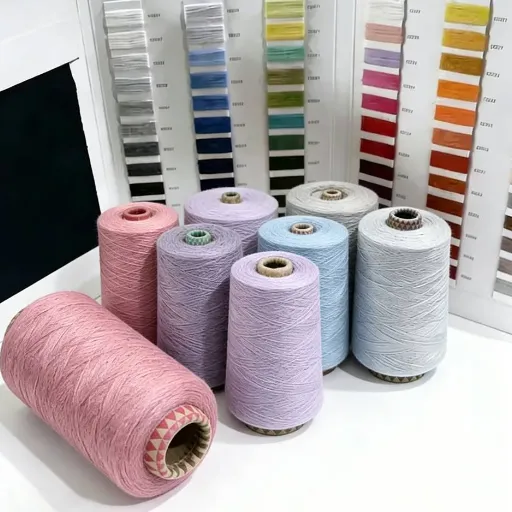
Choosing a partner is the decision that determines whether your custom yarn project succeeds. The process is transparent enough to evaluate, but only if you know what to ask.
Before you commit to a manufacturer, ask these questions:
- What is your exact MOQ for my type of customization? And are there flexible programs for smaller runs?
- Can you show me the technical data sheet from a past custom order? (Names removed, specs visible.)
- How many lab dip rounds should I budget for? A straight answer of “two to three” is more trustworthy than “usually one.”
- How do you prove sample-to-bulk consistency? Ask for their QC workflow and test reports.
- What certifications do you hold? OEKO-TEX, GRS, and ISO 9001 are common markers of a serious manufacturer.
- What applications have you produced for before? An upholstery specialist is the right call for an upholstery project.
- What is your real timeline, including sampling? Compare it against the four-to-five-month reality for full custom projects.
Red flags include vague MOQ answers, an unwillingness to share test data, and pressure to approve a color on a single light source. The right partner will welcome your questions because they know a well-specified order is the easiest order to produce.
Hebei Lida Textile Co., LTD builds custom yarn manufacturing around exactly this level of transparency. We help you translate your design into a manufacturable spec, support flexible order sizes from samples through large-scale production, and document quality at every stage. Start with our custom yarn solutions page to see how an order moves from your first inquiry through approvals to delivery, or request samples to test the quality for yourself.
Frequently Asked Questions About Custom Yarn Manufacturing
What is custom yarn manufacturing?
Custom yarn manufacturing produces yarn to a buyer’s specific requirements rather than supplying a standard stock product. The buyer controls the fiber, count, twist, color, and finish, and the mill engineers every stage, specification, blending, spinning, dyeing, quality control, and packaging, to match.
How are custom yarns made?
Custom yarns are made by translating a buyer’s specification into a technical data sheet, sourcing and blending the fibers, spinning and twisting the yarn to spec, dyeing and matching the color through lab dips, checking quality against the approved sample, and packaging the finished cones.
What is the minimum order quantity for custom yarn?
MOQs range from 1 cone for samples to 500 to 1,000 kg per color for package-dyed custom colors. Custom blends and custom-spun yarns typically start at 1,000 kg, while flexible low-MOQ programs for small brands can start around 50 to 100 kg per color.
How much does custom yarn cost?
Custom yarn costs 10% to 25% more for a custom color, 15% to 30% more for a custom blend, and 50% to 200% more for a fully developed new yarn, plus hidden costs like color matching fees and short-run surcharges.
How long does custom yarn manufacturing take?
A full custom project typically takes four to five months from concept to delivery, including lab dips, sample approval, bulk production, and shipping. Individual customizations add 2 to 10 weeks on top of a standard timeline.
Can I order small batches of custom yarn?
Yes. Many manufacturers offer flexible MOQ programs starting around 50 to 100 kg per color, and some will lower the quantity MOQ if you share the development and setup cost up front.
Conclusion
Custom yarn manufacturing removes the compromise that comes with buying stock yarn. Instead of settling for a close shade, you get a yarn engineered to your spec: the right fiber blend, the right count and twist, the right color, and the right performance for your application.
The key takeaways to remember:
- The process runs through six stages, and the parameters shift for every end use, from upholstery to fashion to industrial.
- Color matching and quality control are where a manufacturer proves its value, so ask for lab dips under multiple light sources and real test data.
- MOQs are more flexible than the industry’s reputation suggests, especially with low-MOQ programs and shared development fees.
- Budget for cost premiums and lead times honestly, and you’ll avoid the surprises that derail collections.
- Choose a partner who documents quality and welcomes your questions.
If you’re ready to turn your idea into a custom yarn, start with a conversation. Request samples, share your color reference, and ask about MOQ options. At Hebei Lida Textile Co., LTD, we manufacture custom yarns for fashion, home textiles, and industrial applications, and we’ll help you get from spec to finished cones without the guesswork. Contact us to discuss your project, or explore our custom yarn solutions to see how the process works end to end.