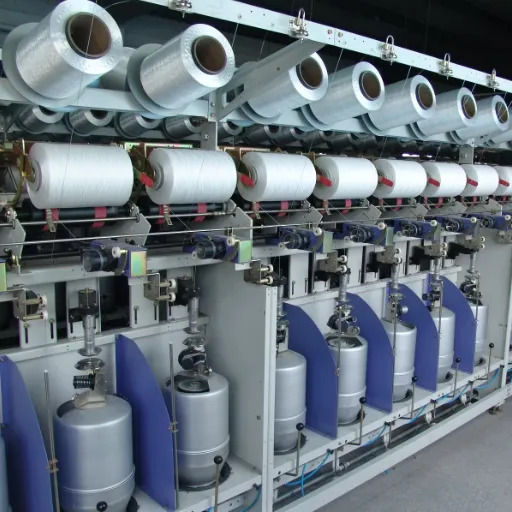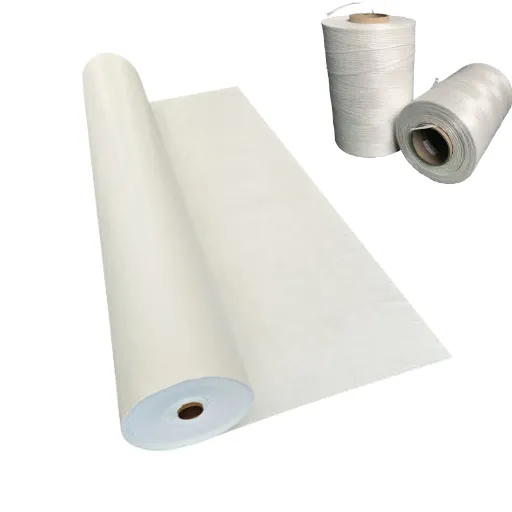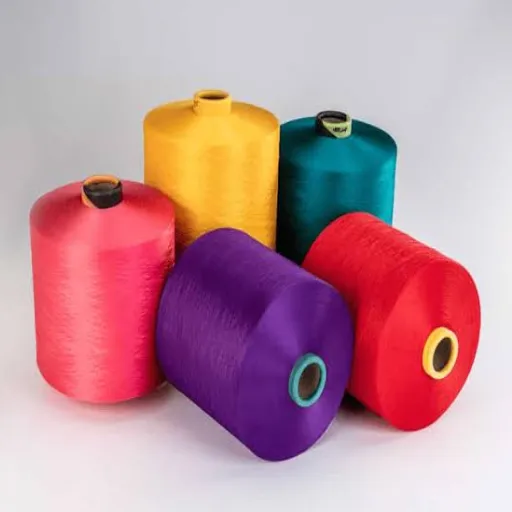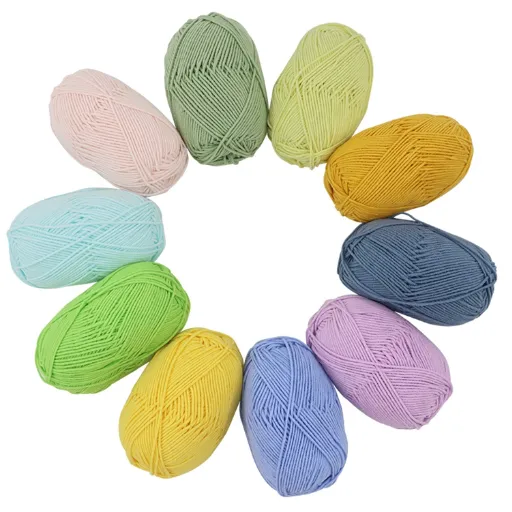
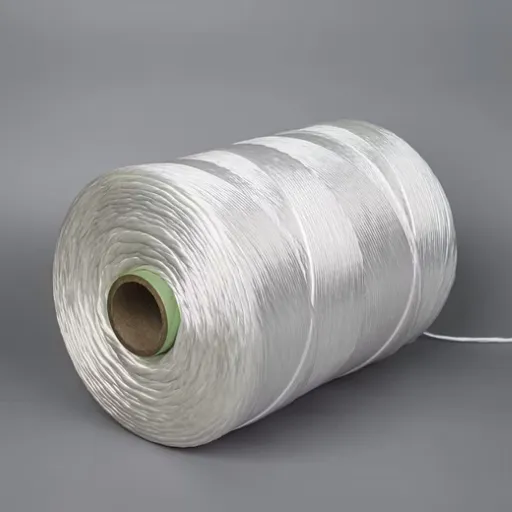
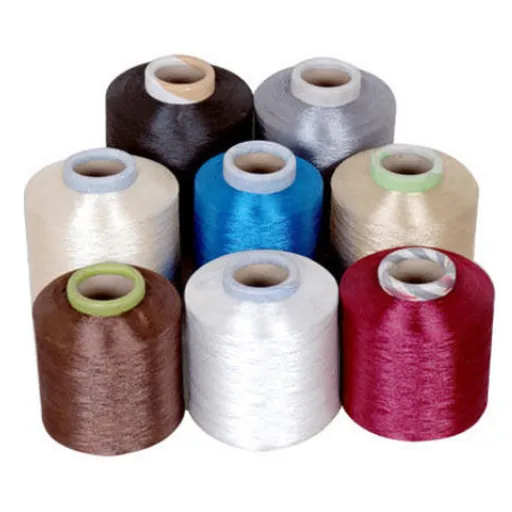
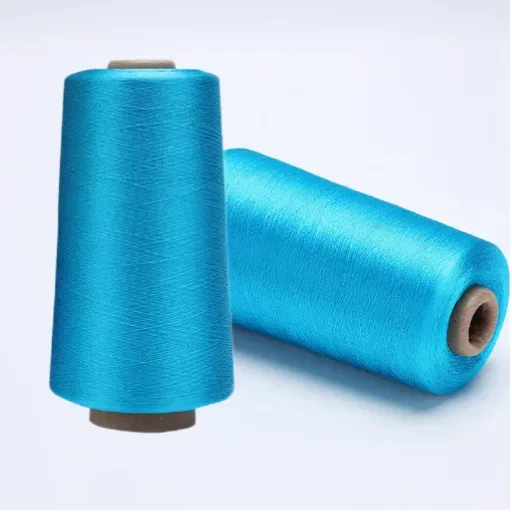


Polyester industrial yarn and ordinary polyester yarn are the same polymer built to different specifications. Industrial yarn is coarse, high-tenacity filament, conventionally 550 dtex or coarser, drawn from higher-viscosity PET and heat-set to a stated shrinkage. Ordinary polyester is finer filament made for hand, drape and colour, and it typically carries about half the strength per unit of weight.
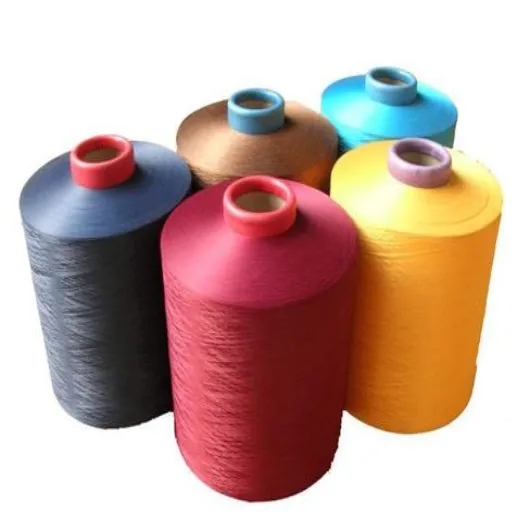
Both arrive on a cone, both are labelled “100% polyester”, and in a warehouse they can look like the same product. That is exactly how costly substitutions happen. Our covers both grades, so the specification language here matches what we quote.
Key Takeaways
- Both grades are PET. The difference is intrinsic viscosity, draw ratio, heat setting and linear density, not chemistry.
- Industrial yarn is conventionally 550 dtex (about 495 denier) or coarser and is drawn to roughly 8 cN/dtex. Ordinary apparel filament runs about 3 to 5 cN/dtex.
- Tenacity figures are only comparable when the unit is stated. 8.2 cN/dtex and 9.3 g/d are the same yarn; 8.2 g/d and 8.2 cN/dtex are not.
- Substituting industrial yarn into apparel over-specifies and costs money. Substituting ordinary yarn into a load-bearing product usually passes inspection and fails months later.
- The proof is a lot test to ASTM D885, not a catalogue page.
The Short Answer: Polyester Industrial Yarn vs Ordinary Polyester Yarn
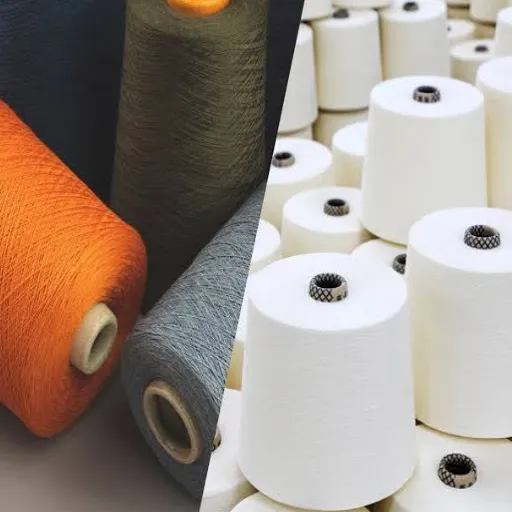
The practical difference is size and strength together. Industrial polyester yarn is coarse filament, typically 550 dtex and above, spun from higher-viscosity polymer and drawn hard so it can carry load. Ordinary polyester yarn is finer, softer filament drawn for appearance and comfort. One is specified by tenacity and shrinkage; the other by denier, hand and colour.
Same polymer, different specification
Polyester is polyethylene terephthalate, made from purified terephthalic acid and monoethylene glycol. Both grades use it; nothing in the chemistry separates them.
What separates them is the process window. Industrial grades start from higher-viscosity PET chip, are drawn at a higher ratio, and are heat-set to a specified shrinkage. Ordinary grades are drawn less, textured or interlaced for bulk, and finished for dyeing and hand. A supplier cannot simply “make it stronger” on request: strength, elongation and shrinkage move together.
What the words actually mean
| Term | What it describes | What it does not tell you |
|---|---|---|
| Ordinary / apparel polyester | Filament made for hand, drape, colour and processing | Tenacity, shrinkage, or whether it can carry load |
| Industrial polyester yarn | A size band, conventionally 550 dtex and coarser | Whether the yarn is actually strong |
| High tenacity polyester yarn | A strength grade, quoted in cN/dtex or g/d | The denier, the shrinkage, or the elongation |
| Textured (DTY) | A finish: bulk and stretch added by false twisting | Anything about tensile strength |
Industrial tells you the yarn is big. High tenacity tells you it is strong. Textured tells you how it was finished. A yarn can be all three, or none.
Answering the question buyers actually type
The difference comes down to intended load. Industrial yarn is made to hold tension without stretching out of tolerance; ordinary yarn is made to look and feel right in fabric, at whatever strength the fabric needs. In one sentence: ordinary polyester is specified by how it looks and processes; industrial polyester is specified by what it carries.
What Actually Differs: The Numbers
Four properties do the real work: tenacity, polymer viscosity, elongation and shrinkage, and linear density. Each is measurable, and each is quoted badly somewhere on the internet.
Tenacity, in both unit systems
Tenacity is breaking force divided by linear density. It separates the two grades more clearly than any other number, and it is the one most often misquoted.
Ordinary apparel filament runs POY about 2.0 to 2.5 g/den, DTY about 3.5 to 4.5 g/den and FDY about 4.5 to 5.5 g/den. At 1 cN/dtex ≈ 1.13 g/d, that is roughly 3.1 to 4.9 cN/dtex for drawn apparel yarn.
Industrial grades run HT at 8.2 cN/dtex (about 9.3 g/d), super-HT at 8.5 (about 9.6) and super-HT high end at 9.2 (about 10.4), from . That sheet lists dtex, denier, breaking strength, cN/dtex, g/d, elongation and hot-air shrinkage side by side. It’s the format worth asking every supplier for.
Those are the same rows buyers compare without realising it. 9.3 g/d and 8.2 cN/dtex describe the same yarn; 8.2 g/d describes something weaker, at about 7.3 cN/dtex.
A second trap: some European sheets quote cN/tex rather than cN/dtex, and one dtex is one tenth of a tex, so the figure looks ten times larger. Diolen’s 855T is published at 83.6 cN/tex, which is 8.4 cN/dtex. It is not ten times stronger; the unit changed.
| From | To | Multiply by |
|---|---|---|
| Denier | dtex | 0.9 |
| dtex | denier | 1.11 |
| cN/dtex | g/d | 1.13 |
| g/d | cN/dtex | 0.88 |
| cN/tex | cN/dtex | 0.1 |
Polymer viscosity
Intrinsic viscosity, or IV, measures how long the polymer chains are. It is the upstream reason the tenacity differs, and the number a chip buyer specifies. Textile-grade PET sits around 0.64 to 0.68 dL/g, according to . Industrial yarn and tire cord sit at about 0.80 dL/g and above, usually reached by solid-state polymerisation after the chip is made. Higher viscosity costs more and processes harder, but it gives the melt enough strength to be drawn into a filament that holds tension.
Elongation and shrinkage
Two yarns with identical tenacity can behave completely differently on a coating line or a loom.
A published HT sheet gives 14.0% elongation with 8.0% hot-air shrinkage; the super-HT row gives 12.0% with 9.0%. at 1100 dtex and 210 filaments is published at 12.5% elongation with 6.1% shrinkage at 180 °C. Ordinary apparel filament is rarely quoted this way: FDY commonly sits at 25 to 35% elongation and DTY at 18 to 25%. That stretch is a feature in knitting and a problem in a sling.
A “3% shrinkage” claim means nothing without the temperature, dwell time and load. Recron publishes its at 3 to 4% hot-air shrinkage at 190 °C for 5 minutes under 0.01 gpd. A sheet testing at 177 °C for 2 minutes measures different behaviour and will produce a different number on the same yarn.
Size and filament count
Linear density separates the grades most easily on paper. Industrial yarn is coarse by definition, and the trade’s working threshold is 550 dtex or more, about 495 denier. : “high-strength, coarse denier polyester industrial filament with a size of not less than 550 dtex.”
Recron’s industrial range runs 250D to 3000D. Ordinary apparel filament clusters at 50 to 300 denier, with 75D/36f and 150D/48f among the most common. Filament count matters as much as the total, since a 1000D/96f and a 1000D/192f yarn share a linear density and behave differently. For how to read those numbers, see our guide to .
Comparison Table: Polyester Industrial Yarn vs Ordinary Polyester Yarn
| Parameter | Ordinary / apparel | Industrial | Why it matters downstream |
|---|---|---|---|
| Polymer IV | about 0.64 to 0.68 dL/g | about 0.80 dL/g and above | Determines achievable tenacity |
| Draw ratio | Lower | Higher | Aligns chains; raises strength, lowers elongation |
| Tenacity | about 3.1 to 4.9 cN/dtex (3.5 to 5.5 g/d) | about 8.2 cN/dtex (9.3 g/d); super-HT to 9.2 | Load capacity per kilogram |
| Elongation at break | about 18 to 35% | about 12 to 16% | Stretch under working load; creep risk |
| Shrinkage | Variable, often bulk-driven | Specified, tested at a stated temperature | Dimensional stability in heat |
| Linear density | Mostly 50D to 300D | 550 dtex and coarser; published to 3000D | Whether the yarn suits the machine at all |
| Filament count | Often high per denier | Lower per denier, engineered | Flexibility versus stiffness |
| Finish | Textured, interlaced, dye-ready | Spin finish, adhesive-activated, sized | Adhesion and processing |
| Price basis | Per kilogram, hand and colour | Per kilogram, test data per lot | What you are actually buying |
| Buying basis | Appearance, dye consistency | Specification with a lot report | How you prove the claim |
Two things the table does not say. Coarse does not automatically mean strong: a 1000 denier yarn can be made at ordinary tenacity. Fine does not automatically mean weak: a fine FDY drawn for a technical fabric can sit above apparel tenacity. The thresholds describe convention, not physics.
Comparing two quotes right now? Send us the tenacity, elongation, shrinkage and denier from each, with the units. Our team will tell you whether they describe the same yarn and what we can supply against that spec. .
Which Grade Fits Which Job
Where ordinary polyester is the right answer
Most polyester in the world is ordinary polyester, and most of the time that is correct. Apparel, home textiles, upholstery, knitwear and crochet all need filament that feels right, takes dye evenly and processes predictably on standard machinery. Tenacity above apparel grade adds cost, stiffness and processing difficulty without improving the product. If your fabric fails by pilling, by drape, or by dye unevenness, industrial yarn will not fix it; it will make it worse.
Where industrial polyester is the right answer
Industrial yarn earns its price where the yarn itself is the load path.
- Webbing and slings: tenacity floor plus an elongation ceiling.
- Rope and cordage: strength, with fatigue resistance checked separately.
- Hose reinforcement: strength plus adhesion to rubber.
- Conveyor and V-belts: dimensional stability under heat more than peak strength.
- Tire cord: heat stability, fatigue and adhesion together.
- Coated fabric and tarpaulin: low shrinkage through the coating oven.
- Geotextile and geogrid: strength retention in soil.
- Industrial sewing thread: tenacity plus abrasion resistance, usually twisted.
- Automotive textiles: heat and fatigue resistance.
Two honest notes. Nylon often beats polyester on flex fatigue, so rope and airbag buyers should test both rather than defaulting; polypropylene wins on chemical resistance and density in some geotextile work. For the detail behind each row, see our guide to .
What Happens When You Substitute Ordinary for Industrial Yarn
This is the section that saves money, and it runs in the opposite direction from what most buyers expect.
Industrial in place of ordinary
This direction is safe on performance and expensive on cost. The yarn carries more load than the product needs, and it is stiffer and harder to process. The risks are processing, not failure. A coarser yarn may not run on machinery set up for apparel filament. It may not dye to the same shade, and it may change the hand of the fabric enough to fail an approval sample.
Ordinary in place of industrial
This is the expensive direction, and it fails quietly.
An ordinary polyester yarn can pass incoming inspection against an industrial specification it was never designed to meet. The two look identical on a cone, and they share a polymer. The failure shows up in service: creep under sustained load, fatigue under repeated cycling, or shrinkage in a hot process. A sling that stretches, a belt that changes length, a tarpaulin that wrinkles in the coating oven. None of these fail on the receiving dock. They fail at the customer months later, and the cost is a claim rather than a discount.
Four questions that settle it
- What load does the yarn actually carry, and for how long without relief?
- What is the elongation ceiling at working load, not at break?
- What temperature does the yarn see after weaving, and for how long?
- How many load cycles does the product survive in service?
If you cannot answer all four, the substitution is a guess. A guess is acceptable for a sample; it is not acceptable for a container. Plan a trial run and a shade check before any production order.
How to Prove Which Yarn You Have
A catalogue page is a claim. A lot report is evidence. The gap between them is where substitutions live.
Which standard covers which claim
| Claim | Standard | What it covers |
|---|---|---|
| Tenacity, elongation, modulus | ASTM D885 / D885M | Test methods for industrial filament yarns and tire cord. Sets methods, not specifications or tolerances |
| Hot-air shrinkage | ASTM D4974 | Shrinkage of yarn and cord in a thermal shrinkage oven, for linear densities of 20 to 700 tex |
| Linear density | ASTM D1907 | Yarn number by the skein method, for yarns finer than 2000 tex |
| Twist | ASTM D1423 | Twist level and direction in plied yarns |
ISO equivalents exist for most of these. What matters is that the report names a method, a date and a lot: a tenacity quoted without a method is not comparable to anything. Note also that ASTM D885 sets no pass or fail limits. It tells you how to measure, and the limits come from your purchase specification, which means someone has to write them.
What a data sheet proves, and what it does not
A technical data sheet gives representative values from routine production. It does not prove the container you receive matches them. A certificate of analysis is stronger, but only if it references your lot and names the test method. A third-party lot test is the only thing that proves the yarn in your warehouse meets the specification. Ask for the lot report before the container ships, keep a retention sample, and for repeat orders agree a sampling frequency in writing. Our guide to covers the wider process.
A note on certificates. A certificate tells you a system was audited. It does not tell you this lot’s tenacity. Both are worth having, and they answer different questions. Hebei Lida does not currently publish product certifications, so ask any supplier, including us, for the lot data rather than the logo.
Price: Polyester Industrial Yarn vs Ordinary Polyester Yarn
Industrial yarn costs more per kilogram than ordinary yarn. The gap is not a premium for the word “industrial”, and it does not follow a fixed ratio. It comes from higher-IV chip, slower spinning and drawing, tighter process control and more testing per lot, heavier and finer constructions, dope-dyed colour, extra twist and finish steps, and small order sizes.
We don’t publish prices, because the honest number depends on denier, quantity, twist and finish. For a figure against your specification, send the spec and ask.
Frequently Asked Questions
What is the difference between polyester industrial yarn and ordinary polyester yarn?
Industrial polyester yarn is coarse, high-tenacity filament, conventionally 550 dtex or coarser, made to carry load. Ordinary polyester yarn is finer filament made for hand, drape and colour, reaching about half the tenacity. Same polymer, different process window and specification.
Is industrial polyester yarn the same as high tenacity polyester yarn?
No, though they usually overlap. “Industrial” describes size; “high tenacity” describes strength. Most industrial yarn is high tenacity, but a coarse yarn can be made at ordinary tenacity and a fine yarn at high tenacity. If a supplier uses one term to imply the other, ask for the number. Our guide to covers the strength side.
Can I use ordinary polyester yarn instead of industrial polyester yarn?
Only if the product does not carry sustained load and does not see heat after weaving. Ordinary yarn will pass a visual inspection and fail later by creep, fatigue or shrinkage. If the yarn is the load path, the substitution is not safe without a lot test.
What does 550 dtex mean, and what is it in denier?
550 dtex means 550 grams per 10,000 metres of yarn. Denier is grams per 9,000 metres, so multiply dtex by 0.9: 550 dtex is about 495 denier. It is the conventional lower edge of the industrial band, not a legal definition.
Is 100% polyester industrial yarn different from 100% ordinary polyester yarn?
Both are 100% polyester, and the label will look the same. The difference is in the specification behind it: intrinsic viscosity, draw ratio, tenacity, elongation and shrinkage. The purchase order, not the cone label, is where the grade is defined.
What is the minimum order quantity?
It depends on whether the yarn is a stock construction or made to your specification, and on denier, colour and twist. Small trial lots are possible for sampling. Send the specification and we will confirm the minimum for that item.
The Bottom Line: Polyester Industrial Yarn vs Ordinary Polyester Yarn
Polyester industrial yarn vs ordinary polyester yarn comes down to four numbers: intrinsic viscosity, draw ratio, tenacity and linear density. Ordinary apparel filament runs about 3 to 5 cN/dtex at 50 to 300 denier. Industrial yarn runs about 8 cN/dtex at 550 dtex and coarser, with elongation and shrinkage specified rather than implied.
Three things follow. First, the grade is defined by the purchase order, not by the cone label: both say “100% polyester” and both look the same on a pallet. Second, substitution is asymmetric. Industrial in place of ordinary costs money and may need a trial run; ordinary in place of industrial passes inspection and fails later, in the field. Third, the only proof is lot data against a named test method. Get those three right and you can price a quote honestly, defend a substitution, and reject a yarn that will not carry the load you are putting on it.
Sourcing Both Grades
Hebei Lida Textile Co., LTD supplies polyester yarn from Xingtai, northern China. We work across seven product lines and seven application sectors, through five warehouses in China and a network of more than 80 partner mills. Our team brings over 15 years of industry experience to specification work.
For industrial and apparel polyester we can discuss count, colour and twist against your specification. We sample before bulk, and we run low-MOQ trials so you can test the yarn in your own process rather than on a data sheet. Where a grade is supplied rather than produced in-house, we’ll say so.
If you are comparing two quotes, send both specification sheets. We will tell you whether they describe the same yarn, and what we can supply against either. For bespoke constructions, our guide to walks through the specification process.