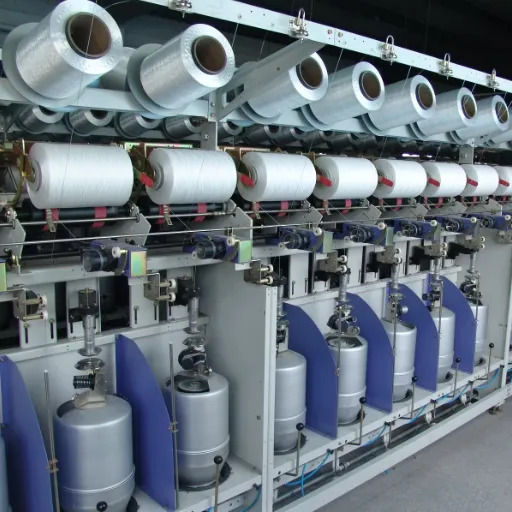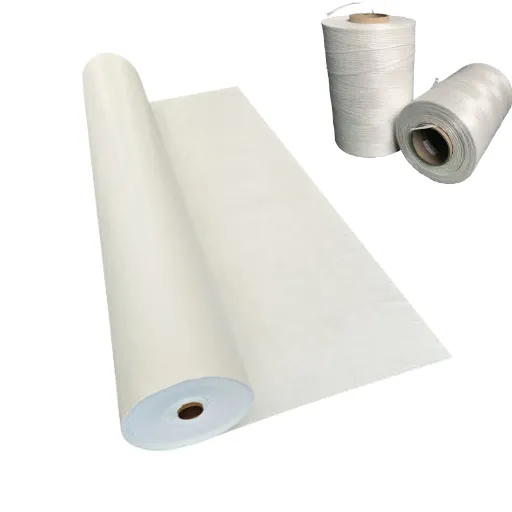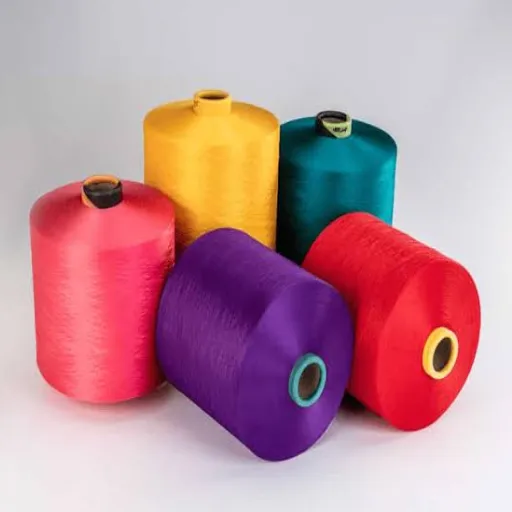
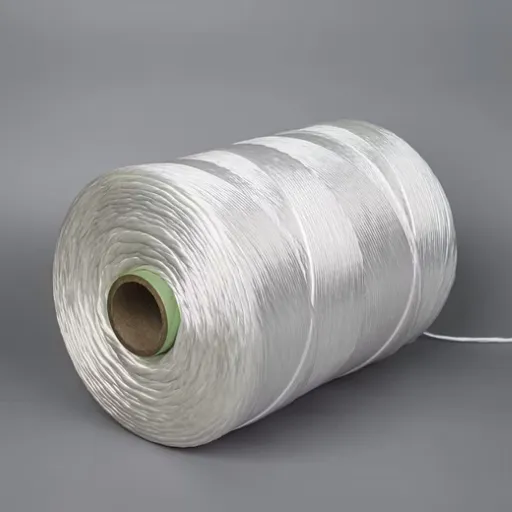
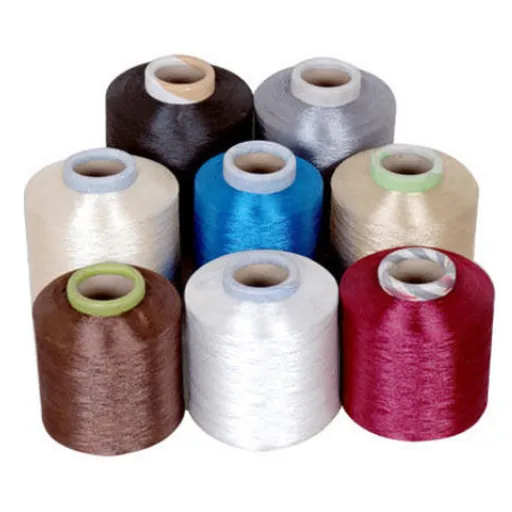


High tenacity polyester yarn is polyester filament engineered to carry load, typically specified between 6.5 and 8.5 cN/dtex, with controlled elongation and shrinkage. “High tenacity” is a measured property, not a marketing label, and the number only means something when the unit and the test condition are stated.
Two suppliers can both call their yarn high tenacity and quote figures that look almost identical. One says 8.5 g/d. The other says 8.0 cN/dtex. Converted to the same unit, the second yarn is about 6% stronger, and nobody in the email chain noticed.
If you specify polyester yarn for webbing, rope, hose, belts, tarpaulin or sewing thread, you have probably met this problem already. This guide gives you the numbers, the unit conversions and the test methods that let you compare quotes honestly. It also shows which grade suits which process, and what to ask a supplier before you commit to an order. Our covers DTY, FDY, staple and industrial filament, so the specification language here matches what we quote every week.
Key Takeaways
- High tenacity polyester yarn usually runs 6.5 to 8.5 cN/dtex. Super-high-tenacity grades reach 8.5 to 9.2 cN/dtex.
- 1 cN/dtex equals about 1.13 g/d, so a claim of 8.5 g/d and a claim of 8.0 cN/dtex are not the same yarn.
- HT, HMLS, LS and SLS grades differ in what they optimize: strength, dimensional stability under heat, or shrinkage.
- A tenacity number is only comparable when the test standard and the shrinkage test temperature are stated.
- 1000D converts to about 1110 dtex, and the filament count matters as much as the denier.
What Is High Tenacity Polyester Yarn?
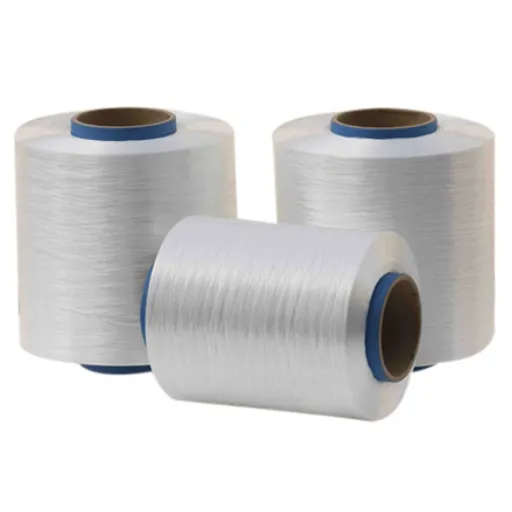
High tenacity polyester yarn is coarse polyester (PET) filament drawn and heat-set to a higher strength than apparel yarn. Industrial grades are usually , with tenacity around 6.5 to 9.2 cN/dtex and an elongation at break of roughly 10.5% to 16.5%. It’s bought for load-bearing use, not appearance.
The definition matters because the phrase is used loosely. Some listings apply “high tenacity” to ordinary apparel filament. Others use it as a synonym for industrial yarn, which is a different idea.
High tenacity vs industrial vs textured vs twisted
These four terms answer different questions. A yarn can be all four at once, or only one.
| Term | What it describes | What it does not tell you | Typical use |
|---|---|---|---|
| High tenacity | A strength grade, measured in cN/dtex or g/d | Shrinkage, elongation, or denier | Webbing, rope, sewing thread |
| Industrial polyester yarn | A size band, usually 550 dtex and coarser | Whether the yarn is actually strong | Tire cord, belts, hose, geotextile |
| Textured (DTY) | Bulk and stretch added by false twisting | Anything about tensile strength | Apparel, upholstery, knitting |
| Twisted | A plied or twisted structure | Fiber strength; twist changes the yarn, not the polymer | Sewing thread, cordage |
| Bright, semi-dull, dope-dyed | Luster or color route | Nothing about performance | Any of the above |
The practical point: industrial tells you the yarn is big, high tenacity tells you it is strong, and textured tells you how it was finished. If a supplier uses one term to imply the other two, ask for the numbers.
The difference between high tenacity and industrial polyester yarn
This is one of the most common questions buyers type into a search engine, and the honest answer is short. Industrial polyester yarn is defined by size, generally 550 dtex and above. High tenacity polyester yarn is defined by strength.
Most industrial yarn is high tenacity, but a coarse yarn can be ordinary tenacity, and a fine yarn can be high tenacity. The terms overlap in practice, but they aren’t interchangeable.
For the full specification-side treatment, including dtex, denier, filament count and how to read a mill’s test report, see our guide to . This page stays on strength.
High tenacity vs ordinary polyester yarn
Ordinary apparel filament typically measures 3.0 to 5.5 cN/dtex. High tenacity grades start around 6.5 and run to 9.2. That’s roughly a doubling of strength per unit of weight.
The difference comes from the process, not the polymer alone. Industrial grades use higher-viscosity PET and a higher draw ratio, then heat-set to a specified shrinkage. The chemistry is the same family. The process window is not.
Specifying a high tenacity polyester yarn? Send the tenacity, elongation, shrinkage and denier you need, and our team will confirm what we can supply and at what minimum order. .
How Strong Is High Tenacity Polyester Yarn?
Tenacity is breaking force divided by linear density. It answers one question: how much load can this yarn carry per unit of weight? Because it’s a ratio, the unit you use changes the number you see, and that’s where most quote comparisons go wrong.
Tenacity in cN/dtex and g/d
Two unit systems dominate the trade. European and Asian mills usually quote cN/dtex. US and some legacy specifications quote grams per denier (g/d).
The conversion is fixed: 1 cN/dtex equals about 1.13 g/d. Going the other way, 1 g/d equals about 0.88 cN/dtex.
A worked example. A supplier quotes 8.0 cN/dtex. Multiply by 1.13 and you get about 9.0 g/d. Another supplier quotes 8.5 g/d.
Divide the second figure by 1.13 and you get about 7.5 cN/dtex. The first yarn is the stronger one, even though the second number looks bigger.
A second trap: some sheets quote cN/tex rather than cN/dtex. One dtex is one-tenth of a tex, so a cN/tex figure is ten times the cN/dtex figure.
, for example, is published as 83.6 cN/tex, which is about 8.4 cN/dtex. The yarn is not ten times stronger than an 8.4 cN/dtex yarn. The unit changed.
Keep this conversion set next to the quotes you’re comparing.
| From | To | Multiply by |
|---|---|---|
| Denier | dtex | 0.9 |
| dtex | denier | 1.11 |
| cN/dtex | g/d | 1.13 |
| g/d | cN/dtex | 0.88 |
| cN/tex | cN/dtex | 0.1 |
Typical tenacity values by grade
| Yarn type | Tenacity, cN/dtex | Roughly, g/d | Elongation at break | Notes |
|---|---|---|---|---|
| Ordinary apparel filament | 3.0 to 5.5 | 3.4 to 6.2 | 20% to 30% | Not load-bearing |
| High tenacity (HT) | 6.5 to 8.5 | 7.4 to 9.6 | 10.5% to 16.5% | The default industrial grade |
| Super-high tenacity | 8.5 to 9.2 | 9.6 to 10.4 | 10% to 14% | Rope, slings, high-load webbing |
| HMLS | 6.5 to 7.5 | 7.4 to 8.5 | 12% to 16% | Low shrinkage, high modulus |
| LS and SLS | Depends on base grade | Depends on base grade | 12% to 18% | Shrinkage is the selling point |
Values in the table are typical ranges drawn from published producer data, including and . Always confirm against the supplier’s own test report for the lot you are buying.
Elongation at break: the number that decides how the yarn behaves
Two yarns with the same tenacity can behave completely differently downstream. Elongation at break explains why.
A 10.5% elongation yarn is stiff. It transfers load quickly and holds shape under tension, which suits webbing and slings. A 16.5% yarn stretches further before breaking, which suits processes that need some give, such as certain cordage and coated-fabric lines.
For a belt or a sling, the elongation ceiling is often more important than the tenacity floor. A yarn that stretches 15% under working load will let the assembly creep, even if its breaking strength is excellent.
Shrinkage is not comparable across test conditions
Shrinkage figures are quoted at different temperatures and dwell times. A “7% shrinkage” claim at 177 °C for two minutes and a “3% shrinkage” claim at 190 °C for five minutes are not measuring the same behavior. The hot-air shrinkage test standard, ASTM D4974, exists precisely because the number depends on the method.
Before you compare two shrinkage figures, confirm four things: the temperature, the dwell time, the load applied during the test, and the standard used. If a data sheet gives a shrinkage percentage with none of those, treat the number as marketing until proven otherwise.
What to confirm on any spec sheet
- Tenacity, with the unit stated (cN/dtex, cN/tex or g/d).
- Elongation at break.
- Hot-air shrinkage, with temperature and dwell time.
- Denier or dtex, and the filament count.
- Test standard for each result (ASTM D885M, D2256, D4974 or ISO equivalent).
- Lot or batch reference, not just a generic product code.
- Finish type (raw, sized, spin-finish) and entanglement.
- Whether the values are typical or guaranteed minimums.
The Grades: HT, Super-HT, HMLS and LS
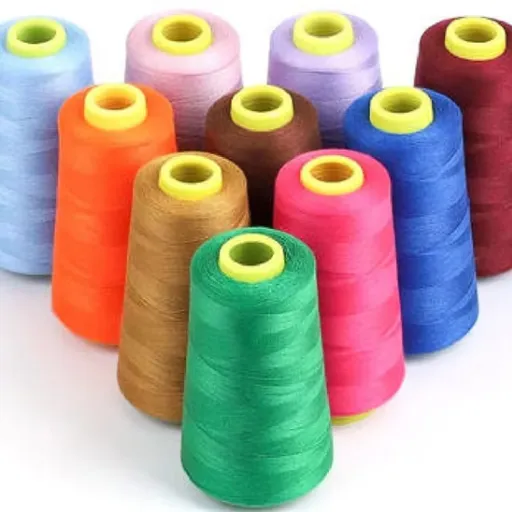
Most high tenacity polyester yarn orders fall into one of four grade families. They are not quality tiers. They are different trade-offs, and choosing the wrong one is a performance problem, not a price problem.
| Grade | What it optimizes | Typical tenacity | Typical shrinkage | Common use |
|---|---|---|---|---|
| HT | Tensile strength | 6.5 to 8.5 cN/dtex | 7% to 9% at 177 °C | Webbing, rope, hose, sewing thread |
| Super-HT | Maximum strength per weight | 8.5 to 9.2 cN/dtex | Similar to HT | Slings, high-load webbing |
| HMLS | Dimensional stability under heat | 6.5 to 7.5 cN/dtex | 3% to 5% | Conveyor and V-belts, tire cord |
| LS and SLS | Minimum shrinkage | Varies | Under 4%, some near 2% | Coated fabric, tarpaulin, awnings |
HT vs HMLS: the choice that decides belt life
HMLS stands for high modulus, low shrinkage. It gives up a little tenacity to gain stiffness and heat stability.
A conveyor belt runs hot and under constant tension. If the yarn shrinks or creeps, the belt length changes, the splice moves, and tracking suffers. HMLS is designed for that environment. HT is the better choice when the load is the main problem and heat exposure is limited.
Neither grade is better. A buyer who specifies HMLS for a rope is paying a premium for a property the rope does not need. A buyer who specifies HT for a hot conveyor is buying a dimensional problem.
When low shrinkage matters
Low-shrinkage grades matter wherever the finished fabric is exposed to heat after weaving or coating. Tarpaulin, awnings, coated fabric and some geotextiles fall into this group.
The failure mode is simple. If the yarn shrinks during coating or lamination, the fabric pulls, the coating wrinkles, and the roll is downgraded. The extra cost of an LS grade is usually smaller than the cost of a rejected roll.
Textured high tenacity yarn
Texturing adds bulk, stretch and a softer hand through false twisting. A textured high tenacity yarn is still strong, but its job has changed: it is used where you need strength plus coverage, such as technical apparel, protective fabrics and some upholstery.
Don’t assume textured means weaker. Do assume the tenacity figure refers to the drawn filament before texturing unless the supplier says otherwise. Ask which stage the number was measured at.
Denier, dtex and Filament Count
Denier is the weight in grams of 9,000 meters of yarn. Dtex is the weight in grams of 10,000 meters. That gives a fixed conversion: denier equals dtex multiplied by 0.9.
So 1000D is about 1110 dtex. 1500D is about 1670 dtex. 2000D is about 2220 dtex.
If a supplier’s title says 1000D and the specification says 1110 dtex, the two are consistent. If the specification says 1000 dtex, the product is about 900D.
Filament count is the second half of a high tenacity polyester yarn specification, and buyers often ignore it. A 1000D/96f yarn and a 1000D/192f yarn have the same linear density but different behavior. More filaments means a more flexible, softer yarn with more surface area. Fewer filaments means a stiffer yarn with better abrasion resistance in some applications.
Industrial high tenacity yarn commonly runs from about 500D to 2000D in twisted and flat forms, and some producers publish ranges up to 3000D or beyond. The right range depends on the process, not on a preference for bigger or smaller.
Where High Tenacity Polyester Yarn Is Used
The application decides which high tenacity polyester yarn you need, and the grade decides the specification. This table is the short version of that decision.
| Application | Usual grade | Property that drives the choice | Test to demand |
|---|---|---|---|
| Webbing and slings | HT or super-HT | Tenacity floor, elongation ceiling | Tensile per ASTM D2256 |
| Rope and cordage | HT, sometimes nylon | Strength plus fatigue resistance | Tensile, cyclic load data |
| Hose reinforcement | HT | Strength and adhesion to rubber | Tensile, dip or finish data |
| Conveyor and V-belts | HMLS | Low shrinkage, dimensional stability | Shrinkage per ASTM D4974 |
| Tire cord | HMLS or HT | Heat stability and fatigue | Tensile, shrinkage, adhesion |
| Coated fabric and tarpaulin | LS or SLS | Low shrinkage during coating | Shrinkage at stated temperature |
| Geotextile and geogrid | HT | Strength retention in soil | Tensile, UV and chemical resistance |
| Industrial sewing thread | HT, usually twisted | Tenacity and abrasion resistance | Tensile, twist level |
| Automotive textiles | HT or HMLS | Heat and fatigue resistance | Tensile, shrinkage, aging |
Two honest notes. First, nylon often beats polyester on fatigue and abrasion, so rope and airbag buyers should test both before defaulting to polyester.
Second, polypropylene wins on chemical resistance and density in some geotextile applications. Polyester is the right answer more often than the alternatives, but not always. For the application detail behind each row, see our guide to , and for ground-engineering uses, .
How High Tenacity Polyester Yarn Is Made
The strength comes from three process decisions: polymer viscosity, draw ratio and heat setting.
- Polymer. Industrial grades start from higher-viscosity PET, typically around 0.90 to 1.00 dL/g, against roughly 0.60 to 0.65 for apparel filament.
- Spinning. The polymer is melt-spun into filament and quenched.
- Drawing. The filament is stretched at a high draw ratio, which aligns the polymer chains and builds tenacity.
- Heat setting. The yarn is stabilized to a target shrinkage. This is where HT, HMLS and LS grades diverge.
- Finishing. Twist, entanglement, sizing or spin finish is applied for the downstream process.
Each step is a checkpoint. A draw-ratio change moves tenacity and elongation together. A heat-setting change moves shrinkage. That’s why a supplier can’t simply “make it stronger” without shifting the other numbers, and why a specification has to state all of them.
How to Verify Tenacity Before You Buy
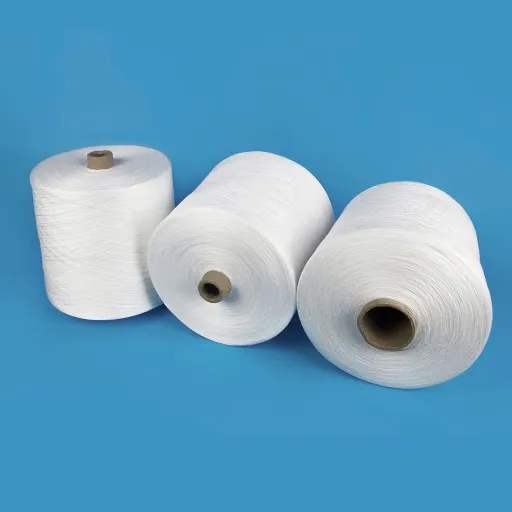
A data sheet is a claim. A test report is evidence. The difference matters most on the first order, when you have no history with the supplier.
Which standard covers which claim
| Claim | Standard to ask for | What it proves |
|---|---|---|
| Tenacity and elongation | ASTM D885M or ASTM D2256 | Breaking force and extension under a defined method |
| Hot-air shrinkage | ASTM D4974 | Shrinkage at a stated temperature and time |
| Linear density | ASTM D1907 | Denier or dtex of the actual lot |
| Twist | ASTM D1423 | Twist level and direction |
ISO equivalents exist for most of these. What matters is that the report names a method, a date and a lot.
What a data sheet proves, and what it does not
A typical data sheet gives representative values from routine production. It doesn’t prove that the container you receive matches them. A certificate of analysis is stronger, but only if it references your lot. A third-party lot test is the only thing that proves the yarn in your warehouse meets the specification.
For a first order, ask for the lot test before the container ships. For repeat orders, agree on a sampling frequency and a retention sample. Our guide to covers the wider process.
Five questions before you place an order
- Which grade are you quoting, and what is the tenacity in cN/dtex?
- What is the elongation at break, and is that a typical value or a minimum?
- What is the shrinkage, at what temperature, for how long?
- Which standard was used, and can you send the lot report?
- What is the filament count, and can you hold it across repeat orders?
If a supplier can’t answer all five in writing, the price comparison is not real yet.
Price, MOQ and Lead Time
High tenacity polyester yarn is priced on the polyester raw material market plus a conversion premium that depends on grade, denier and finish.
Four things move the price most:
- Grade. HMLS and super-HT carry a premium over standard HT because the process window is narrower. has put the HMLS premium in the range of several hundred to about 1,000 CNY per tonne over conventional HT, though the spread moves with the market.
- Color route. Dope-dyed yarn costs more than raw white but can remove a downstream dyeing step.
- Denier and filament count. Fine denier and high filament counts cost more to produce.
- Order size and twist. Small lots and special twists carry higher conversion costs.
We don’t publish prices, because the quote depends on the specification and the volume. Send the full spec and we will quote it. For bespoke specifications, explains the sampling path from lab dip to bulk.
Frequently Asked Questions
What is high tenacity polyester yarn?
It is polyester filament drawn and heat-set to a strength grade usually between 6.5 and 8.5 cN/dtex, made for load-bearing use rather than appearance.
What tenacity should I ask for?
Start from the application. Webbing and slings commonly specify 7.0 cN/dtex or higher. Rope may need super-HT.
Belts usually prioritize low shrinkage over maximum tenacity. State the floor and the elongation ceiling together.
What is the difference between high tenacity and industrial polyester yarn?
High tenacity describes strength. Industrial describes size, generally 550 dtex and above. Most industrial yarn is high tenacity, but the two terms are not interchangeable.
What does 1000D mean, and how does it convert to dtex?
1000D means 1,000 grams per 9,000 meters. Multiply by 0.9 to get dtex, so 1000D is about 1110 dtex.
Is high tenacity polyester yarn the same as textured polyester yarn?
No. Textured yarn has been false-twisted to add bulk and stretch. It can be made from high tenacity filament, but texturing is a finishing step, not a strength grade.
What is the minimum order quantity?
It depends on the grade, denier and color. Standard raw white grades have lower minimums than dope-dyed or specialty twists. Send your specification and annual volume, and we will confirm the MOQ for that combination.
Specifying High Tenacity Polyester Yarn With Confidence
The strength of a high tenacity polyester yarn is only as meaningful as the specification behind it. Four numbers do most of the work: tenacity in a stated unit, elongation at break, shrinkage with its test condition, and denier with its filament count. Get those four in writing, with a standard and a lot reference, and most sourcing arguments disappear before the first container ships.
If you are comparing quotes now, convert everything to cN/dtex first. Then check the shrinkage test temperature. Most of the surprises live in those two steps.
Hebei Lida Textile Co., LTD supplies polyester yarn from Xingtai, northern China, backed by five warehouses and a network of more than 80 partner textile mills. Our team has over 15 years of experience in yarn specification and supply. If you need a high tenacity polyester yarn quoted against a written specification, and we will confirm grade, denier range, sampling and lead time.