


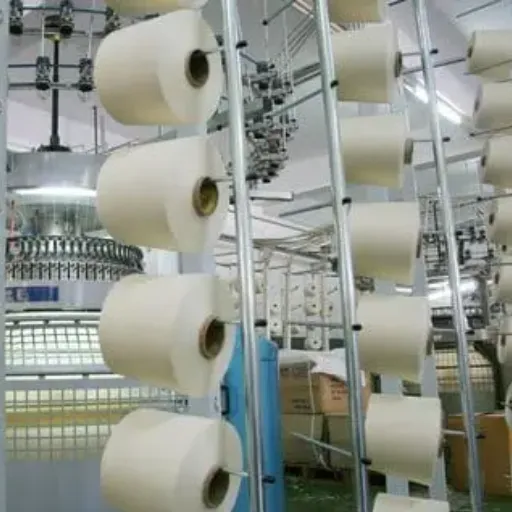
Custom yarn for industrial use is a yarn engineered to a buyer’s exact specification, fiber family, denier or decitex count, twist, ply, coating, and finish, rather than a stock product, so it delivers the tensile strength, heat, chemical, abrasion, or UV resistance a demanding industrial application requires. Instead of choosing from a mill’s catalog, you translate an application problem into a technical specification, validate it through testing, and back it with the documentation regulated industries expect. This guide shows you how to do that, step by step.
Consider a plant engineer named Raj. His conveyor belt snapped on a Tuesday afternoon, halting a production line that feeds 40,000 parts a day. The belt’s reinforcing yarn had worn through where it crossed a metal transfer plate, a spot the stock belt was never designed for. Replacing the belt cost him three days of downtime and a rush shipment fee. A custom yarn, specified for abrasion at that exact contact point, would have prevented the failure for a fraction of the cost.
That story repeats across industries. A marine rope abrades in saltwater. A filter bag fails at 260 degrees. A tire cord loses tenacity at speed. In every case, the answer starts the same way: with the application, not the yarn. By the end of this guide, you will know what can be customized, how to translate an operating condition into a fiber and spec, which tests and certifications apply, what it really costs, and how to source it end to end. Request a custom yarn solution designed around your product and production needs.
Key Takeaways
- Custom yarn for industrial use starts with the application, not the fiber. Translate operating temperature, load, chemical exposure, abrasion, UV, and saltwater into required properties before you pick a material.
- High-tenacity polyester, nylon 6/66, and polypropylene cover most industrial jobs. Aramid, UHMWPE, PBO, carbon, glass, and PTFE handle extreme heat, cut, chemical, and weight-to-strength demands.
- Cost premiums for customization range from +10% for a custom color to +50-200% for full development. MOQs climb from 500-1,000 kg for custom color to 3,000-10,000 kg for solution-dyed technical yarns.
- Testing is application-specific: ASTM D885 for tire cord and industrial filaments, ASTM D6611 for marine rope abrasion, EN ISO 11612 and NFPA 2112 for flame-retardant PPE, FMVSS 302 for automotive interiors.
- Pilot batches of 25-100 kg let you validate a spec before bulk. The global technical textiles market is projected to reach roughly $318.7 billion by 2031, and the demand for engineered industrial yarns is growing with it.
What Is Custom Yarn for Industrial Use?
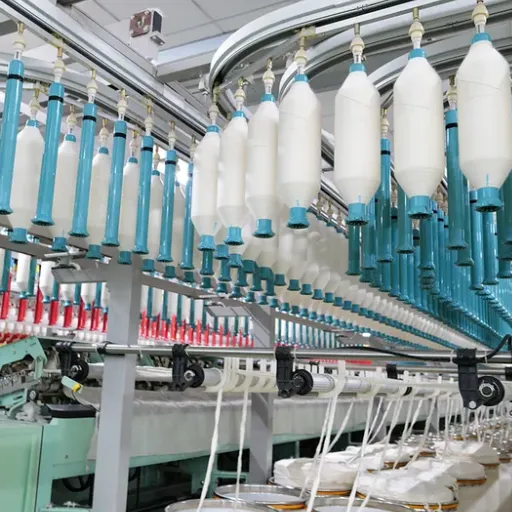
Custom yarn for industrial use is a performance yarn built to your specification instead of pulled from a mill’s standard range. A stock yarn is designed around what a factory already makes, which is why a stock product can be a compromise in a demanding application. A custom industrial yarn is designed around what your job needs, whether that is a specific breaking strength, a low hot-air shrinkage, a coating that resists abrasion, or a construction that survives repeated flexing. For the full picture of what a mill can build, explore our custom yarn solutions.
Industrial yarn differs from apparel or home-textile yarn in four ways. Performance outranks appearance, so hand feel and luster matter less than tenacity and elongation. Constructions favor continuous filaments and high-tenacity twisted or cabled yarns over soft staple yarns. Engineering tolerances are tighter, because a plus-or-minus two percent drift in denier can change how a belt tracks or a rope splices. And the order carries documentation, because a compliance failure can stop a whole product line.
The market context explains the momentum. The global technical textiles market is estimated at roughly USD 228.7 billion in 2025 and projected to reach about USD 318.7 billion by 2031, about 5.9% growth a year. Yarn for technical textile fabrics alone is forecast to expand from roughly USD 28.4 billion in 2026 to USD 51.34 billion by 2035. Automotive industrial yarns, led by airbags and tire cord, are expected to reach about USD 5.6 billion by 2032, with polyester holding roughly 92% of that market. Engineered yarns are not a niche; they are the backbone of modern industry.
Custom vs. Stock Industrial Yarn: What Actually Changes
A stock yarn is an existing product you can order today, often from 20 to 50 kilograms. A custom yarn is yours alone. The fiber, denier, twist, coating, and tolerance are engineered to your spec, which means the mill spends setup time, sampling rounds, and clean-down runs that stock yarn never requires. Those steps drive the cost premium. They are also what make the yarn impossible for a competitor to copy, and what make the end product predictable in the field.
What Can Be Customized
Nearly everything about an industrial yarn can change. You can specify fiber and blend, denier or decitex count, twist in turns per meter with an S or Z direction, ply and cabling, elongation, coating and finish, color and dye method, and package and winding pattern. The depth of customization is the biggest driver of both cost and lead time. If you want the manufacturing side explained step by step, our guide to custom yarn manufacturing walks through how spinning, twisting, and coating change for a custom order.
Why Industrial Buyers Choose Custom Yarns
Buyers commission custom industrial yarns for reasons that go far beyond color. Understanding the motivations helps you decide how deep your own customization should go.
- Application fit and failure prevention: The yarn is engineered for the load, heat, chemical, or abrasion the job demands. One technical yarn converter frames it bluntly: if a yarn isn’t optimized for the process, you’re leaving efficiency on the table.
- Total cost over the lifecycle, not price per kilogram: Fewer failures, less downtime, less scrap. A $0.50 premium per kilogram is trivial next to a three-day line stoppage.
- Batch-to-batch consistency: Controlled sourcing and locked specifications mean repeat orders behave identically, run after run.
- Compliance and traceability: Automotive, PPE, marine, and aerospace buyers need test reports, certificates of conformance, and lot records that stock orders rarely provide.
- Proprietary differentiation: A yarn spec competitors cannot copy protects your product’s performance claim.
When the spec is locked, the order flow follows a proven path. Our guide to custom yarn production covers the milestones, approvals, and delivery gates in detail.
How to Choose Industrial Yarn Fibers for Extreme Conditions
Fiber selection is the first and most important decision, because it drives strength, heat tolerance, chemical resistance, abrasion, weight, and cost. The framework is simple. Define the operating environment, list the required properties, then choose the fiber family that delivers them.
High-Tenacity Synthetics: Polyester, Nylon 6/66, and Polypropylene
High-tenacity (HT) polyester is the workhorse of industrial yarns. Real spec sheets show HT polyester industrial yarn from 280 to 6,600 dtex (250D to 6000D), with breaking tenacity of 7.7 to 8.1 cN/dtex, breaking elongation of 14 plus or minus 2 percent, and hot-air shrinkage of 7.0 plus or minus 1.5 percent at 177 degrees. It is the standard for tire cord, seatbelts, slings, conveyor belts, and V-belts, and it holds roughly 92% of the automotive industrial yarn market.
Nylon 6 and 6/66 bring toughness and energy absorption that polyester cannot match. Nylon 6 industrial yarn runs from about 233 to 2,100 dtex with breaking strength of at least 18 N per end and elongation of 23 plus or minus 3 percent. It is the go-to for airbags, tire cord where impact matters, ropes, and parachute webbing, because it stretches to absorb shock before it snaps.
Polypropylene (PP) is the lightest of the rope fibers. It floats, resists chemicals and water, and costs the least. PP industrial yarn runs from 150D to 3000D with tenacity of 5.6 to 6.2 cN/dtex, and it can be dope-dyed in more than a thousand colors. It is the standard for marine fender lines, geotextiles, fish nets, and filter cloth, especially where UV resistance and low cost matter more than raw strength. Contact Hebei Lida Textile Co., LTD for custom yarn tailored to your specifications.
High-Performance Fibers for Extreme Conditions
- Aramid (para-aramid such as Kevlar, meta-aramid such as Nomex): handles continuous heat of 200 to 250 degrees Celsius, resists cut and flame, and is the backbone of ballistic vests, FR workwear, tire cord, and composites.
- UHMWPE (Dyneema, Spectra, HMPE): the highest strength-to-weight ratio of any fiber, with very low elongation. It dominates marine mooring and towing lines and cut-resistant gloves.
- PBO (Zylon) and Vectran (LCP): extreme tensile strength and heat resistance for aerospace and high-load cordage.
- Carbon, glass, and basalt: reinforcement for composites in aerospace, automotive, and construction, valued for stiffness and dimensional stability.
- PTFE and fluoropolymers: high-temperature filter bags, chemical-resistant fabrics, and low-friction applications where nothing else survives the environment.
Blends and Hybrid Yarns
Many demanding applications need a construction, not just a single fiber. Core-spun yarns wrap a performance core, such as para-aramid or steel, in a protective sheath. Cabled and multi-ply yarns twist several strands together for maximum strength and abrasion resistance. Hybrid yarns combine materials, carbon with aramid, glass with polyester, or UHMWPE with polyester, to balance stiffness, toughness, and cost for composite and rope applications.
Sustainable Options for Industrial Yarn
Sustainability is becoming a specification for industrial buyers too. Recycled polyester (rPET), bio-based nylon, and dope-dyed color-through yarns all appear in industrial catalogs, often carrying GRS or OEKO-TEX certification. A custom industrial yarn gives you both the performance and the sustainability story. For the eco options in depth, our guide to custom eco-friendly yarn solutions covers fibers, certifications, and sourcing.
The table below compares the industrial yarn fibers at a glance.
| Fiber | Key Properties | Best For | Typical Denier Range |
|---|---|---|---|
| HT polyester | High tenacity, low cost, low stretch | Tire cord, seatbelts, slings, belts | 280-6,600 dtex |
| Nylon 6/66 | Tough, energy-absorbing, abrasion-resistant | Airbags, ropes, parachutes, impact tire cord | 233-2,100 dtex |
| Polypropylene | Lightest, floats, chemical-resistant, UV | Marine lines, geotextiles, filter cloth | 150D-3,000D |
| Para-aramid | Extreme strength, 200-250°C heat, cut-resistant | Ballistics, PPE, tire cord, composites | Varies |
| UHMWPE | Highest strength-to-weight, low elongation | Mooring lines, cut-resistant gloves | Varies |
| Carbon / glass / basalt | Stiff, high-modulus reinforcement | Aerospace, automotive composites | Varies |
| PTFE | High-temperature, chemical-resistant | Filter bags, industrial fabrics | Varies |
Specifying Custom Yarn: Denier, Twist, Ply, and Finish
Once the fiber is chosen, the spec translates into four numbers and a finish. These are the parameters a mill actually acts on, and they are the ones that make an industrial yarn reproducible.
Denier, Decitex, and Yarn Count
Denier and decitex both measure linear density, the weight of yarn per unit length. They drive strength per unit, weight, and coverage, and industrial reproducibility demands tolerance control of about plus or minus two percent. A consistent denier keeps a belt tracking straight, a rope splicing cleanly, and a filter fabric holding its pore structure.
Twist and Ply
Twist, measured in turns per meter, balances strength, abrasion resistance, and handle. Low-twist yarns feel soft and give good coverage but sacrifice strength and cohesion. High-twist yarns are firmer but can be wiry. Ply is how many strands are twisted together, and cable and multi-ply constructions deliver the maximum strength and abrasion resistance for lifting slings, ropes, and heavy-duty reinforcement.
Coatings and Finishes
A coating is often the difference between a yarn that lasts and a yarn that fails. Abrasion coatings protect where yarn rubs against metal. Adhesion coatings improve bonding in rubber, as in tire cord. Flame-retardant, antimicrobial, conductive and antistatic, UV-stable, and chemical-resistant finishes each solve a specific problem. The pickup percentage, the amount of coating added to the yarn, is itself a spec parameter that must be agreed and controlled.
Color, Dyeing, and Package Format
Dye method is a buying decision, not a technical footnote. Dope-dyed, or solution-dyed, color is embedded in the polymer before spinning, which resists fading and suits outdoor and marine use, but it carries much higher minimums of 3,000 to 10,000 kilograms per color. Package-dyed color is applied to the finished yarn and starts at 500 to 1,000 kilograms per color. Package format matters too, spool size, winding pattern, cone or ball, because it must match your downstream process. If you want the design methodology behind these specs, our guide to custom yarn designs covers how a requirement becomes a written specification.
Custom Yarn for Industrial Use: Application-Specific Requirements
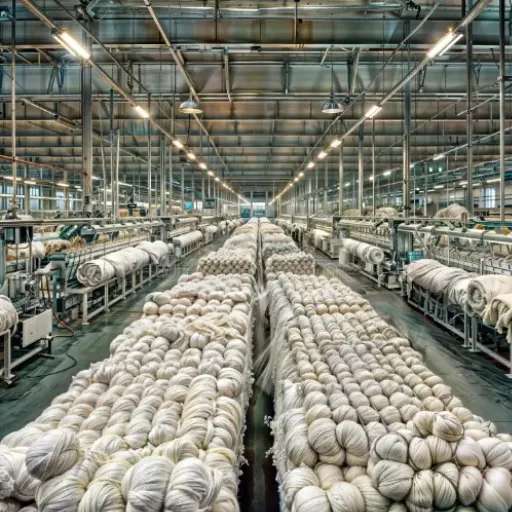
Different industries demand different property profiles. The framework below connects each application to a recommended yarn and the test that proves it.
Automotive and Transportation
Tire cord, seatbelts, airbags, hoses, and interior fabrics each have their own spec. Radial tire cord uses HT polyester, and the tire industry validates it against ASTM D885, the standard for tire cords and industrial filament yarns covering breaking strength, tenacity, elongation, modulus, twist, and adhesion. Airbags use nylon 6/66 FDY for its energy absorption. Interior fabrics must pass FMVSS 302, the US motor-vehicle interior flammability standard, and OEM programs typically add PPAP and FMEA documentation. The automotive industrial yarn market alone is projected to reach about USD 5.6 billion by 2032, with polyester dominant.
Marine and Offshore
Mooring and towing lines use UHMWPE or HT polyester for strength-to-weight, while floating fender lines use polypropylene because it floats. Saltwater, wet-dry cycling, and chafe make yarn-on-yarn abrasion the critical test, and ASTM D6611 covers wet and dry yarn-on-yarn abrasion explicitly for marine ropes and knitted hoses. A marine supplier who ignores abrasion spec is signing up for premature line replacement.
Aerospace and Composites
Structural composites use carbon, aramid, glass, and hybrid reinforcements for stiffness and weight savings, often with low-shrinkage, high-modulus yarns to hold geometry during curing. Carbon tow tensile properties are validated against ASTM D4018. Tolerances here are the tightest in the industry, because a few percent of property drift can change a load-bearing layup.
Geotextiles and Civil Engineering
Geogrids, geo-bags, erosion-control mats, and construction safety netting use dope-dyed PP or HT polyester for soil reinforcement. The yarn needs UV resistance and high strength-to-weight, with tensile validated across the geotextile standard family, including ISO 10319. Dope-dyed color-through means the yarn keeps its strength and color after years buried in soil or exposed to sun.
Filtration and Industrial Fabrics
High-temperature dust collection uses PTFE or glass filter-bag yarns because nothing else survives the chemical and thermal load. Paper-machine forming fabrics need dimensional stability, which means low hot-air shrinkage. Here, low elongation and tight shrinkage specs matter more than raw strength.
Protective Equipment and Workwear
Flame-resistant workwear uses meta-aramid blends, often with an antistatic component in a 93/5/2 ratio, certified to EN ISO 11612 and NFPA 2112. Cut-resistant gloves pair para-aramid or UHMWPE cores with a protective sheath. Ballistic protection relies on para-aramid at its highest tenacity. The Coats Group’s industrial thread range is a useful reference for how FR yarns lock to certification, from EN ISO 11612 for heat and flame to NFPA 2112 for flash fire.
For the manufacturing side of each of these applications, our guide to industrial yarn manufacturing explains how these yarns are physically engineered and produced.
Testing and Certification for Industrial Yarns
Testing is where an industrial yarn earns its keep. A spec without a test plan is just an intention. The right standard depends on the application, and the matrix below organizes the ones buyers most often need.
Key Mechanical Tests
- Tensile strength, tenacity, and elongation: ASTM D885/D885M for tire cords and industrial filament yarns, ISO 2062 for single yarns. These prove the yarn meets the breaking load your application assumes.
- Yarn-on-yarn abrasion: ASTM D6611, the wet and dry abrasion test that matters for marine ropes and hoses.
- Denier tolerance, twist, and shrinkage: batch-level controls that prove reproducibility. Real industrial mills hold linear density within plus or minus two percent.
Application-Specific Standards
- Flame and heat (PPE): EN ISO 11612 and EN ISO 11611 for protective clothing, NFPA 2112 for flash fire.
- Automotive interiors: FMVSS 302 for interior flammability.
- Colorfastness: ISO 105.
- Geotextiles: the ISO 10319 family for tensile strength.
- Carbon tow: ASTM D4018 for tensile properties.
Need custom yarn for a unique textile project? Talk to Hebei Lida Textile Co., LTD.
Facility and Management Certifications
Beyond product tests, verify the mill itself. ISO 9001 certifies a quality management system, ISO 14001 an environmental one, OEKO-TEX Standard 100 covers product safety, and GRS verifies recycled content. Ask to see the certificates, and ask which batch tests are standard on every lot.
| Application | Test / Standard | Why It Matters |
|---|---|---|
| Tire cord, industrial filaments | ASTM D885/D885M | Breaking strength, tenacity, elongation, twist, adhesion |
| Marine ropes, hoses | ASTM D6611 | Wet and dry yarn-on-yarn abrasion |
| FR workwear (heat/flame) | EN ISO 11612 | Protective performance after 5 wash cycles |
| FR workwear (flash fire) | NFPA 2112 | Protective performance after 100 wash cycles |
| Automotive interiors | FMVSS 302 | Interior flammability for motor vehicles |
| Colorfastness | ISO 105 | Dye retention across washing, light, rubbing |
| Geotextiles | ISO 10319 family | Tensile strength of soil-reinforcement fabrics |
| Carbon tow | ASTM D4018 | Tensile properties of carbon/graphite tow |
Documentation and Traceability for Industrial Orders
Industrial buyers buy a yarn and a paper trail. The documentation that protects a regulated product line includes:
- A signed-off technical specification sheet, agreed by both parties, that locks fiber, denier, twist, coating, tolerances, and test benchmarks.
- Batch test reports against the agreed benchmarks, so every lot proves it meets the spec.
- Certificates of conformance (CoC), declaring the lot matches the agreed standard.
- Raw-material traceability, showing where the fiber came from and that it is the agreed grade.
- Lot coding and shade or strength sorting, so repeat orders blend cleanly with the original run.
- For automotive and other regulated industries, PPAP and FMEA records, inspection data, and first-article reports.
A good supplier documents every stage, which is also how you vet one. Our guide to how to choose a custom yarn supplier covers exactly what to request and verify before you commit.
Custom Yarn for Industrial Use: Costs, MOQs, and Lead Times
Budgeting for a custom industrial yarn means understanding where the premiums sit. The cost scales with how much of the yarn you are changing, and the ranges below are consistent across manufacturers who publish their numbers.
| Customization | Cost Premium vs. Stock | Typical MOQ |
|---|---|---|
| Custom color (package-dyed) | +10% to +25% | 500 to 1,000 kg per color |
| Custom blend | +15% to +30% | 1,000 to 3,000 kg |
| Custom twist | +10% to +20% | 500 to 1,000 kg |
| Functional finish (FR, conductive, UV) | +30% to +100% | Depends on treatment |
| Full custom development | +50% to +200% plus sampling | 1,000 kg and up |
| Solution-dyed (dope-dyed) | Higher color premium | 3,000 to 10,000 kg per color |
Lead times follow the same pattern. Custom color adds roughly 7 to 14 days, and dyed custom production can run 25 to 40 days. A custom blend adds four to eight weeks. A functional finish adds four to ten weeks. Sample cones ship in two to five days, trial production of 25 to 100 kilograms takes seven to fifteen days, standard production of 100 kilograms to one metric ton takes fifteen to twenty-five days, and bulk runs of one to ten metric tons take twenty-five to thirty-five days.
Raw materials drive 55 to 65 percent of the total yarn cost, so fiber choice is also a pricing choice. Finer counts cost more, and volume is a pricing lever at every tier. If you want the full economics of custom yarn, GLYarn’s pricing guide is a solid reference for how manufacturers build the number.
How to Start Small: R&D and Pilot Batches
Industrial buyers often assume custom yarn requires massive orders and defense-level budgets. It does not. The R&D path works like this: validate a spec on 25 to 100 kilograms of trial yarn, with sample cones as small as 0.5 to 2.5 kilograms, then scale only the proven spec to bulk. When a safety-equipment maker tested a new cut-resistant core yarn this way, the 50-kilogram pilot caught a tenacity drift that would have contaminated a full production run. The pilot cost a few thousand dollars. The rework would have cost ten times that. For more on low-MOQ strategy, our guide to custom yarn for small businesses covers flexible programs and shared development fees in depth.
Total Cost of Ownership: Beyond Price Per Kilogram
In an industrial setting, the yarn price per kilogram is rarely the whole story. A failure stops a line, ruins a batch, or forces a recall, and that cost dwarfs any per-kilogram saving. A slightly more expensive yarn with controlled tolerances and proven test data is cheaper than a bargain yarn that fails in the field. When you compare quotes, compare the spec sheet and the test reports, not just the price.
How to Work With a Custom Yarn Manufacturer for Industrial Projects
The development workflow from application to bulk production follows a predictable path, and following it in order keeps surprises off the schedule.
- Define the application and operating conditions: Lock the temperature, load, chemical exposure, UV, saltwater, and abrasion your yarn must survive.
- Choose the fiber family: Match required properties to fiber, using the framework in this guide.
- Specify denier, twist, ply, coating, and finish: Put numbers in the brief, and set tolerances.
- Define the testing plan: Agree the standards and the pass criteria before production.
- Sample and test: Run pilot batches, review test reports, and approve with sign-off.
- Run bulk production with batch QC: Confirm every lot against the agreed benchmarks.
- Receive documentation: CoC, batch test reports, and traceability records.
What to Request From a Manufacturer
Request a spec sheet, physical samples, test reports for tensile, abrasion, and shrinkage, certificates, MOQ confirmation, and a development timeline, all in writing. If you can, send a physical reference, a length of the current yarn or a section of the failed product, so the mill can analyze exactly what went wrong and what must improve.
Engineer-to-Mill Communication
The gap between application language and technical specification is where industrial projects stall. State the operating conditions explicitly. Say “the yarn crosses a metal plate at 60 meters per minute under 4 kilonewtons of tension” instead of “it needs to be strong.” Define tolerances. Share failure data if you have it. That specificity is what lets an engineer at the mill design a yarn instead of guessing.
For the co-engineering workflow and how we develop custom yarns together, explore our custom yarn solutions service. Our team at Hebei Lida works with industrial buyers at every scale, from a 25-kilogram pilot to a multi-ton program, with the documentation regulated industries require.
Frequently Asked Questions About Custom Yarn for Industrial Use
What is custom yarn for industrial use?
Custom yarn for industrial use is yarn engineered to a buyer’s specification, fiber family, denier, twist, ply, coating, and finish, rather than a stock product, so it delivers the tensile, heat, chemical, abrasion, or UV performance a demanding industrial application requires.
What is the strongest industrial yarn?
UHMWPE has the highest strength-to-weight ratio of any fiber, and para-aramid delivers extreme strength with heat resistance. For most industrial jobs, high-tenacity polyester and nylon 6/66 offer the best balance of strength, cost, and processability.
What is industrial yarn used for?
Industrial yarn reinforces and performs in tire cord, seatbelts, airbags, conveyor belts, lifting slings, marine ropes, geotextiles, filter bags, composites, protective workwear, and a wide range of engineered fabrics.
What fiber is best for industrial yarn?
It depends on the application. HT polyester covers most load-bearing jobs. Nylon adds toughness and energy absorption. Polypropylene adds light weight, float, and chemical resistance. Aramid, UHMWPE, carbon, glass, and PTFE handle extreme heat, cut, weight, and chemical demands.
What is high tenacity yarn?
High tenacity yarn is yarn with elevated breaking strength per unit of linear density, expressed in cN/dtex. HT polyester, for example, runs 7.7 to 8.1 cN/dtex, versus standard grades that are significantly weaker.
How is industrial yarn tested?
Tensile strength, tenacity, and elongation are tested to ASTM D885 or ISO 2062. Abrasion is tested to ASTM D6611 for marine applications. Application standards add EN ISO 11612 and NFPA 2112 for FR workwear, FMVSS 302 for automotive interiors, and ISO 10319 for geotextiles.
What certifications do industrial yarns need?
The certification depends on the application. FR workwear needs EN ISO 11612 or NFPA 2112. Automotive interiors need FMVSS 302. Mills should hold ISO 9001, and sustainable options carry GRS or OEKO-TEX. Ask for batch test reports and certificates of conformance with every order.
What is the MOQ for custom industrial yarn?
Custom color starts at 500 to 1,000 kilograms per color. Custom blends start at 1,000 to 3,000 kilograms. Solution-dyed yarns run 3,000 to 10,000 kilograms. R&D and pilot programs start at 25 to 100 kilograms.
How long does custom industrial yarn take to produce?
Sample cones ship in two to five days. Trial production takes seven to fifteen days. Standard production runs fifteen to twenty-five days, bulk runs twenty-five to thirty-five days, and custom blends or functional finishes add four to ten weeks.
Can I order custom yarn in small batches for R&D?
Yes. Pilot batches of 25 to 100 kilograms, with sample cones as small as 0.5 to 2.5 kilograms, let you validate a specification before committing to bulk production.
Conclusion
Specifying custom yarn for industrial use starts with the application. Translate the operating environment and the required properties into a fiber, denier, twist, coating, and testing plan, then work backward from your launch date to budget for MOQs, cost premiums, and sampling rounds.
- Start with the application and operating conditions, then choose fiber, denier, twist, ply, and coating.
- Match the testing and certification plan to your industry, from ASTM D885 for tire cord to EN ISO 11612 and NFPA 2112 for FR workwear.
- Budget for premiums of 10% to 200% and MOQs from 500 kilograms up, or start small with pilot batches.
- Demand documentation: signed-off specs, batch test reports, certificates of conformance, and traceability records.
- Validate with a pilot batch before committing to bulk, and compare total cost of ownership, not price per kilogram.
If you are ready to move your custom yarn for industrial use forward, talk to Hebei Lida. We will help you translate your application into a specification, send samples and test reports, and guide you through fiber selection, testing standards, and timelines that fit your project. Every engineered product begins with a single yarn. Turn yours into a specification with us.