



The best yarn for upholstery combines high tensile strength, abrasion resistance, and compliance with flame retardancy standards — typically achieved through multi-ply synthetic or blended fibers engineered specifically for furniture applications. Understanding how that yarn is manufactured, and what specifications separate reliable upholstery yarn from options that will pill, fray, or fail compliance testing, helps furniture manufacturers avoid costly warranty claims and product returns.
When Chen Wei, a sourcing manager at a mid-sized furniture factory in Dongguan, received a batch of polyester yarn for a new sofa line in early 2025, everything looked fine on paper. The supplier promised “high durability” and “suitable for upholstery.” Six months after the sofas hit retail, returns started pouring in. The fabric was pilling after moderate use, and independent testing revealed the yarn had a tenacity rating 30% below industry minimums for residential seating. Chen’s factory absorbed a $120,000 loss — all because the yarn was never manufactured to upholstery specifications in the first place. If you have any questions or need further assistance, don’t hesitate to get in touch with us.
Stories like Chen’s are more common than most manufacturers want to admit. The difference between upholstery that lasts five years and upholstery that lasts twenty rarely starts at the weaving mill. It starts at the yarn level, with decisions about fiber selection, ply construction, twist levels, and finishing treatments that most buyers never think to question. In this guide, we break down exactly how yarn for upholstery is manufactured, what performance standards define quality, and how to source yarn that meets the demands of your specific application.
Key Takeaways
- Upholstery yarn requires higher tenacity, multi-ply construction, and specific twist levels compared to apparel yarn, with synthetic fibers like polyester and nylon dominating due to superior abrasion resistance.
- Abrasion testing standards vary by region: Wyzenbeek (North America, ASTM D4157) and Martindale (Europe, EN ISO 12947-2) measure durability differently, and scores are not interchangeable.
- Flame retardancy compliance (CAL 117, NFPA 701, BS 5852) must be considered at the yarn level, as fiber choice and finishing treatments directly impact whether finished fabric passes certification.
- Solution-dyed yarns offer superior UV stability and colorfastness compared to piece-dyed alternatives, making them essential for outdoor and high-exposure upholstery applications.
- Sustainable upholstery yarn options — including recycled polyester (rPET) and organic cotton — are growing 8-12% annually as furniture brands respond to consumer demand for eco-friendly materials.
What Makes Yarn for Upholstery Different from Standard Yarn?
Yarn for upholstery is an engineered textile product designed to withstand repeated stress, abrasion, and environmental exposure while maintaining structural integrity and appearance over years of use. Unlike apparel yarn, which prioritizes softness, drape, and lightweight comfort, upholstery yarn must balance durability, dimensional stability, and compliance with safety standards — often at the expense of hand-feel qualities that consumers prize in clothing.
The performance demands on yarn for upholstery create a distinct specification profile. Residential furniture may require 15,000+ double rubs on the Wyzenbeek scale, while commercial contract seating demands 30,000+ and heavy-use environments like airports or hospitals need 100,000+. These numbers are not achievable with standard apparel-grade yarn. They require heavier denier filaments, tighter twist construction, and often multi-ply configurations that distribute wear across multiple strands.
For furniture manufacturers evaluating which fiber and construction to specify, our guide to choosing the right yarn for upholstery breaks down selection criteria by application type. Three properties form the foundation of upholstery-grade yarn. Tenacity — measured in centinewtons per tex (cN/tex) or grams per denier (gpd) — determines how much force the yarn can withstand before breaking. Upholstery yarn typically requires tenacity above 4.5 cN/tex for synthetics and above 3.5 cN/tex for natural fibers. Abrasion resistance measures how well the yarn survives repeated rubbing and friction, tested through standardized protocols that simulate real-world wear. Dimensional stability ensures the yarn maintains its shape and tension through weaving, finishing, and years of use without stretching, shrinking, or creeping.
Beyond these mechanical properties, yarn for upholstery must also meet regulatory requirements. Flame retardancy standards like CAL 117 (California Technical Bulletin 117) for residential furniture, NFPA 701 for commercial drapery and upholstery, and BS 5852 for UK contract furniture all impose specific requirements that start with fiber selection. Some fibers, like wool, are naturally flame-resistant. Others, like polyester and cotton, require chemical finishing treatments or inherent flame-retardant additives applied during the extrusion or spinning process.
Types of Yarn for Upholstery Manufacturing
Choosing the right yarn for upholstery starts with understanding the different upholstery yarn types and what each fiber type brings to the finished fabric. The decision is never simply “natural versus synthetic.” It is a calculation of durability requirements, cost constraints, aesthetic goals, and compliance obligations that varies by application.
Natural Fiber Yarns
Cotton yarn remains popular for residential upholstery thanks to its breathability, softness, and ability to accept dyes vibrantly. For upholstery applications, cotton is typically spun into heavier counts — often 10/2 or 16/2 in pearl cotton grades — with tight twist to improve durability. The trade-off is inherent susceptibility to abrasion and staining. Untreated cotton scores poorly on both Wyzenbeek and Martindale tests without blending or finishing enhancements. Mercerization, a chemical treatment that swells and strengthens cotton fibers, improves luster and tensile strength but adds cost.
Wool yarn offers natural flame resistance, resilience, and elasticity that synthetic fibers struggle to match. The crimped structure of wool fibers creates natural loft and recovery, meaning wool upholstery springs back after compression rather than developing permanent crush marks. For upholstery, medium to coarse wool grades with tight ply construction are preferred. Fine merino wool, prized in apparel for softness, is actually avoided in upholstery because it pills and felts under friction. The worsted wool yarn market — a key segment for upholstery — was valued at USD 1,678.8 million in 2025 and is projected to reach USD 2,760.7 million by 2035, with upholstery and home textiles representing 27% of total demand.
Linen yarn delivers exceptional strength and a distinctive textured aesthetic that appeals to high-end residential and hospitality markets. With a tenacity rating among the highest of natural fibers, linen withstands abrasion better than cotton. Its stiffness, however, limits applications where drape and flexibility matter. Linen upholstery yarn is typically 16/2 or heavier, with wet-spun processing to maximize smoothness and strength.
Silk yarn occupies a niche position in decorative upholstery where luxury outweighs durability concerns. Pure silk is rarely used for seating surfaces in high-traffic applications. Instead, silk blends or silk-accented decorative yarns provide visual interest on accent pieces, pillows, and low-use furniture.
For premium yarn for upholstery solutions tailored to your furniture and interior textile needs, contact Hebei Lida Textile Co., LTD today to discuss custom products, bulk orders, and professional support.
Synthetic Fiber Yarns
Polyester yarn dominates the upholstery market, accounting for approximately 60% of all upholstery yarn usage globally. The reasons are straightforward: polyester offers exceptional abrasion resistance, dimensional stability, chemical resistance, and cost efficiency. For upholstery, polyester is typically produced as a high-tenacity filament or staple fiber with denier ranging from 150D to 600D depending on application. Multi-ply construction — commonly 2-ply to 4-ply — distributes stress and improves durability. Solution-dyed polyester, where color pigment is added during the extrusion process rather than applied to finished yarn, provides superior UV stability and colorfastness that piece-dyed alternatives cannot match.
Nylon yarn delivers the highest abrasion resistance of any standard upholstery fiber, making it the choice for heavy-duty commercial, automotive, and industrial applications. Nylon 6,6 yarns can achieve Wyzenbeek ratings exceeding 100,000 double rubs. The trade-offs are higher cost than polyester and susceptibility to UV degradation unless stabilized with additives. Nylon upholstery yarn is typically 200D to 1000D with texturing to add bulk and hand-feel.
Acrylic yarn, particularly solution-dyed acrylic like Sunbrella, has become the gold standard for outdoor upholstery. Acrylic fibers resist UV degradation, mildew, and moisture while maintaining color vibrancy in harsh conditions. The solution-dyeing process locks pigment into the fiber core, preventing fading that piece-dyed yarns suffer under sun exposure. Acrylic upholstery yarn is typically bulked continuous filament (BCF) with texturing for softness.
Olefin (polypropylene) yarn offers excellent stain and moisture resistance at a lower cost point than acrylic for outdoor and marine upholstery. Olefin is inherently hydrophobic — it will not absorb water or stains — and resists mildew growth. However, its lower melting point and UV sensitivity without stabilization limit some applications. Olefin upholstery yarn is commonly 900D to 1500D BCF for heavy-use outdoor furniture.
Blended and Specialty Yarns
Polyester-cotton blends combine the durability and stability of polyester with the breathability and aesthetic warmth of cotton. A typical blend ratio for residential upholstery is 65% polyester / 35% cotton, though ratios vary by application. The polyester component provides structural integrity and abrasion resistance, while cotton improves moisture absorption and dye uptake.
Wool-nylon blends leverage wool’s natural resilience and flame resistance with nylon’s abrasion strength. A common blend for commercial contract upholstery is 80% wool / 20% nylon, which achieves the flame compliance and luxury feel of wool while extending service life in high-traffic environments.
Chenille yarn creates a soft, velvet-like pile through a manufacturing process that attaches short fibers to a central core yarn. The result is luxurious texture and depth, but with a compromise: chenille yarns are inherently less durable than flat-woven alternatives and are best reserved for residential applications with moderate use.
Boucle yarn features looped fibers that create a textured, nubby surface popular in contemporary furniture design. Like chenille, boucle prioritizes aesthetic impact over maximum durability and is typically used in accent pieces or residential seating rather than commercial applications.
Core-spun yarns wrap staple fibers around a continuous filament core, combining the softness and appearance of natural fibers with the strength of synthetic filaments. This construction is increasingly popular for upholstery applications where both durability and premium hand-feel are required.
Get in touch with Hebei Lida Textile Co., LTD today for high-quality yarn for upholstery, customized textile solutions, and reliable wholesale support for your business needs.
| Fiber Type | Abrasion Resistance | Flame Resistance | UV Stability | Best Application |
|---|---|---|---|---|
| Polyester | Excellent | Requires treatment | Good (solution-dyed) | General residential, commercial |
| Nylon | Superior | Requires treatment | Fair (needs stabilization) | Heavy-duty commercial, automotive |
| Acrylic | Good | Requires treatment | Excellent | Outdoor, marine |
| Olefin | Good | Inherently resistant | Fair (needs stabilization) | Outdoor, budget commercial |
| Cotton | Moderate | Requires treatment | Poor | Low-traffic residential, decorative |
| Wool | Good | Naturally resistant | Moderate | Premium residential, contract |
| Linen | Good | Naturally resistant | Moderate | High-end residential, hospitality |
Understanding these fiber properties helps manufacturers identify the best yarn for upholstery based on their specific durability, compliance, and budget requirements.
The Upholstery Yarn Manufacturing Process
Manufacturing yarn for upholstery follows the general textile yarn production pipeline, but with critical differences at nearly every stage. Heavier denier, higher twist, specialized texturing, and application-specific finishing treatments transform standard yarn into a product capable of surviving years of sitting, sliding, and rubbing.
Fiber Selection and Preparation
The process begins with raw material selection. For synthetic upholstery yarn, this means polymer chips — typically polyethylene terephthalate (PET) for polyester or caprolactam for nylon. The polymer must meet specific intrinsic viscosity (IV) requirements to achieve the tenacity levels upholstery demands. Lower-IV polymer produces weaker yarn suitable for apparel or packaging, not furniture.
For natural fibers, preparation involves ginning (cotton), scouring (wool), or retting and hackling (linen). Upholstery-grade natural fibers are selected for longer staple length and higher micronaire (in cotton) or stronger fiber diameter (in wool). Short fibers are removed through combing or gilling, as they would weaken the finished yarn and increase pilling tendency.
At a spinning mill in Jiangsu Province that supplies yarn to several major furniture manufacturers, the quality control manager explains their fiber intake protocol: “We test every bale for micronaire, strength, and color grade before it enters production. A bale that passes for t-shirt yarn might fail our upholstery standards. We reject about 8% of incoming cotton on strength grounds alone.”
Spinning Methods for Upholstery Yarn
Ring spinning remains the preferred method for high-quality upholstery yarn requiring maximum strength and smoothness. In ring spinning, fiber strands are drawn to the desired fineness and twisted using a rotating spindle and traveler. The resulting yarn has excellent tenacity and a smooth surface ideal for woven upholstery fabrics. The trade-off is slower production speed compared to alternative methods.
Open-end (rotor) spinning produces yarn faster and more economically by feeding fibers into a rapidly rotating rotor that deposits them onto the yarn tail. Rotor-spun yarn is bulkier and softer than ring-spun but generally weaker and more hairy. For upholstery, rotor spinning is used in applications where cost is critical and extreme durability is not required — budget residential furniture, decorative pillows, and low-use seating.
Air-jet (vortex) spinning uses air currents to twist fibers around a central core. The resulting yarn has low hairiness and good strength, making it suitable for upholstery applications where a smooth surface is desired. Air-jet spinning is increasingly used for blended upholstery yarns.
Compact spinning, a variation of ring spinning, uses an additional compaction zone to reduce hairiness and improve strength. Compact-spun upholstery yarn offers superior abrasion resistance and a cleaner appearance, justifying its higher cost for premium furniture lines.
Twisting and Plying for Durability
Twist is where upholstery yarn diverges most dramatically from apparel yarn. The twist multiplier — a ratio expressing how many turns per unit length are applied relative to yarn count — directly impacts strength, abrasion resistance, and hand-feel.
Upholstery yarn typically receives higher twist than apparel yarn. A polyester upholstery yarn might use a twist multiplier of 4.5-5.5, while apparel polyester runs 3.5-4.5. The additional twist increases strength and reduces pilling by trapping surface fibers more securely. Too much twist, however, makes yarn stiff and reduces bulk — a problem for applications requiring softness.
Plying — twisting two or more single yarns together — is standard practice for upholstery yarn. A 2-ply construction doubles strength while improving evenness and reducing torque. For heavy-duty commercial applications, 3-ply or even 4-ply constructions distribute wear across more filaments and extend service life. The ply twist direction is typically opposite to the single yarn twist direction (S/Z or Z/S) to balance torque and prevent curling.
Texturing and Bulk Processing
Synthetic filament yarns for upholstery are often textured to add bulk, stretch, and hand-feel characteristics that mimic natural fibers. Without texturing, continuous filament polyester or nylon is glass-smooth, slippery, and uncomfortable against skin.
False-twist texturing crimps filaments by twisting, heat-setting, and untwisting them, creating a yarn with elasticity and bulk. This is the most common texturing method for upholstery polyester.
Air-jet texturing blasts filaments with compressed air to create loops and entanglements. The resulting yarn has a cotton-like hand-feel and is popular for residential upholstery where comfort matters.
Bulked continuous filament (BCF) processing is specific to carpet and some upholstery applications. BCF yarns are extruded as thick filaments with built-in bulk, eliminating the need for separate texturing. Olefin and some polyester upholstery yarns use BCF processing for cost efficiency.
Finishing Treatments
Finishing transforms base yarn into a product ready for upholstery fabric production. The treatments applied depend on the target application and compliance requirements.
Flame retardant finishes are applied through padding, exhaustion, or coating processes. For synthetic fibers, phosphorus-based or halogen-based compounds can be incorporated during polymerization (inherent flame resistance) or applied as topical finishes. Inherent treatments are preferred for upholstery because they survive washing and wear; topical treatments may degrade over time.
Stain-resistant finishes — typically fluorocarbon-based — create a protective barrier around fibers that repels liquids and prevents staining. These are common on residential upholstery yarns, particularly polyester and nylon.
Antimicrobial treatments inhibit bacterial and fungal growth, essential for healthcare, hospitality, and marine upholstery. Silver-ion based treatments and quaternary ammonium compounds are the most common approaches.
UV stabilizers protect against photodegradation from sunlight. These are mandatory for outdoor upholstery yarn and are incorporated during polymer extrusion for maximum effectiveness. Hindered amine light stabilizers (HALS) and UV absorbers (benzotriazoles, benzophenones) are standard additives.
Anti-static finishes prevent static buildup, which attracts dust and creates uncomfortable shocks. This is particularly important for synthetic upholstery yarns in dry climates or air-conditioned commercial spaces.
Winding and Quality Control
The final manufacturing stage winds finished yarn onto cones or cheeses for shipment to weaving or knitting mills. Electronic yarn clearers detect and remove thick places, thin places, and neps — imperfections that would create defects in woven fabric. Auto-splicers repair breaks without creating weak joints.
Quality control at this stage includes testing tenacity, elongation, evenness (Uster CV%), hairiness, and twist level against specification sheets. Batches that fail any test parameter are rejected or downgraded to lower-specification applications.
Critical Performance Standards for Upholstery Yarn
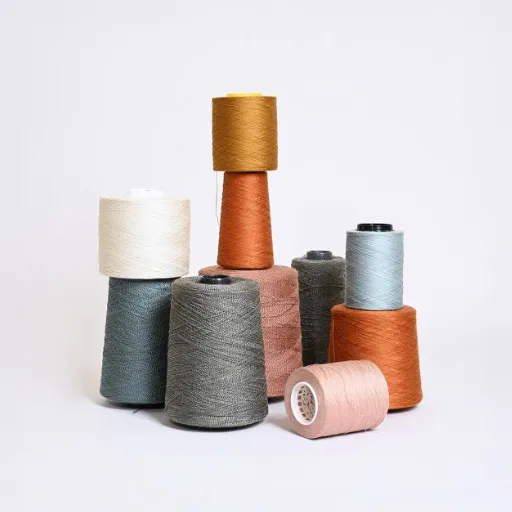
Understanding test standards is non-negotiable for anyone sourcing yarn for upholstery. These standards define whether a finished piece of furniture will survive its warranty period or become a liability.
Abrasion Resistance: Martindale vs. Wyzenbeek Testing
Abrasion resistance is the most frequently cited performance metric for upholstery, but confusion about testing methods creates problems for buyers and suppliers alike.
The Wyzenbeek test (ASTM D4157) is the North American standard. A test specimen is mounted in a frame and rubbed back and forth against a standardized abradant — typically cotton duck fabric or wire mesh for highly abrasion-resistant materials. One complete back-and-forth motion counts as one “double rub.” Testing continues until two yarns break or unacceptable wear is visible.
The Martindale test (EN ISO 12947-2) is the European and international standard. The test specimen moves in a Lissajous figure-eight pattern against a worsted wool abradant or wire mesh, applying multi-directional wear. Results are reported in “rubs” or “Martindales.”
Critical fact: these tests are not correlated. A fabric scoring 50,000 double rubs on Wyzenbeek may score differently on Martindale due to how weave structure and yarn construction respond to linear versus multi-directional abrasion. Specifying “50,000 rubs” without naming the test method is meaningless.
| Wyzenbeek Double Rubs | Martindale Rubs | Classification | Typical Application |
|---|---|---|---|
| Under 3,000 | Under 10,000 | Decorative only | Pillows, curtains, accents |
| 3,000 – 9,000 | 10,000 – 15,000 | Light duty | Occasional chairs, formal seating |
| 9,000 – 15,000 | 15,000 – 25,000 | Medium duty | Living room sofas, dining chairs |
| 15,000 – 30,000 | 25,000 – 30,000 | Heavy duty | Family sofas, homes with children/pets |
| 30,000 – 60,000 | 30,000 – 40,000 | Light commercial | Offices, hotel rooms, conference seating |
| 60,000 – 100,000 | 40,000 – 60,000 | Heavy commercial | Lobbies, restaurants, public seating |
| Over 100,000 | Over 60,000 | Extra heavy commercial | Airports, hospitals, theaters |
When selecting yarn for upholstery, higher abrasion resistance requires higher tenacity, tighter twist, and often heavier denier. A yarn spec’d for 30,000+ double rubs commercial use will be constructed very differently from one intended for 9,000 double rubs residential decorative use.
Tensile Strength and Elongation Requirements
Tenacity measures the force required to break a yarn, normalized by its linear density. For upholstery applications, minimum tenacity requirements vary by fiber:
- High-tenacity polyester: 5.5+ cN/tex
- Standard polyester: 4.0-5.0 cN/tex
- Nylon 6,6: 6.0+ cN/tex
- Wool: 3.5-4.5 cN/tex
- Cotton: 3.0-4.0 cN/tex
Elongation at break — how much a yarn stretches before breaking — matters for upholstery because it affects how fabric responds to stress. Too little elongation creates brittle fabric that tears under impact. Too much creates fabric that stretches and bags over time. Upholstery yarn typically targets 15-30% elongation at break, with the exact target depending on weave structure and end use.
Pilling Resistance Standards
Pilling — the formation of fiber balls on fabric surface — is both an aesthetic and functional defect. The ICI pilling box test (ISO 12945-1) and Martindale pilling test (ISO 12945-2) evaluate pilling tendency. Yarn construction choices dramatically impact pilling: longer staple fibers, higher twist, and smoother surface finishes all reduce pilling. For upholstery, a pilling rating of 3-4 or better on a 1-5 scale is typically expected after simulated use.
Colorfastness and Lightfastness
Colorfastness measures how well dye resists fading or bleeding when exposed to water, perspiration, rubbing, or cleaning. The AATCC publishes standard test methods (AATCC 61, AATCC 8, AATCC 116) that grade color change and staining on a 1-5 scale. Upholstery yarn should achieve ratings of 4 or higher for wet and dry crocking, and 3-4+ for washing and perspiration.
Lightfastness measures resistance to fading under light exposure, tested per AATCC 16 or ISO 105-B02. For residential upholstery near windows, a lightfastness rating of 4 (Blue Wool Scale) is minimum. For outdoor upholstery, ratings of 6-7 are required — achievable only with solution-dyed or heavily pigmented yarns.
Flame Retardancy Compliance
Flame standards vary by jurisdiction and application, creating a complex compliance landscape:
CAL 117-2013 (California Technical Bulletin 117) is the de facto North American residential standard. It requires upholstery fabric to resist ignition from a smoldering cigarette and, for some applications, an open flame. Compliance starts with yarn: inherently flame-resistant fibers like wool meet standards without treatment, while cotton and standard polyester require chemical finishing.
NFPA 701 is the US standard for commercial drapery and upholstery. It involves both small-scale and large-scale flame testing. Passing typically requires flame-retardant polyester or treated natural fibers.
BS 5852 is the UK standard for contract furniture, testing resistance to ignition by smoldering and flaming sources of increasing severity. Cigarette (Source 0), match (Source 1), and crib fires (Sources 2-7) test progressively stricter requirements. High-traffic commercial seating in the UK must pass at least Source 5, which heavily influences yarn and fabric construction choices.
When sourcing yarn for upholstery destined for specific markets, requesting flame compliance certificates upfront prevents costly surprises during finished goods testing.
Yarn Specifications by Upholstery Application
One of the most common mistakes in upholstery yarn sourcing is treating all applications as equivalent. The yarn for upholstery that works for a boutique hotel lobby chair will fail catastrophically in an airport terminal, and vice versa.
Residential Furniture Yarn Requirements
Residential upholstery balances durability with cost and aesthetics. Typical specifications:
- Fiber: Polyester, polyester-cotton blend, or acrylic
- Denier: 150D-300D for standard weight, 300D-600D for heavy-duty
- Construction: 2-ply to 3-ply
- Abrasion target: 15,000-30,000 Wyzenbeek double rubs
- Flame compliance: CAL 117 (North America) or equivalent
- Finishing: Stain-resistant, optional antimicrobial
Residential yarn for upholstery prioritizes hand-feel and appearance alongside durability. Softer texturing, lighter deniers, and blended constructions create the comfortable, inviting surfaces consumers expect in their homes.
Commercial and Contract Upholstery Yarn
Commercial seating in offices, hotels, restaurants, and public spaces faces dramatically higher use intensity. Specifications tighten accordingly:
- Fiber: High-tenacity polyester, nylon, or wool-nylon blend
- Denier: 300D-1000D
- Construction: 3-ply to 4-ply, tight twist
- Abrasion target: 30,000-100,000+ Wyzenbeek double rubs
- Flame compliance: NFPA 701, BS 5852 Source 5+, CAL 133
- Finishing: Heavy-duty stain resistance, antimicrobial, anti-static
Contract upholstery yarn sacrifices some hand-feel for maximum durability. Nylon becomes more common at the heavy-duty end of the spectrum, and constructions favor strength over softness.
Automotive Interior Yarn
Automotive upholstery presents unique challenges: extreme temperature cycling, UV exposure through windows, and resistance to oils, greases, and cleaning chemicals.
- Fiber: Solution-dyed polyester or nylon with UV stabilizers
- Denier: 200D-600D
- Construction: 2-ply to 3-ply, high twist
- Abrasion target: 100,000+ double rubs
- Flame compliance: FMVSS 302 (US), ECE R118 (EU)
- Additional: Lightfastness 6+ (Blue Wool), fogging resistance, odor compliance
Automotive suppliers typically demand exhaustive certification packages including material data sheets, test reports, and production part approval process (PPAP) documentation.
Outdoor and Marine Upholstery Yarn
Outdoor furniture yarn must survive sun, rain, salt, mold, and temperature extremes without degrading.
- Fiber: Solution-dyed acrylic (Sunbrella-type) or UV-stabilized olefin
- Denier: 900D-1500D BCF for olefin; 300D-600D for acrylic
- Construction: BCF or 2-ply texturized
- Abrasion target: 15,000-30,000 Wyzenbeek
- Flame compliance: NFPA 701 for commercial outdoor
- Additional: Mold/mildew resistance, salt resistance (marine), 5-year+ color warranty
The defining characteristic of outdoor yarn for upholstery is solution-dyeing. Piece-dyed yarn fades within one season of sun exposure. Solution-dyed yarn, with pigment locked into the fiber core, maintains color for years.
Healthcare and Hospitality Applications
Healthcare upholstery faces aggressive cleaning protocols, infection control requirements, and 24/7 use.
- Fiber: Nylon or high-tenacity polyester with inherent antimicrobial properties
- Denier: 400D-800D
- Construction: 3-ply, tight twist
- Abrasion target: 100,000+ double rubs
- Flame compliance: NFPA 701, CAL 133, BS 7176
- Additional: Bleach-cleanable, antimicrobial (EPA-registered), blood-borne pathogen resistance, anti-static
Healthcare yarn specifications are among the most demanding in the upholstery industry. The combination of chemical resistance, antimicrobial performance, and extreme durability requires careful fiber selection and finishing.
Sustainable Upholstery Yarn Options
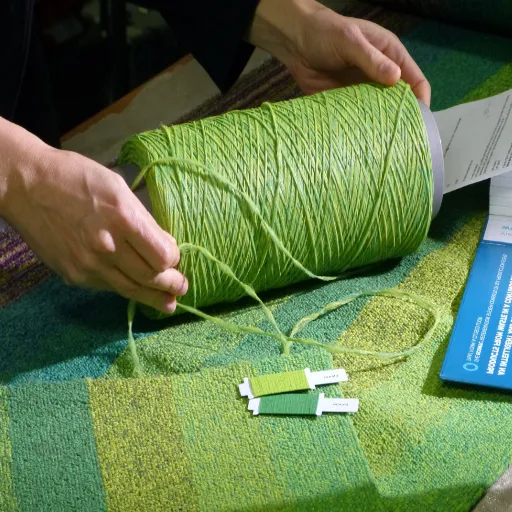
Sustainability is reshaping yarn for upholstery manufacturing. Furniture brands responding to consumer and regulatory pressure are demanding eco-friendly alternatives that do not compromise performance.
Recycled Polyester (rPET) for Upholstery
Recycled polyester made from post-consumer PET bottles and post-industrial waste has matured into a viable upholstery yarn option. Modern rPET yarns achieve tenacity and abrasion resistance within 5-10% of virgin polyester, making them suitable for most residential and many commercial applications. The Global Recycled Standard (GRS) certification verifies recycled content and tracks materials through the supply chain.
IKEA’s commitment to 100% recycled polyester in upholstery textiles, achieved ahead of schedule, demonstrated that rPET can scale to mass-market furniture production. The primary limitation remains color consistency — rPET can produce slight shade variations between batches that must be managed through careful blending and quality control.
Organic and Recycled Cotton Yarns
Organic cotton, grown without synthetic pesticides or fertilizers, offers a natural fiber option for eco-conscious upholstery lines. GOTS (Global Organic Textile Standard) certification ensures organic integrity from farm to finished yarn. Recycled cotton, produced from textile waste, reduces water and chemical use but produces shorter staple fibers that limit strength unless blended with longer fibers or synthetics.
For upholstery, organic cotton is typically blended with recycled polyester to improve durability while maintaining sustainability credentials. A 50/50 organic cotton/recycled polyester blend achieves reasonable abrasion resistance for light-to-medium duty residential use.
Bio-Based and Renewable Fiber Innovations
Emerging fiber technologies are expanding sustainable upholstery options:
Bio-based polyester uses plant-derived ethylene glycol (from sugarcane or corn) rather than petroleum feedstock. The resulting polymer is chemically identical to conventional PET and performs equivalently, but with a reduced carbon footprint.
PLA (polylactic acid) fiber from fermented plant starch offers biodegradability but currently lacks the heat resistance and durability required for most upholstery applications. Research continues to improve PLA performance for textile use.
Bio-based nylon using castor oil-derived sebacic acid is commercially available from some suppliers, offering a renewable alternative to petroleum-based nylon with comparable performance characteristics.
Certifications That Matter
When sourcing sustainable upholstery yarn, request these certifications:
- GRS (Global Recycled Standard): Verifies recycled content and chain of custody
- GOTS (Global Organic Textile Standard): Certifies organic fibers and responsible processing
- OEKO-TEX Standard 100: Ensures yarn is free from harmful substances
- Cradle to Cradle Certified: Evaluates material health, recyclability, and renewable energy use
- BLUESIGN: Certifies responsible chemical management in textile production
Sustainable upholstery yarn demand is growing 8-12% annually as major furniture brands integrate environmental targets into their sourcing requirements. Suppliers who can deliver certified sustainable options with documented performance data gain competitive advantage in B2B procurement processes.
Want to explore sustainable upholstery options for your next furniture line? Browse our eco-friendly yarn collection to see certified recycled and organic options with full performance specifications.
How to Source Yarn for Upholstery: A B2B Buyer’s Guide
Sourcing yarn for upholstery requires more than comparing price lists. The right supplier relationship, built on clear specifications and verified performance data, prevents the costly failures that damage brands and bottom lines.
Key Questions to Ask Your Yarn Supplier
Before placing an order, demand answers to these questions:
- What is the tenacity rating, and can you provide test reports? Do not accept vague claims like “high strength.” Request specific cN/tex or gpd values with third-party test reports.
- What abrasion rating does this yarn achieve in finished fabric, and which test method was used? A supplier claiming “50,000 rubs” without specifying Wyzenbeek or Martindale is either uninformed or deliberately vague.
- Is this yarn solution-dyed or piece-dyed? For outdoor or high-UV applications, solution-dyeing is essential. For indoor residential, piece-dyeing may be acceptable and more cost-effective.
- What flame retardancy treatments are applied, and are they inherent or topical? Inherent treatments survive cleaning and wear; topical treatments may degrade. Request certification to specific standards (CAL 117, NFPA 701, BS 5852).
- What is the lot-to-lot color consistency? Request Delta E color difference data. A Delta E under 1.0 is imperceptible; under 2.0 is acceptable for most applications.
- Can you provide a Technical Data Sheet (TDS) and Certificate of Analysis (CoA) for each lot? Professional suppliers maintain these documents as standard practice.
Certifications and Compliance Documentation to Request
Never rely on verbal assurances for compliance-critical applications. Request physical or digital copies of:
- Test reports for abrasion (Wyzenbeek or Martindale), tensile strength, pilling, colorfastness, and lightfastness
- Flame compliance certificates to the specific standard required for your market
- Chemical safety certificates (OEKO-TEX, REACH compliance)
- Sustainability certifications (GRS, GOTS, BLUESIGN) if marketing eco-friendly products
- Material Safety Data Sheets (MSDS) for finishing chemicals used
Sampling and Testing Protocols
Always request production samples before committing to bulk orders. A proper sampling protocol includes:
- A-standard sample: Representative of bulk production, used for your internal testing and approval
- Retention sample: Sealed and stored by both parties for dispute resolution
- Shade band: Showing acceptable color variation limits
Conduct your own testing whenever possible, or engage a third-party lab (SGS, Intertek, Bureau Veritas) for independent verification. The cost of testing a sample batch is negligible compared to the cost of discovering problems in finished goods.
When Maria Santos, a product development manager at a Portuguese furniture exporter, began working with a new Chinese yarn supplier in 2024, she insisted on a phased qualification process: sample testing, small production trial, then quarterly audits. “The initial sample passed everything,” she recalls. “But the first production trial failed lightfastness by a full grade. Without the trial phase, that yarn would have gone into 2,000 chair covers bound for a Dubai hotel project. The delay was frustrating, but it saved us from a disaster.”
MOQs, Lead Times, and Logistics Considerations
Upholstery yarn MOQs vary dramatically by supplier and product. Standard colors in common deniers may have MOQs of 500-1,000 kg, while custom colors or specialized constructions can require 3,000-5,000 kg minimums. Factor these constraints into your product planning.
Lead times typically range from 2-6 weeks for stocked items to 8-12 weeks for custom production. Plan inventory accordingly, and confirm whether your supplier holds safety stock for repeat orders.
For international sourcing, clarify Incoterms, shipping methods, and customs documentation requirements. Yarn shipments crossing borders require accurate HS code classification and may be subject to textile-specific trade regulations or tariffs.
Ready to source yarn for upholstery that meets your exact specifications? Contact Hebei Lida Textile to request samples, technical data sheets, and a customized quote for your next furniture project. Our team works with furniture manufacturers worldwide to deliver yarn engineered for durability, compliance, and performance.
Frequently Asked Questions About Yarn for Upholstery
What is the best yarn for upholstery?
The best yarn for upholstery depends on the application. Polyester and polyester blends are the most versatile choice for residential and commercial use due to their abrasion resistance and cost efficiency. Nylon delivers the highest durability for heavy-duty commercial and automotive applications. Acrylic and solution-dyed olefin are the top choices for outdoor upholstery thanks to superior UV stability. Wool and linen excel in premium residential settings where natural fibers are preferred.
What makes yarn suitable for upholstery?
Yarn for upholstery must achieve higher tenacity, tighter twist, and multi-ply construction compared to apparel yarn. Key requirements include abrasion resistance (tested via Wyzenbeek or Martindale methods), tensile strength above 4.5 cN/tex for synthetics, dimensional stability, and compliance with flame retardancy standards like CAL 117 or NFPA 701. Finishing treatments for stain resistance, UV protection, or antimicrobial properties may also be required depending on the application.
What is the difference between solution-dyed and piece-dyed yarn for upholstery?
Solution-dyed yarn has color pigment added during the polymer extrusion process, locking it into the fiber core. This provides superior UV stability and colorfastness, making it essential for outdoor upholstery. Piece-dyed yarn is dyed after spinning, which is more cost-effective but produces inferior lightfastness. Outdoor upholstery should always use solution-dyed yarn.
How is yarn for upholstery tested for durability?
Durability is measured primarily through abrasion testing. The Wyzenbeek test (North America, ASTM D4157) uses linear back-and-forth rubbing, while the Martindale test (Europe, EN ISO 12947-2) applies multi-directional figure-eight wear. Results are not interchangeable. Residential upholstery typically requires 15,000+ double rubs, commercial seating 30,000+, and heavy-use environments 100,000+.
Can upholstery yarn be sustainable?
Yes. Recycled polyester (rPET) made from post-consumer bottles achieves performance within 5-10% of virgin polyester. Organic cotton certified to GOTS standards and bio-based polyester from plant-derived feedstocks are also viable options. Demand for sustainable yarn for upholstery is growing 8-12% annually as furniture brands respond to consumer and regulatory pressure.
Conclusion
Yarn for upholstery manufacturing is a specialized discipline where generic textile knowledge falls short. The fiber choices, construction decisions, and finishing treatments applied during yarn production determine whether upholstered furniture survives its warranty period or becomes a costly liability.
The key takeaways for sourcing yarn for upholstery are clear. First, match yarn specifications to application requirements — residential, commercial, automotive, and outdoor each demand different performance profiles. Second, verify claims with independent test data rather than accepting supplier marketing language. Third, understand that compliance standards start at the yarn level; flame retardancy, colorfastness, and abrasion resistance are all influenced by decisions made before fabric ever reaches the loom. Fourth, sustainable options are increasingly viable, with recycled polyester and certified organic cotton delivering performance that approaches conventional alternatives. Fifth, build supplier relationships based on transparency, documentation, and phased qualification rather than price alone.
The global upholstery fabric market, valued at over USD 46 billion and growing steadily, rewards manufacturers who invest in quality at the yarn level. Those who treat yarn as a commodity input rather than a strategic quality driver risk the kind of failures that destroy brands and customer trust.
At Hebei Lida Textile Co., LTD, we manufacture custom yarn for upholstery with the understanding that our customers’ reputations depend on our product performance. From high-tenacity polyester for contract seating to solution-dyed acrylic for outdoor collections, we deliver yarn engineered to specification, tested to standard, and documented for compliance. Contact our team today to discuss your upholstery yarn requirements and request samples for evaluation.