




The application decides which property you must specify. Tire cord is governed by dimensional stability, seat belts by elongation at a specified load, geotextiles by wide-width tensile strength, and belts and hose by adhesion after aging. Tenacity matters in every one of them, but tenacity alone is never the full specification.
Martin, a procurement manager at a belt converter in Poland, learned that the expensive way. He switched to a lower-cost high-tenacity polyester with an identical tenacity figure on the datasheet.
Six weeks later, belts in a humid plant began delaminating at the splice. The yarn was strong enough. It had not been specified for adhesion after humidity aging.
That is the pattern behind most industrial yarn failures. The fiber was not weak. The purchase order asked for the wrong number.
This guide covers 12 polyester industrial yarn applications. For each one you get the property that decides pass or fail, the test to demand, and the failure mode when the spec is incomplete. If you already know the application, the table below is the short version.
Key Takeaways
- Specify by application, not by fiber. The same high-tenacity polyester can be right for webbing and wrong for tire cord.
- The decisive property is often not strength. It is dimensional stability, elongation at load, adhesion, shrinkage, or UV retention.
- Every number on a purchase order should name a test method. A value without a method is not a specification.
- Ask for the property after the service condition, not just after production: after humidity, after UV, after flex fatigue, after washing.
- A test certificate per lot is the cheapest insurance in an industrial yarn order.
Industrial Yarn Applications at a Glance
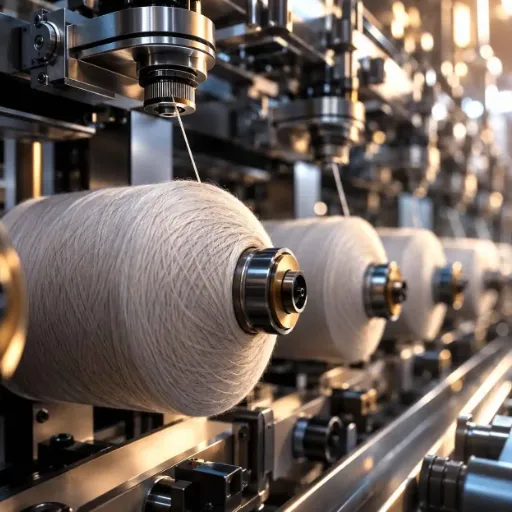
An industrial yarn application is one where the yarn’s performance is the product requirement. Hand-feel and appearance matter less than strength, dimensional stability, heat resistance, chemical resistance, or UV life. That’s the line between apparel yarn and industrial yarn, and it’s why an industrial yarn isn’t simply a premium version of an apparel yarn.
If you’re new to the category, our overview of how yarn applications are classified explains the difference between apparel, home textile, and technical end uses. The table here goes one level deeper.
| # | Application | Dominant fiber | The number that decides the spec | Test to demand | Failure mode |
|---|---|---|---|---|---|
| 1 | Tire cord | HMLS polyester; nylon 6/66 | EASL and hot-air shrinkage at service temperature | ASTM D885; supplier cord certificate | Flat-spotting, heat degradation, cord/rubber separation |
| 2 | Conveyor belts | PET warp, nylon weft (EP) | Tensile retention after flex fatigue | ASTM D885 plus belt fatigue test | Carcass fatigue, ply separation |
| 3 | V-belts and hose | HT polyester; nylon | Adhesion after heat and humidity aging | Peel adhesion after aging | Cord pull-out, hydrolysis, cover failure |
| 4 | Seat belts and webbing | HT polyester | Elongation at the specified load | FMVSS 209 assembly tests | Excess stretch, edge abrasion, UV loss |
| 5 | Lifting slings and tie-downs | HT polyester; nylon | Strength retention after abrasion and UV | Abrasion and UV exposure per supplier spec | Creep, cutting, UV degradation |
| 6 | Ropes and cordage | HT polyester; HMPE | Creep under sustained load | Creep and rupture test; UV exposure | Creep rupture, internal abrasion |
| 7 | Fishing nets and aquaculture | Nylon 6/6.6; polyester | Knot strength retention after seawater and UV | Knot strength; UV aging | Knot slippage, UV embrittlement |
| 8 | Geotextiles and soil reinforcement | PP; HT polyester | Wide-width tensile strength per unit width | ISO 10319 | Installation damage, UV loss, clogging |
| 9 | Erosion control and drainage | PP; polyester | Permeability retention and clogging resistance | ISO 10319 plus permeability test | Clogging, installation puncture |
| 10 | Filtration media | PP; polyester; PTFE or glass where needed | Dtex fineness and shrinkage at service temperature | Air permeability; shrinkage test | Shrinkage, chemical attack, blinding |
| 11 | Industrial sewing thread | Bonded HT polyester; nylon | Tenacity and abrasion resistance at the seam | Seam strength; abrasion test | Seam failure, needle heat, skipped stitches |
| 12 | Protective and FR textiles | Aramid; modacrylic; FR-treated blends | Flame, heat, and cut performance after washing | EN ISO 11612; NFPA 2112 | Finish wash-out, heat shrinkage, cut penetration |
Read the third column as the line to put in your RFQ. Read the fourth as the proof you ask for. If a supplier quotes a number without naming the method, you have a claim, not a specification.
Need a second opinion on a spec? Send your current yarn specification to our team and we will flag the properties it leaves out. Request a specification review
Rubber-Reinforced Applications: Tire Cord, Belts, and Hose
Rubber goods are where industrial polyester yarn does most of its work, and where the gap between “strong” and “suitable” is widest. The yarn has to bond to rubber, survive heat, and hold its dimensions under repeated flex. Our industrial yarn manufacturing guide covers how these yarns are made; this section covers what to specify.
Tire Cord
Tire cord is the clearest example of a property that is not strength. A polyester cord can exceed its breaking-force target and still fail because it grows or shrinks under heat. That movement changes tire shape, which affects handling, fuel efficiency, and heat buildup.
HMLS polyester, or high modulus low shrinkage, exists to control that movement. Two numbers matter.
EASL is elongation at a specified load, a proxy for how much the cord stretches in service. Hot-air shrinkage measures how much it contracts when heated.
Ask for both at the test temperature your customer uses. 177 °C is common for polyester tire cord, but the standard and the customer’s specification govern.
The second specification is adhesion. A dipped cord has to bond to the rubber compound through the dip system and the cure. Ask for the adhesion value after the customer’s cure cycle, not from a generic datasheet. ASTM D885 sets out the test methods for tire cords and industrial filament yarns, so it is the reference to name on the purchase order.
Conveyor Belts
Most conveyor belt carcasses use EP fabric: polyester warp, nylon weft. The combination is deliberate. Polyester gives low stretch and dimensional stability along the belt. Nylon gives impact tolerance and edge strength across it.
The decisive property is not initial tensile strength. It’s strength retention after flex fatigue. A belt that runs over small pulleys flexes millions of times, and the carcass has to survive that without cracking or separating from the cover. Ask for fatigue data and ply adhesion, and state the pulley diameter and belt speed so the supplier can match the construction.
V-Belts and Hose
V-belts and hose share a failure mode: the cord pulls out of the rubber. Heat and humidity accelerate it. So the number to demand is adhesion after aging, not adhesion measured on a fresh sample.
For hose, add hydrolysis resistance if the service fluid is water-based or the hose is stored humid. For V-belts, add heat resistance and flex fatigue. Both are cases where a yarn that passes on day one can fail in month six.
Load-Bearing Textiles: Seat Belts, Slings, Ropes, and Webbing
Load-bearing textiles convert yarn strength into a safety function. Here the specification has to account for the assembly, not just the yarn.
Seat Belts and Webbing
Seat belt webbing is governed by elongation at a specified load, not by ultimate breaking strength alone. A belt that stretches too far lets the occupant move too far forward before the restraint takes full load. A belt that is too stiff is uncomfortable and can abrade at the buckle.
FMVSS 209 sets the assembly performance requirements in the United States, including webbing tests after abrasion and light exposure. Ask your webbing supplier for elongation at the specified load and for abrasion and UV test data, not just a breaking-strength figure. If the belt is exported, name the destination market’s standard on the purchase order.
Lifting Slings and Tie-Downs
Slings and tie-downs fail in three ways: creep under sustained load, cutting at a sharp edge, and UV degradation during storage or outdoor use. The specification should cover all three.
Ask for strength retention after abrasion, after UV exposure, and after a defined number of load cycles. State the working load limit and the safety factor the finished sling must meet. The yarn’s breaking strength is an input; the sling’s rating is the output.
Ropes and Cordage
Rope buyers usually compare polyester with HMPE, or high-modulus polyethylene. Polyester offers good strength, low stretch, and predictable behavior at a lower cost. HMPE offers higher strength-to-weight but creeps under sustained load, which matters for mooring and static rigging.
The decisive number is creep under the actual load and temperature, not tensile strength. Ask for a creep curve or a rupture test at the service load. Also ask about internal abrasion between strands, because a rope can fail from the inside while the outer braid looks intact. Our guide to yarn twisting and plying explains how strand construction changes that behavior.
Nets add one more requirement: knot strength. A net fails at the knot before it fails in the mesh, so ask for knot strength retention after seawater and UV aging.
Civil Engineering: Geotextiles, Drainage, and Erosion Control
Civil applications are specified by the project engineer, and the yarn has to meet a design value that includes installation damage and service life. Two fabrics with the same tensile strength can perform very differently after a year in the ground.
Geotextiles and Soil Reinforcement
Geotextiles are specified by wide-width tensile strength per unit width, tested to ISO 10319. That test gives strength and elongation on a wide specimen, which is closer to field behavior than a narrow strip test.
Three additional properties decide the real specification:
- UV stabilization matters for exposed or near-surface installations.
- Installation damage resistance matters because aggregate can puncture a fabric during placement.
- Permeability and clogging matter for drainage and filtration functions.
Ask for all four, and state the design life and exposure conditions.
Priya, a civil engineer in Maharashtra, specified a geotextile by tensile strength alone for a slope project. The fabric passed the design value.
Eighteen months of direct sun made it brittle, and a section tore during maintenance. The replacement specification added UV stabilization and an installation damage test. The tensile number had been correct; it was simply not the whole design.
Erosion Control and Drainage
Erosion control blankets and drainage composites fail hydraulically more often than mechanically. A fabric can be strong enough and still clog, or pass water too freely to filter soil.
Specify permeability, apparent opening size, and clogging resistance alongside tensile strength. For drainage, ask for flow rate under the expected confining pressure. For erosion control, ask for UV life and anchorage strength. Contact Hebei Lida Textile Co., LTD for application-specific yarn.
Filtration, Sewing Thread, and Protective Textiles
These three applications are grouped as “technical textiles,” but each is governed by a different property.
Filtration Media
Filtration yarns are specified by fineness and stability, not by strength. Dtex controls the pore structure and the surface area available for capture. Shrinkage at service temperature controls whether the filter bag keeps its shape.
Ask for dtex, shrinkage at the operating temperature, and chemical resistance to the actual medium. For baghouse filters, add temperature resistance and resistance to the cleaning method. For liquid filtration, add extractables and compatibility with the process fluid.
Industrial Sewing Thread
The seam is the weak point. A thread that matches the fabric in strength can still fail because it abrades, overheats at the needle, or loses its finish.
Bonded polyester thread is standard for industrial seams because the bond reduces fraying and improves abrasion resistance. Specify tenacity, abrasion resistance, and the bond type. For high-speed sewing, ask about needle heat and loop strength. Test the finished seam, not just the thread on the cone.
Protective and FR Textiles
Specify protective textiles by hazard, not by fiber. Flame resistance, heat resistance, and cut resistance are different properties, and a fabric that excels at one can be mediocre at another.
For flame and heat, EN ISO 11612 and NFPA 2112 are the standards buyers name most often. Ask for performance after the number of washes the garment will actually see. For cut protection, ask for the cut test method and the level, not a generic “cut-resistant” claim.
Comparing suppliers? Ask each one for a test certificate on the same property, tested to the same method. We can supply current certificates with our polyester yarn and industrial thread ranges.
How to Specify an Industrial Yarn by Application

The specification process is the same across all 12 applications. Only the decisive property changes.
- Start from the end product’s standard. Identify the regulation, customer specification, or design code the finished product must meet. Do not start from a yarn datasheet.
- Name the one property that governs pass or fail. It might be EASL, elongation at load, adhesion after aging, wide-width tensile, shrinkage, or UV retention.
- Set the value against a named test method. A number without a method can’t be verified. Write both on the purchase order.
- Specify the finish and the package, not just the yarn count. Dip, bond, wax, UV stabilizer, and package format all change performance downstream.
- Require a test certificate per lot and agree the sampling plan. Decide in advance what happens if a lot misses the target.
A complete RFQ for an industrial polyester yarn usually includes: dtex or denier, tenacity, elongation at the specified load, shrinkage, twist and ply, dip or finish, package format, test method for each property, acceptance range, and the certificate requirement. If you need help translating an application into those fields, our guide to custom yarn for industrial use walks through the full RFQ.
What Goes Wrong, and How to Test for It
Most failures fall into seven patterns. Each one has a test that would have caught it before the order shipped. Our yarn quality control guide covers the sampling plan.
| Failure mode | What it looks like | The test that catches it |
|---|---|---|
| Hydrolysis | Strength loss in humid or wet service | Adhesion and strength after humidity aging |
| Creep | Gradual elongation under sustained load | Creep or rupture test at service load |
| UV embrittlement | Surface cracking, strength loss outdoors | UV exposure followed by tensile test |
| Adhesion loss | Cord pulls out of rubber or coating | Peel adhesion after cure or aging |
| Shrinkage | Fabric or cord changes dimension at temperature | Hot-air shrinkage at service temperature |
| Flex fatigue | Cracking after repeated bending | Fatigue test at the service pulley diameter |
| Installation damage | Punctures or tears during placement | Installation damage test with site aggregate |
The cheapest test matches the service condition, not the lab bench. A dry, new sample tells you little about a yarn that will spend ten years wet, hot, and flexing.
Tomas, a purchasing manager for a sling manufacturer in Norway, bought high-tenacity polyester on strength alone. The slings were stored outdoors between jobs, and after a season they had lost noticeably more strength than the same product stored indoors.
Nothing was wrong with the yarn. The purchase order had simply never asked about UV stabilization. He added a UV exposure test and a storage specification, and the claims stopped.
Frequently Asked Questions
What is an industrial yarn application?
An industrial yarn application is an end use where yarn performance, rather than appearance or hand-feel, is the product requirement. Examples include tire cord, conveyor belts, seat belts, ropes, geotextiles, filtration media, and sewing thread.
What is the strongest industrial yarn?
There’s no single answer. Aramid and HMPE reach higher tenacity than polyester, but strength is only one property. For most rubber goods, geotextiles, webbing, and ropes, high-tenacity polyester offers the best balance of strength, dimensional stability, and cost.
Is polyester or nylon better for industrial use?
Polyester is usually better for dimensional stability, UV resistance, and cost. Nylon is usually better for abrasion resistance, impact tolerance, and elasticity. Conveyor belt carcasses often use both: polyester warp for low stretch, nylon weft for impact strength.
What does “high tenacity” mean on a spec sheet?
It means the yarn has been drawn and processed for higher breaking strength than a standard textile yarn. The label alone is not a specification. Ask for the tenacity value, the test method, and the other properties that matter for your application.
Specify the Property, Not Just the Fiber
The 12 applications in this guide share one rule. The end use determines the property, the property determines the number, and the number needs a test method.
- Tire cord and rubber goods are governed by dimensional stability and adhesion, not raw strength.
- Seat belts, slings, and ropes are governed by elongation, creep, and strength retention after aging.
- Geotextiles and drainage are governed by wide-width tensile, UV life, and clogging.
- Filtration, sewing thread, and protective textiles are governed by fineness, shrinkage, abrasion, and flame performance.
If you’re sourcing polyester industrial yarn, start with the application and work backward. Send us the end use, the standard it must meet, and the property your current specification leaves out. Our team will match the yarn, name the test, and supply the certificate with the lot. Talk to our industrial yarn team.