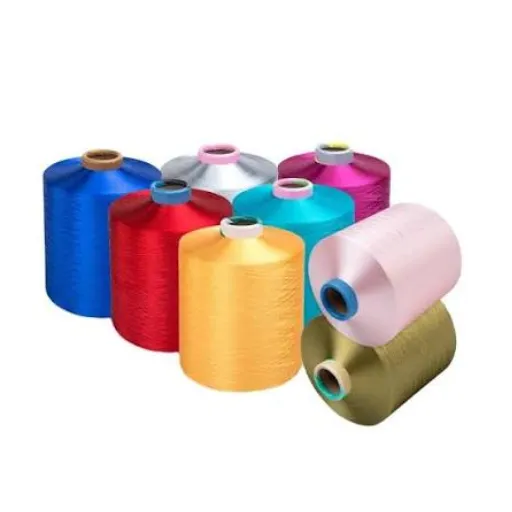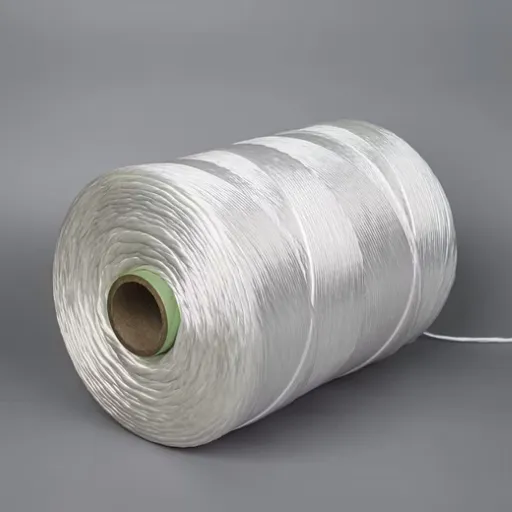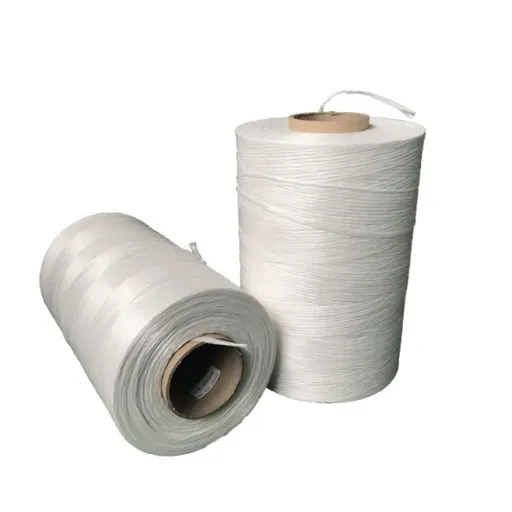



High tenacity polypropylene geotextile yarn sits above 6.7 cN/dtex (about 7.5 g/den) in non-fibrillated tape and around 6.0 cN/dtex (about 6.6 g/den) in fibrillated tape. Those numbers only mean something when the construction, the test method and the UV package are written beside them.
Most spec sheets don’t do that. A listing shows a single strength figure and stops there.
The substitution problem is the common version of this. A buyer asks for 1,200 denier PP multifilament for a woven separation fabric. The reply offers 1,200 denier tape at a better price, on the grounds that both are high tenacity PP.
The tape would weave. It would also change the fabric’s elongation, its 5%-strain strength and its opening size, and none of those appear in the comparison because nobody wrote them down.
That is the gap this guide closes. It stays at the yarn: what “high tenacity” means in polypropylene, how tape and multifilament behave differently, why PP creeps when polyester does not, and which test proves which number before you commit to a container.
Key Takeaways
- Polypropylene tape yarn carries published benchmarks above 6.7 cN/dtex for non-fibrillated tape and around 6.0 cN/dtex for fibrillated tape.
- Tape, fibrillated tape, multifilament and monofilament are four different products. The same tenacity figure doesn’t make them interchangeable in a loom or a fabric.
- PP is used above its glass transition temperature, so it creeps faster and is more temperature-sensitive than polyester. That rules it out of many sustained-load reinforcement jobs.
- A UV claim needs a number and a method. AASHTO M288 sets 50% strength retained after 500 hours of ASTM D4355 as the floor.
- ASTM D2256 excludes yarns that stretch more than 5.0% between 0.05 and 1.0 cN/tex, and high-modulus polyolefin tape may need special clamping. Two labs can test the same yarn and report different numbers.
Need a yarn specification reviewed? Send the fabric construction, the target standard and the properties you need met. We will confirm what we can match and what you should test elsewhere. Request a specification review.
What Is High Tenacity Polypropylene Geotextile Yarn?
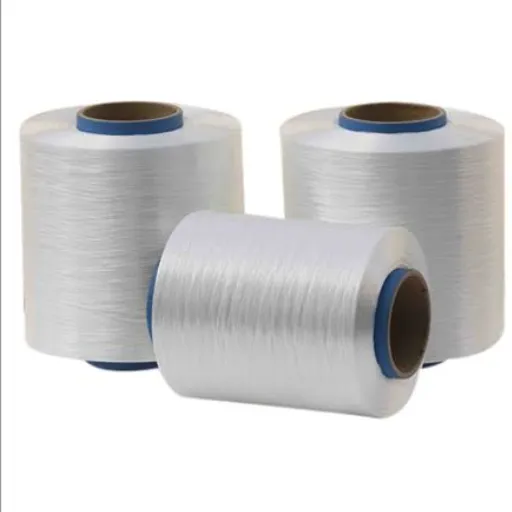
High tenacity polypropylene geotextile yarn is a continuous polypropylene strand, either slit film or multifilament, drawn hard enough to develop tenacity well above the textile range. It is specified by construction, linear density, tenacity with its test method, elongation, shrinkage, and UV package.
That definition is deliberately narrow. It leaves out two things people usually bundle in.
First, “high tenacity” describes a band on a continuum, not a product class. Polypropylene is drawn to many levels of orientation. Lightly drawn yarn makes sacks and carpet backing. Heavily drawn yarn makes geotextile tape.
There’s no certification body that stamps a yarn “high tenacity.” The word is a marketing term until a number and a method sit next to it.
Second, the construction matters as much as the polymer. A fibrillated tape and a multifilament can both be called high tenacity PP yarn and still behave completely differently in weaving, in coating and in the finished fabric. If your supplier’s data sheet does not name the construction, it is not a specification. It is a description.
Tape, fibrillated tape, multifilament and monofilament
Four constructions dominate PP geotextile yarn. They aren’t grades of each other.
| Construction | How it is made | What it suits | What to watch |
|---|---|---|---|
| Non-fibrillated tape | Film extruded, slit into flat tapes, drawn in line | Woven separation and stabilization fabrics; the workhorse of PP wovens | UV package; width consistency; draw ratio |
| Fibrillated tape | Drawn film slit into a mesh-like network of connected strands | Woven fabrics where a softer hand and a more open structure help | Lower tenacity benchmark than non-fibrillated tape; fibrillation consistency |
| Multifilament | Many continuous filaments spun and drawn, then bundled | Woven geotextiles needing flexibility, even coating pickup, geotubes and geobags | Filament count; twist or intermingling; consistency across the bundle |
| Monofilament | One filament per strand, round or shaped | Filtration fabrics where pore size must be controlled precisely | Diameter tolerance; how the shape affects the opening size |
The published benchmarks from Oerlikon Neumag, an extrusion equipment maker, put qualified tape at more than 6.7 cN/dtex (7.5 g/den) for non-fibrillated tape and around 6.0 cN/dtex (6.6 g/den) for fibrillated tape. That difference is not small. It reflects how fibrillation changes the load path through the tape.
For a polypropylene monofilament yarn or a multifilament, no single benchmark applies the way it does for tape. Ask the mill. The market quotes a wide spread, and the spread is real. A lightly drawn textile multifilament and a heavily drawn geotextile multifilament are not the same product even when both are labeled high tenacity polypropylene yarn.
Twist and intermingling belong in the same conversation. A flat multifilament weaves differently from a twisted one, and twist level changes both the loom behavior and the hand of the finished fabric. Ask whether the supply is flat, twisted or intermingled, and at what turns per meter, before you approve a multifilament lot.
Virgin and recycled feedstock
Buyers often ask for virgin fiber polypropylene on the assumption that virgin is the stronger choice. The same grade is quoted as a high tenacity virgin fibre polypropylene geotextile in Europe and India and as virgin fiber PP in North America. The spelling is the only difference. What the buyer actually has to verify is the feedstock, not the word.
Virgin PP means polymer that has not been through a previous melt cycle. Recycled PP can perform well in geotextiles, but the feedstock changes what you have to test. Molecular weight distribution, contamination and the additive package all shift, and they shift tenacity, elongation and UV performance with them.
A recycled-content certificate tells you where the polymer came from. It doesn’t tell you what the yarn will do in the ground. Test the yarn against the same specification you would apply to virgin material, and ask for lot-to-lot data rather than a single certificate.
How Strong Is High Tenacity Polypropylene Geotextile Yarn?
Tenacity is the breaking force a strand carries per unit of linear density. The arithmetic is simple. The trouble starts when two suppliers of PP geotextile yarn use different units and neither states the method.
g/d, cN/dtex and cN/tex
Three unit systems appear on PP yarn data sheets.
- g/d (grams per denier) is the older textile convention, still common in supplier listings.
- cN/dtex (centinewtons per decitex) is the SI-adjacent convention and the one most European and equipment-maker literature uses.
- cN/tex (centinewtons per tex) is used when the yarn is quoted in tex.
The conversion between g/d and cN/dtex sits a little above 1.1. That is close enough to one to one that people skip the arithmetic, which is exactly why the confusion persists.
1 cN/dtex is approximately 1.13 g/d.
Work it on a real published pair. Oerlikon states the non-fibrillated tape benchmark as 6.7 cN/dtex, which it also gives as 7.5 g/den. Divide 7.5 by 6.7 and you get about 1.12. The fibrillated pair, 6.0 cN/dtex and 6.6 g/den, gives about 1.10.
So the ratio is a little above 1.1 and a little below 1.13 depending on rounding. Treat “about 1.13” as a working conversion, and note that the same constant governs the polyester grade comparison, where it is worked through in both directions. Never compare a g/d figure with a cN/dtex figure without converting one of them first.
Typical values by construction
| Construction | Published tenacity benchmark | Test method to ask for | Elongation to expect | Source |
|---|---|---|---|---|
| Non-fibrillated tape | >6.7 cN/dtex (>7.5 g/den) | ASTM D2256 or ISO 2062, method stated on the report | 5% stretch at the high-modulus end up to 25 to 30% | Oerlikon Neumag |
| Fibrillated tape | ~6.0 cN/dtex (~6.6 g/den) | ASTM D2256 or ISO 2062, method stated | Same range, set by draw ratio | Oerlikon Neumag |
| Multifilament | Mill-stated; market listings quote a wide spread | ASTM D2256 or ISO 2062 | Mill-stated | Ask the mill |
| Monofilament | Mill-stated; driven by diameter and draw | ASTM D2256 or ISO 2062 | Mill-stated | Ask the mill |
Only the two tape rows carry a published benchmark. That isn’t a gap in this article. It’s the state of the public data. Anyone who prints a narrow multifilament range as if it were a standard is quoting a listing, not a specification.
One more unit trap is worth naming. Some data sheets report tenacity per filament, others per strand. A higher number doesn’t always mean a stronger yarn. It can mean a different denominator.
Elongation is half the specification
A tape with 5% stretch at break and a tape with 25 to 30% stretch are different products. Oerlikon’s own figure for tape stretch runs from 5% for extremely high modulus to 25 to 30% at the other end.
Why it matters: the fabric’s strength at low strain depends on the yarn’s modulus, not its breaking strength. A high-modulus tape reaches its working load with little movement. A high-elongation tape stretches before it carries anything. On a stabilization fabric over soft ground, that difference decides how the system behaves under the first load.
The practical rule is to specify both. A tenacity figure on its own lets the wrong yarn through as often as it lets the right one through.
Tenacity at strain, not just at break
This is where yarn data sheets and fabric data sheets diverge, and where buyers get caught.
A yarn certificate quotes tenacity at break. A fabric data sheet usually quotes strength at ultimate and at 5% strain, and the design value is often the second one.
A published example makes the gap concrete. The Mirafi HP665 datasheet reports wide-width tensile of 78.8 and 109.4 kN/m at ultimate in the two directions, but only 17.5 and 61.3 kN/m at 5% strain. The fabric carries a fraction of its ultimate strength at the strain a design normally allows.
So when a supplier hands you a yarn tenacity and a fabric strength, you are looking at two different measurements taken at two different points on the same curve. Ask for the strain at which the fabric number was taken.
Why Polypropylene and When Polyester Is the Better Answer
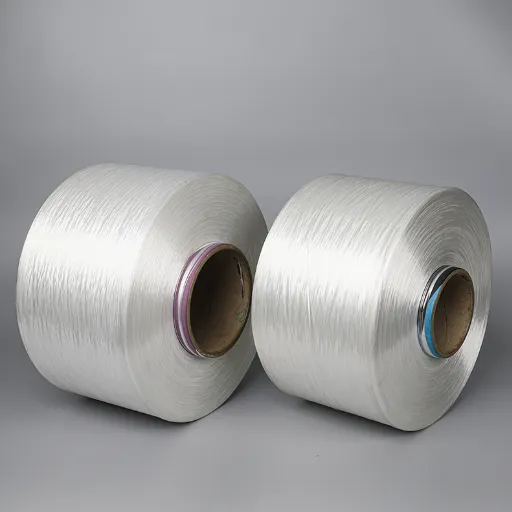
PP has real advantages. It’s chemically robust, it resists acids and alkalis across a wide range, and its density is about 0.91 g/cm³, so it floats. For drainage, waste containment and coastal work those properties matter.
It also has a limitation that the tenacity number on the yarn certificate hides completely.
The creep mechanism, stated plainly
PP is used above its glass transition temperature at normal service temperatures. Its amorphous regions are therefore in a rubbery state rather than a glassy one. Polyester is used below its glass transition temperature, so its amorphous regions stay glassy.
That single difference explains most of what follows. A polymer above its Tg rearranges under sustained load more readily, and the rearrangement accelerates with temperature.
Rollin’s review of long-term geotextile performance makes the same point from the other direction. In polymers such as PE and PP that are used above Tg, the review notes, the amorphous regions sit in a rubbery rather than a glassy state. Creep therefore proceeds faster, and it responds more to temperature than it does in polymers such as PET that are used below Tg.
The consequence for a buyer is simple. PP carries short-term and moderate load well. Under sustained load it creeps, and at high load fractions creep leads eventually to creep rupture.
What that rules out
If your geotextile has a reinforcing function that must hold load for the design life, PP is usually the wrong polymer. That’s polyester territory, and the site’s high tenacity polyester yarn guide covers the PET grade structure and verification path.
If your geotextile separates, filters, drains or protects, and the load is transient or moderate, PP is often the better technical and commercial choice. Chemical resistance and low density do real work in those applications.
The counterweight: polyester’s own weakness
PET is not universally better. Rollin’s review notes that polyester is susceptible to hydrolysis. Alkaline or external hydrolysis occurs in alkaline soils above pH 10, particularly with calcium present, and the review advises caution with polyesters for long periods above pH 9. Internal hydrolysis proceeds in humid soil at any pH.
So the honest comparison is a failure-mode trade, not a ranking. PP trades creep resistance for chemical inertness. PET trades chemical durability in hot alkaline conditions for modulus and creep behavior. Neither wins everywhere.
For the full PP-versus-PET comparison across the five geotextile functions, the site’s guide to matching geotextile yarn to function already sets it out. This article does not rebuild it.
The UV Package Is Part of the Specification
Ultraviolet exposure degrades polypropylene faster than it degrades polyester, and the reason is measurable. Rollin’s review gives the wavelength that initiates the reaction in each polymer: about 300 nm for PE, 325 nm for PET and 370 nm for PP. The longer the initiation wavelength, the larger the share of the solar spectrum that can trigger damage.
So a PP geotextile yarn needs a UV stabilization package. For the high tenacity grades that usually means a hindered amine light stabilizer (HALS) combined with carbon black or another UV absorber. “UV stabilized” on its own tells you nothing about the loading, the additive or the test behind it.
The only UV number worth accepting
AASHTO M288, the standard specification for geotextiles in highway construction, sets the acceptance floor at 50% strength retained after 500 hours of ASTM D4355 exposure. That is the minimum, not a target. The AASHTO M288-24 technical note sets out the survivability classes and the UV requirement together.
A supplier claiming better retention is claiming above the floor, which is good, but the claim has to come with a report. The Mirafi HP665 sheet, for example, publishes 80% retained at 500 hours as its minimum test value. That is a specific, checkable statement tied to a named method. “UV stabilized” is not.
Buried versus exposed
The stabilizer package is sized for a service environment. The exposure period before cover is a construction decision, and it’s the one most often ignored.
An unprotected PP yarn left in the sun through a slow site program can lose strength before it is ever buried. Ask what exposure your supplier’s package was qualified for, and match the site program to it, or specify a heavier package.
Request a competitive quote for your next polyester yarn procurement project.
Creep, Shrinkage and Heat: the Failure Modes the Tenacity Number Hides
Three properties decide field behavior and rarely appear on a shortlisting sheet.
Creep. Under sustained load, PP continues to extend. The design questions are how much strain is acceptable and whether the load fraction leaves margin against creep rupture. Ask for creep data, or for a creep-reduced design strength, before you use PP where load is sustained.
Shrinkage. Tape and multifilament shrink differently, and the draw ratio changes the result. Shrinkage must be reported with its method, because boiling-water and hot-air methods do not give the same answer. A low-shrinkage specification matters most where dimensional stability of the finished fabric drives the design.
Heat. PP softens and melts at a substantially lower temperature than PET. Where the fabric meets a hot process step or a hot applied material, check the resin datasheet and the supplier’s temperature guidance before assuming PP is suitable.
Do not take a melting point from a blog post, including this one. Take it from the resin data.
What to do about all three: specify a tenacity-at-strain floor rather than only a tenacity-at-break figure, demand shrinkage with its method, and keep PP out of sustained-load reinforcement unless the creep data supports it.
Which Geotextile Function Does High Tenacity Polypropylene Yarn Fit Best?
Five functions, and PP’s fit is different for each. The table below is the short version for a polypropylene high tenacity geotextile; the function-first treatment with test methods is in the linked guide.
| Function | Construction usually used | PP’s fit | Yarn property that decides it |
|---|---|---|---|
| Separation | Woven tape or multifilament | Strong fit | Tensile and puncture resistance at installation |
| Filtration | Monofilament woven or nonwoven | Fits, with pore control | Filament diameter and opening size |
| Drainage | Thick nonwoven or composite | Fits in many soils | Permittivity and clogging resistance |
| Reinforcement | Woven or warp-knitted PET | Weak fit for sustained load | Modulus and creep |
| Protection | Heavy nonwoven | Fits | Mass per area and puncture resistance |
The reinforcement row is the one to read twice. PP can reinforce in a short-term or low-stress case. It isn’t the polymer for a wall that must hold load for decades.
Two notes complete the picture. Nonwoven geotextiles are made from fiber, not yarn, so if your product is a nonwoven polypropylene geotextile fabric the input specification is a fiber specification, not this one.
Most high tenacity polypropylene geotextile fabrics serve more than one function at once, so the reinforcement row is rarely the only one that applies. That’s why the table is a starting point, not a design.
The next section sets out the eight lines a PP yarn specification has to carry. Compare your current data sheet against them before you send it anywhere.
What Belongs on a High Tenacity Polypropylene Geotextile Yarn Specification
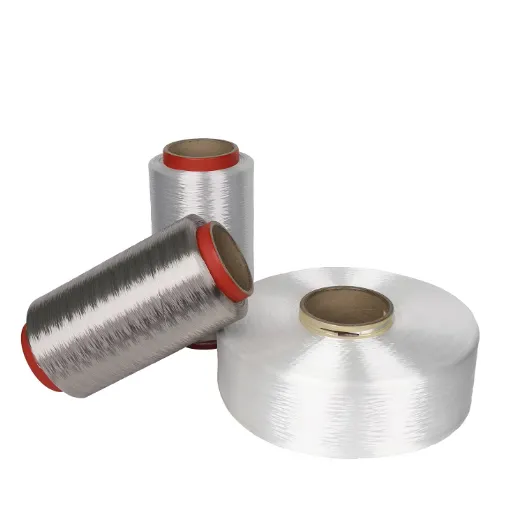
A usable PP yarn specification has eight lines. If a data sheet omits any of them, you can’t compare suppliers on it. The table below is the checklist in the order a mill will answer it.
| # | Line item | What the sheet has to say |
|---|---|---|
| 1 | Polymer and feedstock | PP, and whether virgin, recycled or blended. If recycled, name the source and the feedstock controls. |
| 2 | Construction | Non-fibrillated tape, fibrillated tape, multifilament or monofilament. Not “PP yarn.” |
| 3 | Linear density, in dtex and denier | Oerlikon’s tape winders run up to 4,000 dtex standard and up to 20,000 dtex on the heavy model, so the mill always has the number. |
| 4 | Tenacity, with unit and method | ASTM D2256 or ISO 2062, result in cN/dtex or g/d, method named. |
| 5 | Elongation at break, with method | The line most often missing, and the one that lets a drifting lot through. |
| 6 | Tenacity or fabric strength at 5% strain | Required wherever reinforcement is in scope. Without it you’re specifying a breaking strength and hoping. |
| 7 | Shrinkage, with method | Boiling water or hot air, stated explicitly. |
| 8 | UV package and its ASTM D4355 result | Additive type, loading, and retained strength after a stated exposure. |
One line above the eight matters as much as any of them: the lot-to-lot range. A single certificate proves one lot. Ask for tenacity, elongation and shrinkage ranges across the last several lots, because that range is what your loom will actually receive.
For how those tests fit into a wider quality program, the yarn quality control guide covers the testing structure, and the industrial yarn manufacturing article covers where in the process each property is set.
How to Verify a PP Geotextile Yarn Claim
Every number on a PP yarn data sheet is produced by a test. Knowing which standard covers which claim, and which party holds the result, is how you tell a specification from a slogan. This table stops where the yarn evidence stops.
| Evidence | Standard | What it measures | Who holds the report |
|---|---|---|---|
| Yarn tenacity and elongation | ASTM D2256 / ISO 2062 | Single-strand breaking force and elongation | Yarn mill |
| Yarn creep | Mill creep data; ASTM D5262 for fabric-level creep | Time-dependent strain under sustained load | Yarn mill for yarn data, fabric producer for D5262 |
| Yarn UV resistance | ASTM D4355 | Strength retained after accelerated exposure | Yarn mill for the yarn, fabric producer for the roll |
| Fabric index and mechanical tests | D4595, D4632, D6241, D4491, D4751 | Wide-width tensile, grab, CBR puncture, permittivity, opening size | Fabric producer only |
Why two labs can disagree on the same yarn
ASTM D2256 is the standard most yarn tenacity figures rest on, and its own scope explains a lot of the confusion.
The method covers monofilament, multifilament and spun yarns, single, plied or cabled. It excludes yarns that stretch more than 5.0% between 0.05 and 1.0 cN/tex. And it notes that special clamping adaptations may be necessary with high-modulus yarns made from fibers such as glass or extended chain polyolefin.
Read those two sentences together with a PP tape in mind. A highly drawn tape sits close to the boundary of the method’s applicability. Clamping, gauge length and rate all influence the result, and labs can differ on how they handle a stiff, flat tape.
That’s why the same yarn can arrive with two different tenacity figures, and both reports can be honest.
ISO 2062 has its own conditions: a constant-rate-of-extension tester, a 500 mm gauge length, 0.5 cN/tex pretension, and a target time to break of 20 plus or minus 3 seconds. Those conditions are not identical to D2256’s, and the results are not interchangeable between the two. If you are comparing a D2256 report with an ISO 2062 report, compare the methods before you compare the numbers.
What each document proves
- A technical data sheet states what the supplier intends to supply. It is a promise about a product family, not evidence about your lot.
- A certificate of analysis ties a result to a specific lot. It proves that lot, and only that lot.
- A lot test you commission is the only evidence about the material in front of you.
The yarn-to-fabric boundary
This one is worth stating plainly, because the market blurs it constantly.
Whatever the letterhead says, the yarn layer and the fabric layer are tested separately and owned by different parties. The yarn evidence is single-strand: tenacity and elongation to ASTM D2256 or ISO 2062, plus resin, additive and lot data.
The fabric evidence sits in M288 or EN 13249 territory, tested on the finished roll, including permittivity and apparent opening size, which no strand test can predict. A yarn mill can supply the first. Only the fabric producer can sign off a high tenacity polypropylene geotextile fabric against those standards.
The Mirafi HP665 sheet is a good illustration of the handoff. It reports the yarn as high-tenacity polypropylene monofilament, then reports the fabric against D4595, D4632, D6241, D4491, D4751 and D4355, with permittivity of 0.26 per second and an apparent opening size of 0.425 mm. Two layers of evidence, one document, and the yarn layer is described rather than certified.
That split isn’t a weakness in the supply chain. It tells you who to ask for what.
Frequently Asked Questions
What does “high tenacity yarn” mean?
High tenacity yarn is yarn drawn to a strength well above the ordinary textile range for its polymer. For polypropylene geotextile tape the published benchmark is above 6.7 cN/dtex for non-fibrillated tape and around 6.0 cN/dtex for fibrillated tape. The term carries no certification and means little without a stated test method.
What is PP multifilament yarn?
PP multifilament yarn is a bundle of many continuous polypropylene filaments spun and drawn together into one strand. Unlike tape, which is a flat slit film, multifilament gives a rounder, more flexible yarn that coats more evenly and handles better in fine weaving. Woven geotextiles, geotubes and geobags all draw on it, and so do the lighter woven fabrics where tape would feel too stiff.
Is polypropylene or polyester better for geotextiles?
Neither is better in general. PP resists acids and alkalis well and floats, which suits separation, drainage, waste containment and coastal work. PET has a higher modulus and much better creep behavior under sustained load, which suits reinforcement.
PET is vulnerable to hydrolysis in hot alkaline soil, and PP creeps under sustained load. Choose by the failure mode you can tolerate.
What tenacity should a PP geotextile yarn have?
For non-fibrillated tape, ask for more than 6.7 cN/dtex (about 7.5 g/den) and treat anything below that as ordinary rather than high tenacity. For fibrillated tape, the benchmark sits around 6.0 cN/dtex. For multifilament and monofilament, there is no single public benchmark, so ask the mill for lot data and compare it on a stated method.
Can recycled polypropylene be used in geotextile yarn?
Yes, in many applications, provided the yarn is qualified. Recycled feedstock can change molecular weight, contamination level and additive content, and those shift tenacity, elongation and UV performance. A recycled-content certificate establishes provenance and nothing more. Test the yarn against the same specification you would apply to virgin polymer.
What is polypropylene yarn used for?
Polypropylene yarn goes into anything that needs low weight, chemical resistance or moisture tolerance. In geotextiles it is woven into separation and stabilization fabrics, used in filtration and drainage structures, and formed into geotubes and geobags. Those same properties, low density and resistance to rot, are why it turns up outside geotextiles too, wherever a yarn has to survive moisture and chemicals.
Buying High Tenacity Polypropylene Geotextile Yarn
Hebei Lida Textile Co., LTD supplies yarn from Xingtai in northern China, working with more than 80 textile manufacturing facilities and holding stock across five warehouses. The team has over 15 years in the trade. The product range covers acrylic, blended, silk, polyester, sewing thread, wool and cotton yarns, across apparel, home textiles, medical, industrial, automotive, geotextile and craft applications.
Polypropylene is not one of the seven listed product lines, and this page is not a catalogue entry for it. What the team can do on a PP geotextile yarn enquiry is review the specification against the partner-mill network and say plainly where it cannot match. It can also point to the properties that have to be tested rather than promised. That distinction matters more on a geotextile yarn than on most products, because the failure modes are slow and a certificate is often the only thing a buyer holds before burial.
If you’re specifying a PP geotextile yarn, the useful next step is a specification review rather than a catalogue. Send the fabric construction, the function the geotextile must perform, the target standard and the properties you need met.
Name the linear density, the tenacity with its method, the elongation, the shrinkage method and the UV package. We will tell you what we can match, what we cannot, and what you should verify independently on the lot you receive.
Send your yarn specification for review and include the standard your fabric will be tested against. That single detail shortens the conversation more than any other.