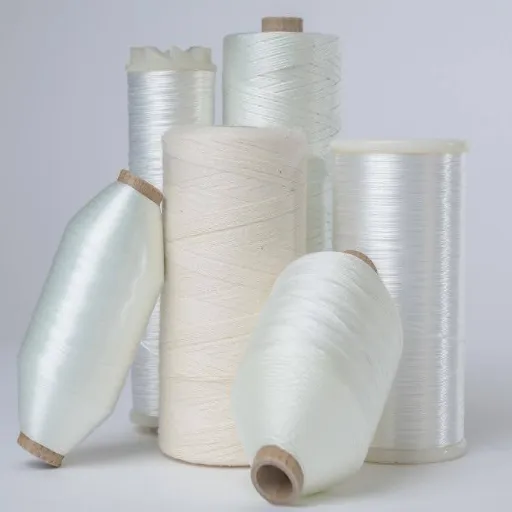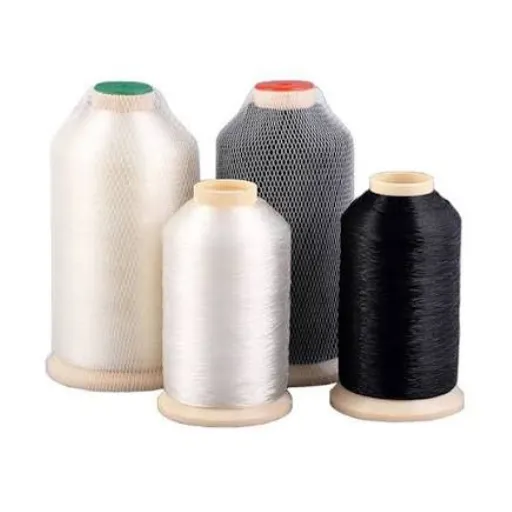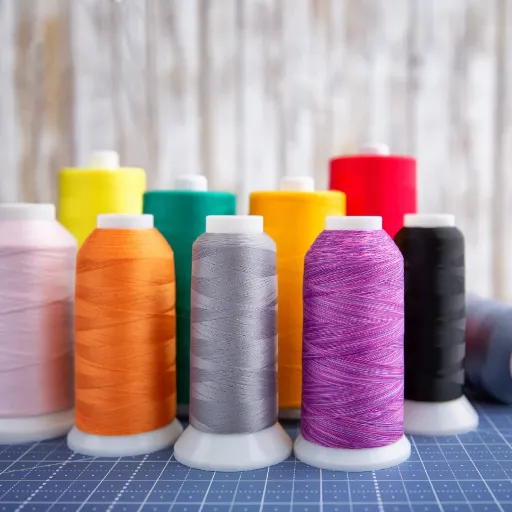
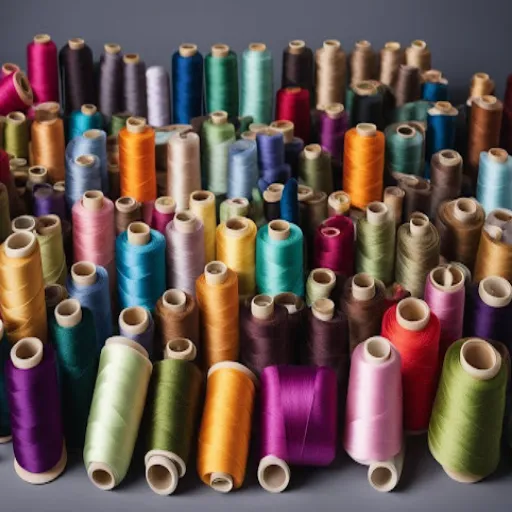
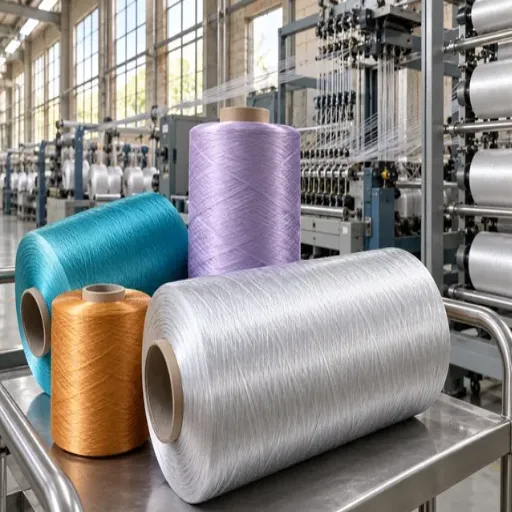
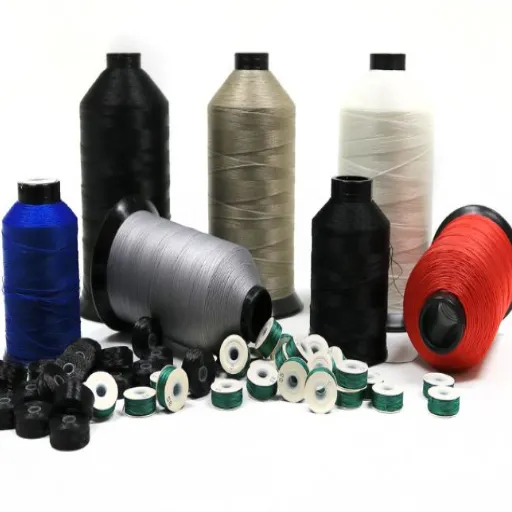
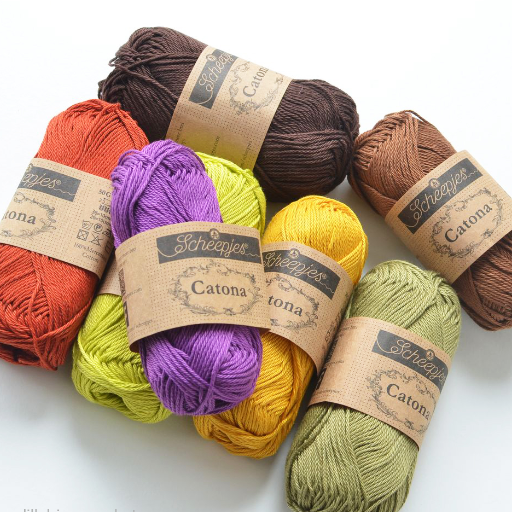

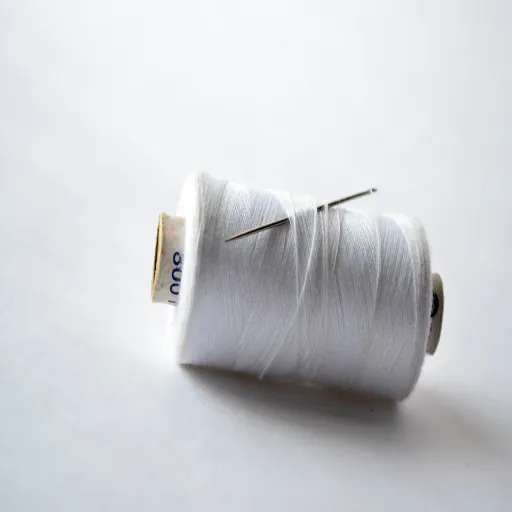


The cotton thread vs polyester thread decision comes down to one trade: polyester wins on strength, stretch, abrasion and moisture resistance; cotton wins on heat tolerance, matte finish and the ability to take dye with the garment. Choose polyester or core-spun for knits, denim, workwear and outdoor seams; choose cotton for quilting, heirloom work, natural-fibre wovens and any garment that will be dyed after sewing.
That short answer is what most buyers need. The expensive cases hide underneath it.
Illustration: A uniform programme specifies a two-ply cotton thread for a poly-cotton work shirt, on the reasonable logic that cotton is softer against skin. The first production run passes.
The second run, washed at 60 °C, comes back with seams puckered along the placket and broken stitches at the cuff. The thread didn’t fail because it was weak. It failed because the fabric and the thread shrank by different amounts, and the seam had no give.
Names and figures in the examples in this article are illustrative.
That is the trap. Most thread decisions are made on a single property, strength, and the seam rarely fails on strength alone. It fails on the interaction between fibre, construction, fabric and finishing.
This guide compares cotton and polyester thread on measured properties, explains what each number means in a seam, and gives you a fabric-by-fabric rule and the language to write a purchase order that cannot be misread. If you already have a spec and want it checked, send it to our thread team and we will compare it against the seam it has to survive.
Key Takeaways
- Cotton spun thread measures 25 to 35 cN/tex tenacity; polyester core-spun measures 40 to 50 and polyester filament 50 to 65. Polyester is stronger, but loop efficiency narrows the seam-level gap.
- Cotton thread loses a larger share of its breaking force during sewing than spun polyester, roughly 12 to 29% against 5 to 15% in one high-speed lockstitch study.
- Moisture regain separates the fibres cleanly: about 8.5% for cotton, 0.4% for polyester. That single number explains rot, mildew, drying time and much of the shrinkage behaviour.
- Cotton tolerates the hottest iron and takes dye with the garment. Polyester melts near 255 °C and keeps its original colour in garment dyeing.
- Core-spun, a filament polyester core inside a spun wrap, is the standard compromise for denim, workwear and knitwear, and it outperforms both in abrasion.
The Short Answer: When Cotton Wins, When Polyester Wins
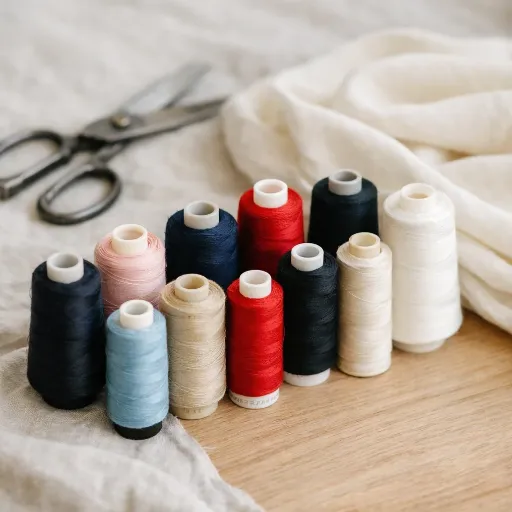
Polyester is the default for any seam that will stretch, rub or get wet. Cotton is the default for any seam that will be ironed hot, dyed after sewing or judged on its matte surface. Core-spun exists because most production seams need some of each.
Simple enough. The detail is where it gets interesting.
Put the rule in three sentences:
- Choose polyester when the fabric stretches, the seam abrades, or the garment is washed often at low temperature. Knitwear, sportswear, workwear, bags, outdoor gear and upholstery all fall here.
- Choose cotton when the fabric is a natural woven, the seam will be pressed hot, or the garment will be dyed after it is sewn. Quilting, heirloom sewing, cotton and linen shirting, and garment-dyed collections fall here.
- Choose core-spun when you need polyester strength with a cotton hand or a cotton-dyeable surface. Denim, twill workwear, and cotton-rich knits are the classic cases.
The rest of this article is the evidence behind those three sentences, plus the cases where the rule bends.
Cotton Thread vs Polyester Thread: The Numbers Side by Side
Thread properties are measured, not debated. The figures below come from published thread testing and from standard fibre data. Ranges reflect construction differences within each fibre.
| Property | Cotton thread | Polyester thread | What it decides |
|---|---|---|---|
| Tenacity (cN/tex) | 25 to 35 (spun) | 40 to 50 (core-spun), 50 to 65 (filament) | Seam strength per unit of thickness |
| Elongation at break | 5 to 10% | 12 to 15% (spun), 15 to 25% (core-spun), 20 to 30% (filament) | Whether the seam can move with the fabric |
| Martindale rubs to destruction | 4,800 | 7,600 (spun), 17,000 (core-spun), 24,000 (filament) | Abrasion life at cuffs, pockets and edges |
| Relative loop strength | 60 to 75% (spun threads score highest) | 60 to 75%, with filament at the low end | How much of the lab strength survives a stitch |
| Moisture regain | 8.5% | 0.4% | Drying, rot, mildew, dimensional stability |
| Melting or char behaviour | Chars and decomposes; does not melt | Softens, then melts near 250 to 260 °C | Ironing and needle heat |
| Shrinkage after finishing | Higher and variable; often 2 to 5% unless pre-shrunk | Under 1% when heat-set | Seam pucker and dimensional mismatch |
| UV and sunlight | Degrades; loses strength faster outdoors | Resists UV better, but not immune | Outdoor and marine seams |
| Rot and mildew | Cellulose, so it supports mildew | Resists both | Damp storage, outdoor use |
| Dyeing after sewing | Takes dye with the garment | Keeps its original colour | Garment-dyed collections |
| Surface and lint | Matte, more lint | Slight sheen, less lint | Appearance and machine cleanliness |
Read the table down, not across. The fibre sets the ceiling and the floor. Construction decides where inside that range a given spool sits. Two polyester threads can sit at opposite ends of it.
The tenacity, elongation and abrasion figures come from AMANN’s published thread testing. Abrasion was measured on a Martindale instrument to DIN EN ISO 12947-2.
AMANN notes there is “no DIN or ISO standard for the abrasion testing of sewing threads”, so its rub counts hold within one lab rather than across brands (AMANN, Abrasion resistance). Moisture regain follows the conventional values in ASTM D1909.
A filament polyester thread and a spun polyester thread share a chemical name and behave like different products. The same is true of grey cotton and mercerized cotton. That’s why a supplier quote that says only “polyester thread” isn’t a specification.
Cotton vs Polyester Thread: Strength, Stretch, and the Seam
Tenacity and Loop Strength
Tenacity is breaking force divided by linear density, the fairest way to compare threads of different thickness. Cotton spun thread sits at roughly 25 to 35 cN/tex. Polyester core-spun reaches 40 to 50, polyester filament 50 to 65 (AMANN, Strength).
On paper, polyester is close to twice as strong per unit of thickness. In a seam, the gap is smaller.
Much smaller.
A stitch is a loop, and a loop concentrates stress at its crown. Threads do not deliver their full tensile strength in loop form. Conventional threads return roughly 60 to 75% of their straight tensile strength as loop strength. Spun threads score higher on that measure than filament threads. Cotton’s loop efficiency partly offsets its lower tenacity, which is why a cotton seam can hold better than a tenacity comparison predicts. Ply structure and twist change that ratio, as our guide to twisting and plying explains.
The practical consequence: don’t select thread on tenacity alone, and don’t assume a stronger thread makes a stronger seam. A thread much stronger than the fabric can tear the fabric at the seam instead of breaking itself. AMANN puts the rule bluntly: higher strength “must match the fabric and application”. On delicate or loosely woven cloth, the gentler thread is the correct engineering choice.
What the Sewing Machine Does to Thread
Thread passes through the needle eye, the fabric, the bobbin case and the tension discs dozens of times per seam. Each pass abrades and flexes it. The thread that enters the machine is stronger than the one that leaves it.
Cotton loses more in the process. In a study of high-speed industrial lockstitch sewing, conventional thread feeding cost cotton 11.69 to 29.45% of its breaking force, against 5.25 to 14.73% for spun polyester. Breaking elongation fell 4.66 to 21.96% for cotton and 0.71 to 12.62% for polyester (Midha et al., 2019). The losses rose with thread size and fabric weight.
Needle heat compounds the problem. At industrial speeds, needle temperatures above 230 °C have been measured with untreated staple polyester thread, which is close enough to the softening range to matter. A cotton-wrapped core-spun protects the polyester core from that heat while keeping a cotton surface, which is one reason the core spun polyester thread dominates denim and workwear.
If a seam is failing at the needle rather than in the wash, the problem is often thread construction, not thread brand. Matching thread to your machine covers the tension and needle side of the same problem.
Stretch and Shrinkage Mismatch
Elongation decides whether a seam can move with its fabric. Cotton breaks at 5 to 10% extension. Spun polyester reaches 12 to 15%, core-spun 15 to 25%, and filament polyester 20 to 30% (AMANN, Elongation and elasticity).
On a knitted fabric, that difference is decisive. A cotton seam on a jersey garment has almost no reserve stretch. The first time the garment is pulled over a head or a hip, the seam takes the load and the thread breaks. Polyester or core-spun gives the stitch somewhere to go.
Shrinkage works the same way in reverse. A thread that shrinks more than its fabric pulls the seam tight and produces pucker. A thread that shrinks less leaves the seam slack and can produce a rippled edge after washing.
Either way, the seam looks wrong and the thread gets blamed.
Heat-set polyester thread is commonly specified under 1% shrinkage; cotton thread commonly runs 2 to 5% unless it has been pre-shrunk. The exact figure depends on finishing, so ask for the boil-shrinkage value, not a generic claim.
Illustration: A knitwear producer approves a cotton thread on a sample that is never washed. In bulk, the garment is washed in production, the thread draws up, and 400 necklines have to be reworked. The thread met every strength requirement on the tech pack.
Heat, Moisture, Sunlight, and Rot
Ironing and Needle Heat
Cotton doesn’t melt. It chars, scorches and eventually decomposes. That makes it the safer thread for seams that see a hot iron, a fusible press or a high-temperature finishing line. Cotton also tolerates the hottest household iron setting without glazing.
That is its strongest single argument in apparel.
Polyester softens below its melting point and melts near 250 to 260 °C. A hot iron can glaze the surface, flatten the stitch or fuse the thread to the fabric. Polyester seams need a lower setting or a pressing cloth, and a production line that irons at cotton temperatures needs to know which thread is in the seam.
Moisture, Mildew, and Outdoor Exposure
Moisture regain is where the two fibres diverge most sharply. Cotton absorbs about 8.5% of its weight in water at standard conditions; polyester absorbs about 0.4% (ASTM D1909 conventional values; GB/T 9994-2018).
That difference has consequences beyond drying time. Cotton is cellulose, and cellulose is food for mildew and rot. A cotton seam stored damp, or used outdoors in a humid climate, can weaken and stain. Polyester resists both.
For awnings, boat covers, outdoor furniture, bags and any seam that stays wet, polyester is the correct default.
Sunlight adds a second pressure. Cotton loses strength under prolonged UV exposure and moisture. Polyester resists UV better, though it is not immune, and UV-stabilised polyester is available for demanding outdoor work. Nylon, often assumed to be the strongest option, degrades faster than polyester in sunlight and is usually the wrong choice for exposed seams.
Mercerized Cotton: What the Treatment Changes
Mercerization is a tensioned caustic-soda treatment that swells the cotton fibre, improves dye uptake and lustre, reduces shrinkage and raises tensile strength. Manufacturer data puts the strength gain at roughly 10 to 30%, with a corresponding loss of abrasion resistance (Gunold COTTY).
Mercerized cotton thread is the better choice for visible seams and for quilting, where its sheen and dye depth matter. It’s still cotton. It still loses to polyester on abrasion and moisture, and it still needs a pre-shrink check before a bulk run.
Colour, Sheen, and Dyeing After Sewing
Cotton takes dye. Polyester resists it. In a garment-dyed collection, that difference is the whole decision.
Nothing else on this page matters as much in that one case.
A cotton thread sewn into a cotton garment will take up the same dye and finish close to the fabric, so the seam reads as part of the garment. A polyester thread in the same garment keeps its original colour, which produces the pale or contrasting stitch line that some brands want and others regard as a defect.
The same logic applies to sheen. Cotton sews matte. Polyester has a slight sheen, more pronounced in filament than in spun.
On a formal cotton shirt or a quilt where the stitching is part of the design, the matte surface is usually the intent. On technical outerwear, the sheen is accepted as part of the product. Put that decision on the tech pack, next to the colour reference, so the sewing room and the buyer work from the same surface.
Lint is the third difference. Cotton sheds more of it, which means more cleaning and a higher risk of contamination in the bobbin area. Polyester sheds less.
Illustration: A garment-dyed capsule collection specifies cotton thread in the topstitching and polyester in the internal seams, so the visible stitching takes the dye while the hidden seams get the strength. The split is common in premium casualwear, and it only works when the purchase order names both threads separately.
Matching Cotton and Polyester Thread to Fabric
Fibre matching is the starting rule: a natural-fibre fabric usually sews well with a natural-fibre thread, and a synthetic fabric with a synthetic one. The exceptions are where the seam, not the fabric, sets the requirement.
| Fabric or application | Thread choice | Why |
|---|---|---|
| Cotton shirting and poplin | Two-ply cotton or poly-cotton core-spun | Cotton for matte finish and garment dyeing; core-spun for strength and low shrinkage |
| Linen | Cotton or core-spun, pre-shrunk | Linen shrinks; the thread must not shrink more |
| Wool suiting | Fine cotton, silk or core-spun | Pressing heat and a soft hand matter more than abrasion |
| Jersey, rib and stretch knit | Polyester or core-spun | The seam must stretch with the fabric |
| Denim and heavy twill | Core-spun, heavy tex | Abrasion resistance plus a cotton-dyeable surface |
| Outdoor, marine and awning | Bonded polyester, UV-stabilised where specified | UV, moisture and rot resistance |
| Upholstery and furniture | Bonded polyester or nylon | Abrasion and seam strength under repeated flexing |
| Quilting, heirloom and antique reproduction | Mercerized cotton | Matte finish, heat tolerance, fibre match |
| Machine embroidery | Polyester filament or viscose | Sheen, colour range and high-speed performance |
| Leather goods and footwear | Bonded nylon or polyester | Abrasion, flex fatigue and heavy tex |
| Garment-dyed collections | Cotton, or cotton-wrapped core-spun | The thread must take dye with the fabric |
| Fusible and high-heat pressing | Cotton | Polyester can glaze or fuse |
Two rules sit above the table. Match the fibre first, then adjust for the seam. If the fabric and the seam disagree, the seam wins, because a broken stitch is a returned garment.
Our sewing thread range covers spun and core-spun constructions in the cotton counts and filament deniers most apparel programmes specify. If you are choosing between two counts, the next section is the one to read before you write the order.
Specifying the Thread on a Purchase Order
Thread specifications fail in one place again and again: the count. “40/2” is not a complete description, and two suppliers can read it differently.
One number. Two products.
Cotton count (Ne) is the number of 840-yard hanks in one pound. It’s an indirect system, so a higher number means a finer single yarn. To convert a single cotton yarn to tex, divide 590.5 by the count. For a plied thread, multiply by the number of plies: 40s/2 is 590.5 ÷ 40 × 2, or 29.5 tex.
That gives the working conversions:
| Thread label | Linear density |
|---|---|
| 40s/2 | 29.5 tex |
| 50s/2 | 23.6 tex |
| 60s/2 | 19.7 tex |
| 40s/3 | 44.3 tex |
| 30s/2 | 39.4 tex |
| 20s/2 | 59.1 tex |
| 20s/3 | 88.6 tex |
Tex is the direct system: grams per 1,000 metres. Denier is grams per 9,000 metres. A 150D/2 polyester thread is 16.7 tex per filament yarn and 33.3 tex as a two-ply.
Ticket number is the awkward one. It’s a commercial label, and the conversion isn’t fixed. Trade formulas commonly treat ticket as roughly 3,000 divided by tex, which puts Ticket 120 near 25 tex. ASTM D3823 defines ticket differently, in bands of tex. Manufacturers also differ on whether the number is calculated before or after twisting. If a ticket number is the only size on the document, ask for the tex value in writing.
A purchase order that cannot be misread names all of the following:
- Fibre and construction (for example, polyester core-spun with a cotton wrap)
- Linear density in tex, plus the ply count
- Finish (mercerized, glazed, bonded, heat-set, lubricated)
- Colour reference and dye-lot tolerance
- Put-up (cone weight, length per cone, core type)
- Any performance requirement (boil shrinkage, tenacity, colourfastness) and the test method
- Certification requirement, with the certificate scope stated
That last line matters more than most buyers expect. A certificate covers a facility and a product scope, not every thread a supplier sells. Ask for the certificate and read what it actually covers.
Testing follows the same discipline. ASTM D204 sets out the standard test methods for sewing threads, including yarn number, strength and elongation, loop and knot strength, twist, shrinkage and colourfastness (ASTM D204). If a supplier cannot tell you which method produced a number, the number is marketing. This guide to yarn quality control covers how the tests are run in practice.
FAQ
Is polyester thread stronger than cotton?
Yes, per unit of thickness. Polyester core-spun measures roughly 40 to 50 cN/tex and filament 50 to 65, against 25 to 35 for cotton spun thread. The seam-level difference is smaller because cotton has better loop efficiency and polyester loses less strength during sewing.
Can I use polyester thread on cotton fabric?
Yes, and it is the industry default for cotton wovens when the seam needs strength or low shrinkage. A standard all-purpose polyester thread like CA02776 is the type usually meant. Use a poly-cotton core-spun if you want a cotton surface, and check the boil shrinkage of both thread and fabric before production. The risk isn’t compatibility. It’s differential shrinkage and a hot iron.
Is cotton or polyester thread better for quilting?
The cotton or polyester thread for quilting question usually comes down to the quilt. Cotton for heirloom quilts, antique reproductions and any quilt that will be pressed hard, because it is matte, heat-tolerant and matches cotton fabric. Polyester for quilts that will be washed often, used by children, or sewn on a longarm at speed, because it is stronger and more abrasion-resistant. Many quilters use both, cotton in the top and a fine polyester in the bobbin.
How can I tell whether a thread is cotton or polyester?
The burn test is the practical method. Cut a short length, hold it with tweezers outdoors, and bring it near a flame. Cotton burns like paper, smells of burning paper, and leaves grey ash. Polyester shrinks away, melts, smells chemical, and leaves a hard black bead. Never test a finished garment, and follow normal fire safety.
Does cotton thread shrink more than polyester?
Yes. Heat-set polyester thread is commonly specified under 1% shrinkage. Cotton thread commonly runs 2 to 5% unless it has been pre-shrunk. Ask for the boil-shrinkage figure and the test condition, because both vary with construction and finishing.
Which is thicker, 40 wt or 50 wt thread?
In the weight system, a lower number is thicker, so 40 wt is heavier than 50 wt. Weight is a length-per-mass measure, similar in logic to cotton count, and it isn’t directly comparable across brands or between natural and synthetic threads. Convert to tex before comparing two products.
The Cotton Thread vs Polyester Thread Decision, in Order
The cotton thread vs polyester thread decision rarely comes down to which fibre is better in the abstract. Start with the fabric.
If it stretches, choose polyester or core-spun. If it is a natural woven that will be pressed hot or dyed after sewing, choose cotton. If it is denim, twill, workwear or a cotton-rich knit, choose core-spun and get the best of both.
Then check the seam. Abrasion, UV and moisture push you toward polyester. Heat, matte finish and garment dyeing push you toward cotton. Where the two conflict, decide which failure is more expensive: a broken stitch or a puckered seam.
Then write the order properly. Fibre, construction, tex, ply, finish, colour and test method, in that order. The thread that arrives will be the thread you specified, and the seam will behave the way the sample did.
If you want a second opinion on the cotton thread vs polyester thread choice before the bulk order, send us the fabric and the seam and we will match the thread to both. For the wider picture, from spun and core-spun to bonded and monofilament, see the complete guide to sewing thread types, or explore our cotton yarn and polyester yarn ranges.