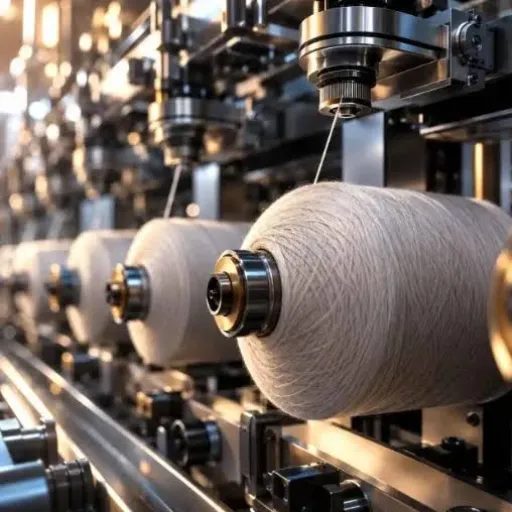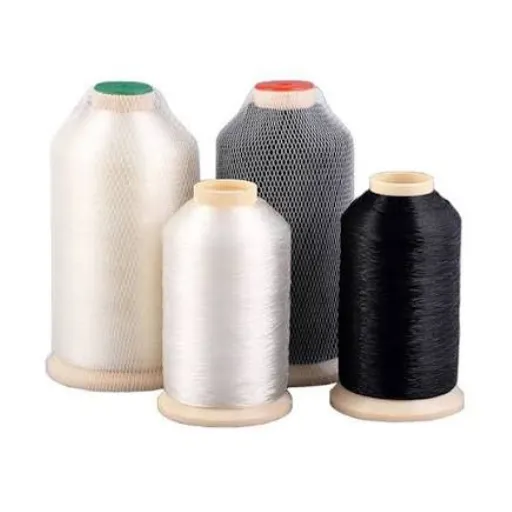
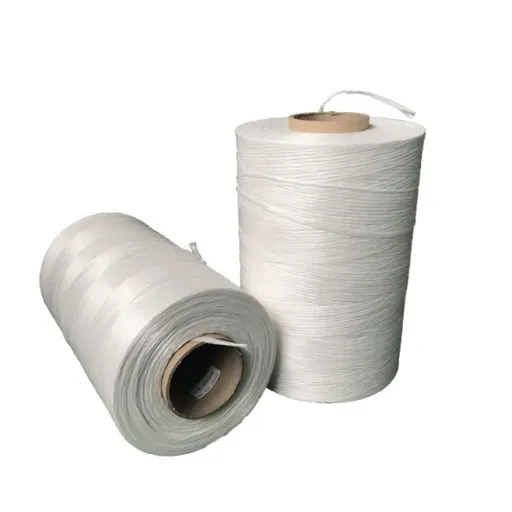





Nylon monofilament industrial yarn is a single extruded polyamide filament, normally PA6 or PA66. It’s defined by five numbers: polymer type, linear density or diameter, tenacity at a named test method, shrinkage after heat setting, and the stabilization package. The word “industrial” describes where the filament goes, not what it is. A listing that stops at “100% nylon 6” hasn’t specified anything yet.
Most listings do stop there. They give a diameter range and a price, then leave the buyer to discover the rest at incoming inspection.
That gap has a cost. A filament can pass every number on the purchase order and still fail on the machine. The number that mattered was never on the order.
This guide covers the five numbers a nylon monofilament specification needs, how to check each one, and which failure each one prevents. It also explains why PA6 and PA66 aren’t interchangeable, and why two labs can report different tenacity for the same yarn. You’ll also see what a UV claim needs before it means anything.
Key Takeaways
- Nylon is two polymers with different behavior. 21 CFR 177.1500 lists nylon 6 and nylon 66 as separate resins with separate specifications.
- Diameter and denier are the same fact in two units: denier = 7068.6 x d squared x density, with d in millimeters.
- Tenacity without a test method is not a specification. Gauge length, conditioning and test speed can move the reported number.
- Shrinkage is set during annealing. If it isn’t written into the order, the downstream oven will set it for you.
- UV performance depends on the stabilization package, and white filament does not automatically outlast natural filament.
What Nylon Monofilament Industrial Yarn Means as a Specification

A usable specification for nylon monofilament industrial yarn answers five questions in writing.
- Which polymer. PA6, PA66, a copolymer, or a modified grade.
- How thick. Nominal linear density in denier or dtex, plus the diameter it corresponds to and the tolerance allowed.
- How strong. Tenacity and elongation at break, each tied to a named test method and a stated conditioning routine.
- How stable. Shrinkage after a defined heat-setting cycle, measured at a stated temperature and time.
- How protected. The stabilization package, and the compliance route if the filament touches food.
Everything else is a preference. Those five are the specification.
If you need the definition of monofilament itself, our guide to what a monofilament yarn is covers the basics. This page assumes you already know, and focuses on the numbers.
Why Nylon Is Two Polymers, Not One
PA6 and PA66 are both polyamides. They aren’t the same material, and regulators don’t treat them as one.
The US food-contact regulation for nylon resins lists both, as separate entries with separate specifications. It covers 16 nylon resin families in total, and each one carries its own limits on specific gravity, melting point, viscosity number and extractable fractions. If you want to see how granular it gets, 21 CFR 177.1500 is the primary text.
That structure reflects a physical reality. The two polymers differ in melting behavior, moisture uptake, dye response and how they age under heat. A supplier who quotes “nylon” without naming the polymer is asking you to accept whichever resin was cheapest that month.
Need a second opinion on a filament spec? Send the polymer, the diameter, the end use and the test methods you plan to accept. We’ll tell you which numbers are underspecified and which ones you should verify in your own lab. Request a specification review.
Here is what happens when the fifth number is missing.
Ravi buys filament for a brush plant. His drawing called for 0.20 mm PA6, and three consecutive lots passed the tenacity check. On the tufting line, about 4% of bristles pulled loose.
The cause wasn’t strength. It was shape: the filament had flattened from round to roughly 1.08 to 1 across lots, and the tufting needle’s grip depended on a round cross-section. Nobody had written a roundness limit into the order, because the drawing only said 0.20 mm.
Names and figures in the examples throughout this article are illustrative. The failure patterns aren’t.
PA6 or PA66: The Choice That Sets Everything Else
For nylon monofilament industrial yarn, the polymer decision comes before the diameter decision, because it changes what the other numbers can be.
Thermal Margin
PA66 holds its properties to a higher temperature than PA6. That’s the main reason buyers ask for it. The trade-off is a narrower processing window. A nylon 66 monofilament needs tighter temperature control through the extruder and the quench, and it punishes a machine that drifts.
If your end product sees sustained heat, PA66 earns its cost. If it sees ambient temperatures and mechanical wear, PA6 usually does the job with more forgiving processing.
Moisture and Dimensional Change
Both polymers absorb moisture. A nylon 6 monofilament absorbs more, and it does so faster.
That matters twice. At extrusion, wet resin produces voids and weak spots. In service, absorbed moisture changes dimensions and mechanical properties.
For a filter mesh with a tight pore tolerance, this isn’t a minor detail. It matters even more when the filament has to hold a dimension in a humid climate. Either way, it belongs in the specification as a conditioning requirement, not as a footnote.
Dyeing and Color
PA6 generally takes dye more readily and gives deeper shades at lower temperatures. PA66 is harder to dye and tends to need more heat or more dye to reach the same depth.
For a natural or solution-dyed filament, this matters less. For a colored product where shade consistency across lots is part of the sale, it matters a lot. Ask how the color is introduced, and whether the answer is masterbatch, solution dyeing or package dyeing. Each behaves differently in UV and in wet service.
When PA66 Is Not the Better Answer
PA66 is often treated as the premium choice. Sometimes it’s the wrong one.
- If the filament will be heat-set at a temperature close to its own softening range, a higher-melting polymer gives you less room, not more.
- If the end product needs suppleness and knot strength, PA6 usually wins.
- If the supply chain is long and the warehouse is humid, PA6’s higher moisture uptake is a real cost that has to be managed in packaging.
The right question isn’t “which is better.” It’s “which failure am I trying to prevent.”
The same question applies to other polymers. If the choice is polyester rather than polyamide, our polyester monofilament guide treats that comparison on its own terms.
Diameter, Denier and Dtex: One Number You Can Check
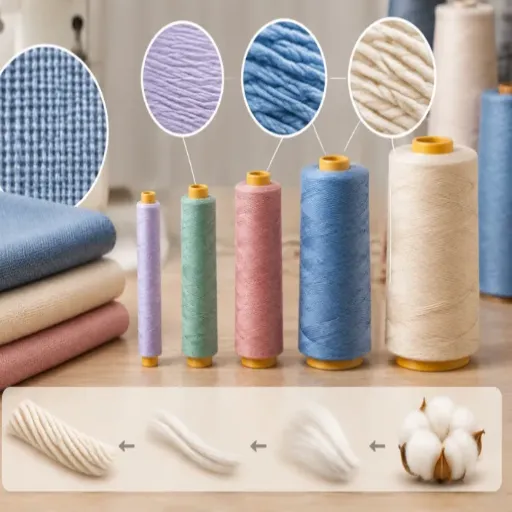
Diameter and linear density describe the same nylon monofilament. Buyers in different industries use different units, which is why so many purchase orders contain two numbers that quietly disagree.
The Conversion Formula
For a round filament, the relationship is fixed by geometry:
denier = 7068.6 x d squared x density
Here d is the diameter in millimeters and density is in grams per cubic centimeter. Denier is the weight in grams of 9,000 meters of filament, so the factor comes from the volume of a 9,000-meter cylinder.
Dtex uses a 10,000-meter basis, so dtex = denier / 0.9.
At a density of about 1.14, which is close for both PA6 and PA66:
| Diameter (mm) | Denier | Dtex |
|---|---|---|
| 0.10 | 81 | 90 |
| 0.15 | 181 | 201 |
| 0.20 | 322 | 358 |
| 0.30 | 725 | 806 |
| 0.50 | 2,015 | 2,238 |
| 1.00 | 8,058 | 8,954 |
Use the actual resin density from the supplier’s datasheet when the tolerance is tight. A 1% error in density moves the answer by 1%. A 1% error in diameter moves it by about 2%, because area scales with the square of diameter.
That asymmetry is the practical point. Diameter is the number to control, and denier is the number to audit.
Why Ovality Matters More Than Mean Diameter
A filament can measure 0.20 mm on average and still be the wrong shape. If the cross-section is elliptical, the mean of two axes can sit exactly on target. The area, however, is smaller than a round filament of the same nominal size.
Downstream, that shows up in three places:
- Pore size in woven mesh, where the opening depends on the filament’s actual footprint.
- Grip in tufting, brushing and winding, where contact depends on curvature.
- Coverage in weaving, where flattened filament packs differently.
So the spec needs two lines, not one: nominal diameter with a tolerance, and a maximum ovality ratio. A roundness figure of 1.05 to 1 means the long axis is at most 5% longer than the short axis. It’s easy to measure and easy to argue about, which is exactly what you want in an inspection clause.
For a woven product, the mesh construction matters as much as the filament. Our guide to woven monofilament mesh covers how thread diameter sets opening size.
Tenacity and Elongation: Why the Datasheet Number Is Not Comparable
Tenacity is breaking force divided by linear density. The phrase high tenacity nylon yarn gets used loosely in listings. The number behind it is often quoted without the context that makes it meaningful.
The Three Things That Change the Result
Two labs can measure the same yarn and report different tenacity. That isn’t fraud. It’s method.
- Gauge length. A longer sample has more opportunity to contain a weak point, so it usually breaks at a lower force per unit length.
- Conditioning. Polyamide takes up moisture from the air. A sample tested dry and a sample conditioned in a standard atmosphere aren’t the same specimen.
- Test speed. A faster test gives a higher apparent strength in many polymers, because the material has less time to relax.
A tenacity figure is therefore a tuple, not a number: value, method, gauge length, conditioning, speed. If the datasheet gives only the value, you have a marketing claim, not a specification.
The standard most buyers name is ISO 2062, which covers single-end breaking force and elongation at break using a constant rate of extension tester. Naming the standard is a start. Naming the gauge length and the conditioning routine is what closes the gap. If you’re building an acceptance routine around it, our guide to yarn quality control and testing standards covers sampling, records and how to compare two labs.
A Worked Example
Take a 0.20 mm filament at 322 denier, which is 358 dtex. Suppose it breaks at 25 newtons.
- Convert force: 25 N = 2,500 cN.
- Divide by linear density: 2,500 / 358 = 7.0 cN/dtex.
- Convert to the older unit: 1 g/den = 0.883 cN/dtex, so 7.0 / 0.883 = about 7.9 g/den.
Now suppose a second supplier reports 8.5 g/den for the same nominal product. Before you switch, ask for the gauge length and the conditioning. The difference may be real, or it may be a shorter sample tested dry.
Elongation matters just as much, and it’s the number buyers forget. A filament with high tenacity and low elongation is brittle in handling. A filament with high elongation and moderate tenacity absorbs shock and survives a bad feed path. Write both, and write the acceptance range for both.
| What a listing gives | What the order should give |
|---|---|
| “High tenacity” | Minimum tenacity in cN/dtex, test method, gauge length, conditioning |
| “Good elongation” | Elongation at break with a minimum and a maximum |
| “0.20 mm” | Nominal diameter, tolerance, maximum ovality |
| “Nylon 6” | Polymer, viscosity number or grade reference, resin supplier |
| “UV stabilized” | Stabilizer class, loading, and a retention figure at stated exposure hours |
The right-hand column is the minimum an industrial nylon monofilament yarn buyer should accept.
Heat Setting and Shrinkage in Nylon Monofilament Industrial Yarn
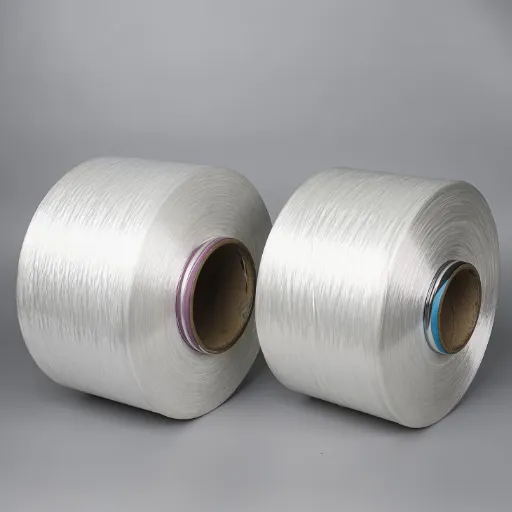
A drawn filament carries internal stress. Heat setting relaxes it and fixes the length the filament will try to return to.
What Annealing Does
The LOTTE Chemical monofilament guide describes the line as five stages: extrusion, cooling, drawing, annealing and winding. Drawing is what develops strength. Annealing is what makes the result stable.
Without it, a rapidly quenched filament shrinks quickly or unevenly as it crystallizes. LyondellBasell’s process description puts the same point more simply: the filament is annealed to minimize internal tension before it is wound.
That’s why shrinkage is a process fingerprint, not a material constant. Two suppliers using the same resin can deliver different shrinkage because they annealed at different temperatures or under different tension.
The Shrinkage Test You Should Specify
Shrinkage is easy to measure and rarely specified. The method is simple. Condition a known length, measure it, expose it to a stated temperature for a stated time, then dry and measure again. Report the change as a percentage.
The number is meaningless without the conditions. Boiling water for 30 minutes and dry heat at 150 °C for 5 minutes produce different answers on the same filament. So the order needs three things: the medium, the temperature, and the time.
Ask for shrinkage in the condition closest to your actual process. If your filament goes into a dye bath, specify boiling-water shrinkage. If it goes through a coating oven, specify dry-heat shrinkage at the oven temperature.
Watch the line run. This short video shows general monofilament extrusion, not nylon specifically. It’s useful for seeing how quenching, drawing and winding sit in sequence. The polymer in the footage isn’t identified, so treat it as a process overview rather than a nylon reference.
Elena runs extrusion for a trimmer-line plant. Her product passed every mechanical test at dispatch. Six weeks later, cartons stored in a humid warehouse showed cracking along the filament.
The cause wasn’t sunlight. It was moisture uptake combined with residual stress that the annealing cycle had not relieved. The fix was three changes: drier resin, a longer annealing dwell, and a humidity barrier in the carton. The specification change was one line: retained elongation after humid aging.
UV and Hydrolysis: The Two Ways Nylon Monofilament Fails Outdoors
Outdoor failures rarely come from one cause. In polyamide they usually come from light, moisture, or both.
What the UV Data Shows
A 1988 study on nylon netting twines gives a useful calibration. The authors found that about 200 hours in a fade meter was roughly equivalent to one year of outdoor exposure. Breaking strength and elongation both fell as irradiation continued.
The same study found that multifilament degraded faster than monofilament under the same exposure. That’s a point in favor of monofilament in outdoor applications, though it doesn’t make monofilament immune.
A more recent polyamide monofilament patent adds a result that surprises most buyers. In a 26-day test, a nylon 610 monofilament with conventional titanium dioxide lost 45% of its break load. A variant with a finer, higher-loading titanium dioxide lost 25%. And white or opaque filaments lost more strength than natural or translucent ones, despite transmitting less light.
The lesson isn’t “buy white” or “avoid white.” It’s that appearance tells you nothing about stabilization. The package does.
When a supplier says “UV stabilized,” ask three questions:
- Which stabilizer class: absorber, quencher, capturer or photo-shield?
- At what loading?
- What retained strength, after how many hours, in which test?
If the answer is a shrug, the claim is decoration.
Hydrolysis Is a Moisture Problem
Polyamide reacts with water, and heat accelerates the reaction. That’s why humid storage, steam exposure and hot wet service shorten filament life more than dry heat alone.
The practical controls are unglamorous: dry resin before extrusion, moisture-barrier packaging, and a retained-property test after humid aging. None of them appear on a price list. All of them show up in a failure report.
Food Contact and Compliance: The Grade Is Approved, Not the Material
“Nylon is FDA approved” is a sentence that should make a buyer ask for the resin grade.
The regulation doesn’t approve a material family. It lists specific resins, each with its own manufacturing route, its own specification limits, and its own permitted conditions of use. For nylon 66, for example, the extractable fraction is limited to 1.5% in water and 0.2% in ethyl acetate. Other grades carry temperature ceilings and restrictions by food type.
Compliance therefore has three parts:
- The resin is a listed grade under 21 CFR 177.1500.
- It meets the extractive limits for that grade.
- The finished article is used within the food types and conditions the regulation allows, which are keyed to 21 CFR 176.170.
A converter who buys “food grade nylon monofilament” without a resin declaration is trusting a label. A specification should require the declaration, the regulation reference and the extractives data. It should also name who holds the compliance statement for the finished article.
Tom learned this on a conveyor mesh project. His supplier confirmed the filament was “FDA approved.”
The resin was a listed grade, but the intended use, a fatty food at elevated temperature, sat outside the conditions the entry allowed. The project moved to a different grade and added a resin declaration to the purchase order. The delay cost six weeks. The lesson cost nothing after that. Contact Hebei Lida Textile Co., LTD for yarn solutions tailored to industrial applications.
Matching Nylon Monofilament Industrial Yarn to the End Use
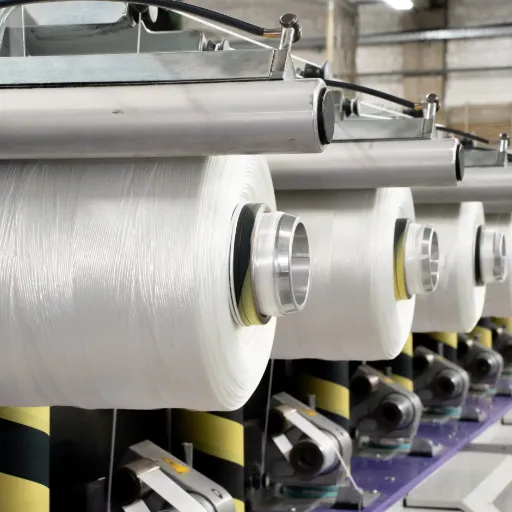
The same polymer can be specified four different ways depending on what the filament has to survive. A technical nylon monofilament yarn for a filter is a different document. So is a textile grade nylon monofilament for a weaving mill. Both may start from the same resin.
| End use | First priority | Second priority | Number most often left off the order |
|---|---|---|---|
| Trimmer line | Impact toughness | Diameter tolerance | Ovality limit |
| Brush bristles | Straightness | Abrasion resistance | Roundness ratio |
| Filter mesh | Diameter tolerance | Retained strength after hot wet aging | Food-contact declaration |
| Woven industrial fabric | Ovality | Shrinkage | Heat-set temperature and time |
Trimmer Line and Brush Bristles
Both need toughness and abrasion resistance more than raw tensile strength. Both benefit from PA6 for suppleness, or PA66 where stiffness and heat resistance matter. Both are exposed to sunlight in storage and use, so the UV package is not optional. A PA6 monofilament yarn is often the starting point when the line has to stay supple.
For bristles, add straightness and ovality to the order. A bristle that curves will not tuft reliably, no matter how strong it is. For trimmer line, add impact resistance and a diameter tolerance tight enough to hold in the head.
Filter Mesh and Woven Industrial Fabric
Here the filament diameter is a geometric input, not a strength number. In a nylon monofilament mesh, opening size depends on thread diameter and weave, so diameter tolerance and ovality translate directly into pore-size variation.
Food and beverage filtration adds the compliance layer. Hot-water service adds hydrolysis to the list. If the mesh runs at temperature, ask for retained strength after hot wet aging, not just room-temperature tenacity.
Why Fishing Line Is a Different Specification
Fishing line is the application most people picture when they hear “nylon monofilament,” and it’s a poor reference for industrial yarn.
Fishing line is optimized for knot strength, suppleness, transparency and controlled stretch. Industrial monofilament is optimized for dimensional consistency, heat stability and retained strength in a process. A line that makes an excellent fishing line can be a poor filter filament, and the reverse is also true.
If your application is textile or industrial, judge the offer on the five numbers, not on the fishing aisle.
A Six-Point Acceptance Checklist for Nylon Monofilament Industrial Yarn
Use this list before approving a first lot of nylon monofilament industrial yarn. Each line exists because its absence causes a specific failure.
- Resin identity and grade. Polymer, viscosity number or grade reference, resin supplier and lot. Without it, you can’t reproduce the result.
- Linear density and diameter. Nominal value, unit, tolerance and the density used to convert between them.
- Ovality limit. A maximum ratio, measured the same way by both parties.
- Tenacity and elongation. Values, acceptance ranges, test method, gauge length, conditioning and test speed.
- Shrinkage. Medium, temperature, time and maximum percentage.
- Stabilization and compliance. Stabilizer class and loading, retained-strength data, and the food-contact declaration if applicable.
Add a seventh line for packaging if the filament will travel or sit. Name the moisture barrier, the reel type, and the maximum storage time before the retained-property data expires.
If you’re sourcing through a trading company rather than a mill, ask the same six questions of any nylon monofilament yarn supplier. The synthetic monofilament supplier guide covers the questions that separate a converter from a reseller. The industrial yarn manufacturing overview explains how those answers map to the production line.
Frequently Asked Questions
Is nylon monofilament the same as nylon yarn?
No. Nylon is the polymer. Monofilament is a construction: one continuous filament.
Nylon yarn can be monofilament, multifilament or spun from staple fiber, and nylon monofilament thread is the same single-filament construction at a much finer diameter. The distinction matters because the same polymer behaves differently in each construction.
Is nylon monofilament or multifilament?
It’s monofilament by definition. A multifilament nylon yarn contains many fine filaments grouped together, which gives a softer hand and faster UV degradation in the study cited above. If a supplier offers “nylon monofilament multifilament,” ask which one they mean.
What denier is a 0.20 mm nylon monofilament?
At a density of about 1.14, it is roughly 322 denier, or 358 dtex. Use the resin’s actual density for a tight tolerance, and remember that a 1% diameter error changes the answer by about 2%.
What tenacity should industrial nylon monofilament yarn have?
There’s no single answer, because tenacity depends on polymer, draw ratio and test method. A specification should state a minimum in cN/dtex with the method and conditioning attached. A filament at 358 dtex breaking at 25 N gives 7.0 cN/dtex, which is a useful reference point, not an industry standard.
Does nylon monofilament degrade in sunlight?
Yes. UV exposure reduces breaking strength and elongation, and the rate depends on the stabilization package. In the 1988 study, about 200 hours in a fade meter was roughly equivalent to a year outdoors. Ask for a retained-strength figure, not a yes or no.
Is nylon monofilament food safe?
Only if the specific resin grade is listed for food contact and the finished article stays within the permitted conditions. 21 CFR 177.1500 lists the grades and their limits. A general statement that “nylon is food safe” isn’t enough for a compliance file.
Conclusion
Nylon monofilament industrial yarn is a specification before it is a product. The polymer choice sets the thermal and moisture behavior. The diameter and ovality set the geometry. An industrial monofilament yarn is bought against a drawing, not a description.
The tenacity and elongation set the mechanical performance, but only when the test method travels with them. Shrinkage and stabilization decide whether the filament survives the process and the weather.
Get those five numbers into the purchase order, and most of the arguments disappear before the first container ships.
Hebei Lida Textile supplies seven published yarn lines. Nylon monofilament isn’t one of them, so we won’t quote it as a catalogue item. What we can do is review a specification against the end use and tell you which numbers are missing. When the fit is right, we’ll connect you with a partner mill.
Send us the drawing. Include the polymer, diameter, end use and the test methods you plan to accept. We’ll reply with the gaps we see and the tests we would run first. Start a specification review.