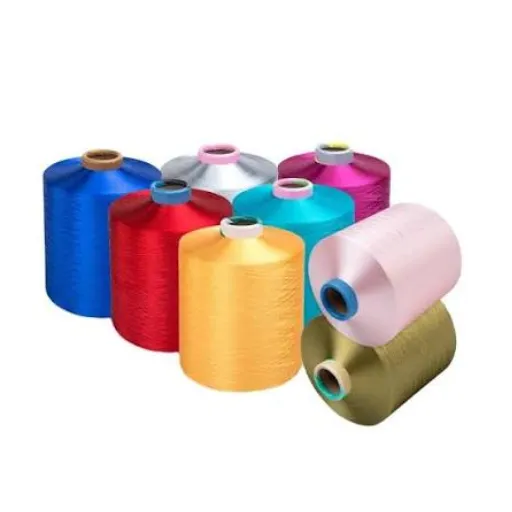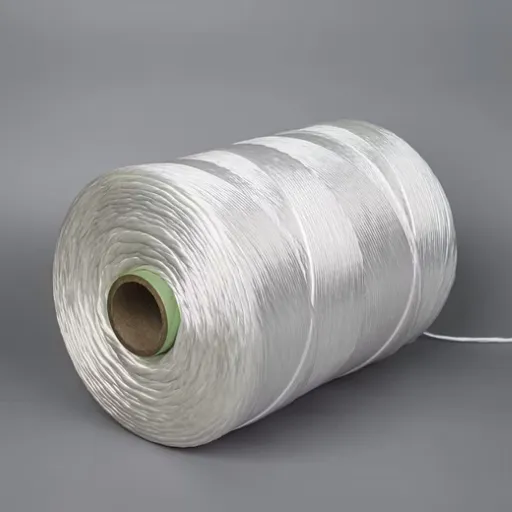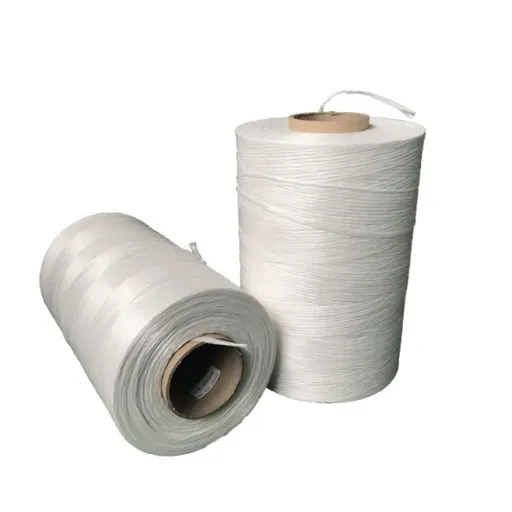

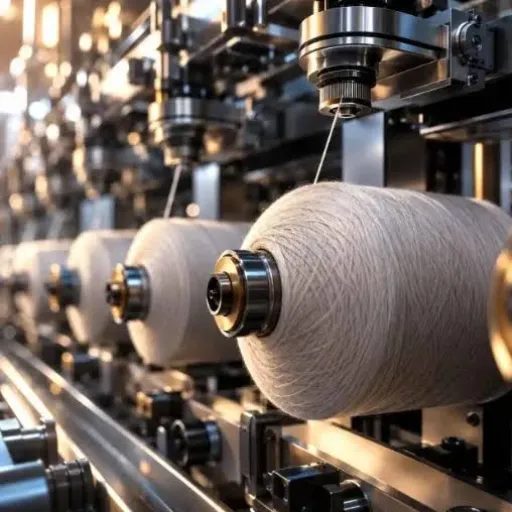
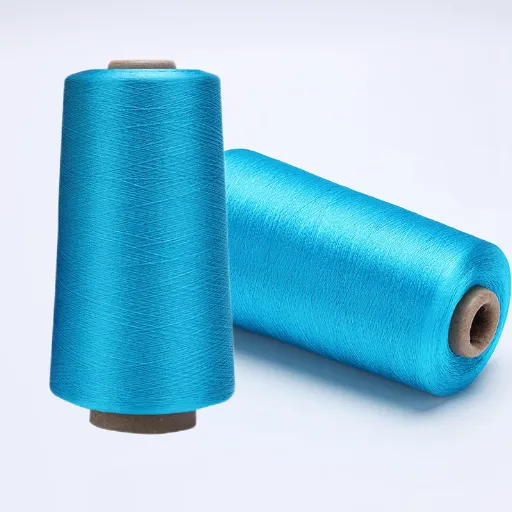



Industrial yarn for V-belts and hoses is a reinforcing material, not a cover material. V-belts use a load-carrying cord, usually high-tenacity or HMLS polyester and sometimes aramid or nylon. Hoses use a braided or spiral textile layer, usually polyester, nylon, aramid or a blend. The fiber name is only the start; the dtex, ply, twist, creep, dip and adhesion decide whether the part survives.
In one illustrative case, a belt converter in Pune qualified a cord on breaking strength alone. The belt passed the bench pull test.
After run-in on a small pulley, the belt had grown and the drive would not hold tension. The cord was strong enough. Its creep had never been specified.
This guide explains what industrial yarn for V-belts and hoses has to do, how the two products differ, and which numbers belong on the order. It is written for buyers who have to defend a specification, not for a catalog.
Key Takeaways
- The cord carries the load in a V-belt; the rubber protects it and transfers force. In a hose, the braid or spiral carries pressure and the rubber seals it.
- V-belts usually specify HMLS polyester for dimensional stability. Hoses often specify HT polyester, nylon, aramid or a hybrid, depending on pressure, heat and flex.
- Polyester bonds poorly to rubber without an activation layer. Adhesive-activated yarn allows a single RFL dip; non-activated yarn needs an isocyanate or epoxy pre-dip first.
- Adhesion after cure and aging decides more orders than tenacity. A dry, new-sample adhesion figure is not a service specification.
- ISO 4079 limits textile-reinforced hydraulic hose to +70 °C for water-based fluids. That is a hydrolysis limit, not a marketing number.
Need the cord specification in writing? Send the belt profile or hose standard, the rubber compound and the service temperature. We will confirm the property, the test method and the dtex band we can match. Ask for a specification review.
What Industrial Yarn for V-Belts and Hoses Has to Do
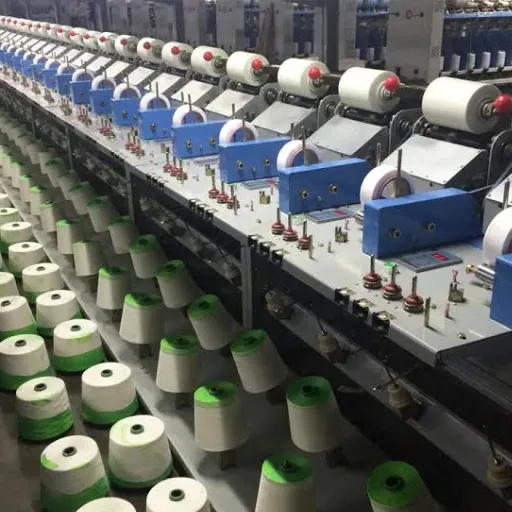
The yarn carries load with as little stretch as the product can tolerate, and keeps that load through heat, flex and moisture. The rubber protects the yarn. The dip bonds the two so they act as one composite.
Buyers purchase the material in three forms: greige yarn for further processing, twisted cord ready for dipping, or dipped cord ready for the belt winder or braider. The same 1,100 dtex industrial filament yarn can be sold in all three. The properties that matter change with the form.
| Requirement | V-belt | Hose |
|---|---|---|
| Primary load | Tensile load around the pulleys | Hoop stress from internal pressure |
| Cyclic stress | Bending over the pulley diameter | Pressure impulse and flex |
| Heat source | Flex heat and the ambient environment | The fluid, plus ambient heat |
| Moisture | Humidity, washdown, coolant mist | The fluid, steam, or water-based hydraulic fluid |
| Governing property | Cord modulus, shrinkage and adhesion after aging | Braid strength, elongation, adhesion and hydrolysis |
| Typical failure | Cord pull-out, belt growth, splice separation | Burst, braid separation, cover blister |
A belt designer worries about length. If the cord creeps or shrinks, the belt no longer tracks the pulley and the drive loses tension.
A hose designer worries about expansion and burst. If the braid extends too far under pressure, the hose swells, the coupling pulls, and impulse life falls. That’s why a yarn that performs well in one product can fail in the other.
The cord also doesn’t work alone. In a V-belt it sits near the pitch line, where bending strain is lowest, and the rubber above and below transfers the load. In a hose the braid sits between the tube and the cover. If the bond fails, the strongest yarn in the world cannot save the part.
V-Belt Cords: The Belt Type Decides the Yarn
A V-belt is a rubber composite with a tensile cord, a compression section and, in most designs, a fabric jacket or a molded cog profile. The belt type decides how much load the cord sees and how hot it runs.
Wrapped, raw-edge and cogged belts
Wrapped V-belts have a fabric jacket bonded to the sides and base. The jacket protects the rubber and improves pulley grip. Classical profiles such as A, B, C and D are commonly wrapped.
Raw-edge V-belts have no side jacket; the sides are cut or ground to profile, and the belt may carry molded cogs. They flex more easily, run cooler and tolerate smaller pulleys, which is why they dominate automotive drives.
Cogged belts are a subset of raw-edge construction: the cogs reduce bending stiffness and help heat escape.
Classical V-belt lengths and pulley grooves are standardized in ISO 4184 and ISO 4183, so the belt profile comes before the cord choice. Antistatic belt requirements are covered by ISO 1813.
The belt type changes the cord specification. A raw-edge belt has no jacket to protect the cord at the cut edge, so adhesion and cord stiffness matter more. A cogged belt runs cooler but flexes more often, so fatigue matters more. A wrapped belt runs hotter but protects the cord better, so dimensional stability and adhesion dominate.
Some buyers ask for V-belt cord fabric. V-belts usually use individual dipped cords, not a woven fabric. Polyester cord fabric and tire cord fabric are woven sheets of cord, usually dipped, and are more common in conveyor belts and some hose carcasses.
If a supplier quotes V-belt cord fabric for a classical V-belt, ask which construction the belt uses. If your construction uses fabric, specify fabric weight, cord count, dip and adhesion separately.
HMLS polyester, aramid or nylon
Most V-belt cords are polyester. The common grade is HMLS, high modulus, low shrinkage. HMLS polyester yarn gives up a little tenacity compared with standard high-tenacity polyester yarn, and gains lower shrinkage and better dimensional stability. That trade is usually worth it, because belt length and tension depend on the cord.
Aramid is the upgrade for high load, small pulleys and shock. It carries more power in the same profile, but it changes length as it absorbs moisture and has a negative thermal coefficient, so tension can drop as the drive cools. Gates makes both points in its comparison of tensile members.
Nylon stretches more but tolerates fatigue and impact better. Rayon and glass appear in niche designs.
The cord line sits near the pitch line. When the belt bends, the outside stretches and the inside compresses; the pitch line is the neutral surface where neither happens. Placing the cord there keeps bending strain low and reduces bending fatigue. A thicker cord carries more load but needs a thicker belt and a larger minimum pulley, so the cord cannot be specified apart from the belt design.
Cord constructions are written as two numbers, for example 2×3 or 5×3. The two numbers describe the plies and the yarns per ply; their product is the number of base yarns. A 3×3 cord contains nine 1,100 dtex yarns, or about 9,900 dtex before twist and dip.
The table below uses one supplier’s HMLS semi-stiff cord as an example. It isn’t an industry standard.
| Cord (1,100 dtex yarn) | Breaking strength | Elongation at break | Hot-air shrinkage, 150 °C × 3 min | Adhesion to NR |
|---|---|---|---|---|
| 2×3 | ≥420 N | 9.5 ± 1.5% | 2.8 ± 0.5% | ≥240 N/cm |
| 5×3 | ≥1,020 N | 10.0 ± 1.5% | 2.6 ± 0.5% | ≥320 N/cm |
| 12×3 | ≥2,400 N | 10.0 ± 2.0% | 2.5 ± 0.6% | ≥480 N/cm |
Source: Weifang Kelida HMLS semi-stiff dipped cord, accessed 2026-11-16. Values are for one supplier’s construction and natural rubber (NR) compound.
Breaking strength rises roughly with the yarn count, but not exactly, because twist and dip change the efficiency. Elongation stays near 10% because the cord is designed for dimensional stability. None of these numbers tells you whether the cord will survive the belt. That needs a belt fatigue test and an adhesion test after aging.
Related: The industrial polyester yarn applications guide covers the other end uses, from tire cord to webbing.
Hose Reinforcement: Braid, Spiral and Fiber Choice
A textile-reinforced hose has three layers: a tube that carries the fluid, a reinforcement that carries the pressure, and a cover that protects the reinforcement. The reinforcement can be braided, spiral-wound or knitted. Braid is the most common construction for low and medium pressure. Spiral is used for higher pressure.
Hose reinforcement yarn is supplied on cones or cheeses, and the package size for hose braiding yarn has to match the braider. A yarn with the right tensile number but the wrong package or splice frequency will stop the line.
Barcelona Performance Yarns lists hose and belt yarns from 1,100 to 3,300 dtex, with twist from 60 to 400 tpm in S or Z. The range is wide; one dtex is not a specification.
Braid angle and the neutral angle
A braid is a set of yarns wound helically around the tube in alternating directions. At about 54°44′, usually rounded to 54.7°, the braid is in equilibrium: internal pressure produces hoop and axial stress in the proportions the yarn can carry with balanced strain. Engineers call this the neutral angle.
Below the neutral angle, pressure makes the hose grow in diameter and shorten. Above it, pressure makes the hose shrink in diameter and grow. Commercial hoses run roughly 40° to 60°, and often 47° to 60°, because the design also has to satisfy burst, expansion, bend radius and coupling grip. The angle is a hose design variable, not a yarn property.
| Fiber | Strength and elongation | Heat | Hydrolysis | Best fit | Watch out |
|---|---|---|---|---|---|
| Polyester (PET) | High strength, 10-19% elongation | Moderate; depends on compound and fluid | Susceptible in hot water and steam | Hydraulic and industrial hose below the stated limit | Strength loss in hot wet service |
| Nylon (PA) | Lower modulus, 13-27% elongation | Moderate | Susceptible; moisture regain changes dimensions | Pulse hose, low-pressure hose, flex duty | Higher expansion, length change |
| Aramid | Highest strength, low elongation (about 3-4%) | High | Can lose strength in hot, humid or chemical service | High-pressure hose, small bend radius | Cost, chemical compatibility |
| Hybrid | Tuned elongation and modulus | Depends on the blend | Depends on the fibers | Controlled-expansion hose, impulse duty | More complex specification |
The nylon and polyester ranges come from a Gates patent on controlled-expansion hose; the aramid range is typical of para-aramid datasheets. Nylon’s higher elongation can raise volumetric expansion under pressure, which is one reason hybrid constructions exist.
In that patent, a nylon-only braid lasted about 258,000 impulse cycles. A polyester-only braid lasted about 505,000. A hybrid with one nylon layer and one polyester layer lasted about 1.88 million cycles at 15.5 MPa and 135 °C under SAE J343.
The hybrid won because the two elongation curves complemented each other: nylon carried strain and polyester controlled expansion.
That’s one patent’s test data, not a guarantee for every hose. It shows why “which fiber is best” is the wrong question. The right question is which combination meets the hose’s expansion, burst and impulse targets.
Consider a hose maker moving a water-based hydraulic hose from polyester to a nylon/polyester hybrid to control expansion. The hybrid passed burst and impulse on the bench.
In the field, the hose grew in a different pattern and the coupling pulled. The braid angle and coupling had been set for polyester.
The lesson is not that the hybrid failed. It is that a fiber swap changes the whole construction, and the braid angle, coupling and test plan have to be re-qualified together.
Braid is flexible and economical. Spiral uses more yarn and a controlled angle for higher pressure, but it is stiffer and more expensive. Wire is used where pressure or temperature exceeds what textile can handle. Textile reinforcement is lighter, doesn’t corrode and can be non-conductive, which is why textile-reinforced hydraulic hose has its own standard, ISO 4079.
Toray’s Hybrid Cord page shows how a cord maker combines first and second twist, fiber choice and dip heat-setting for belt and hose reinforcement.
How to Specify Industrial Yarn for V-Belts and Hoses
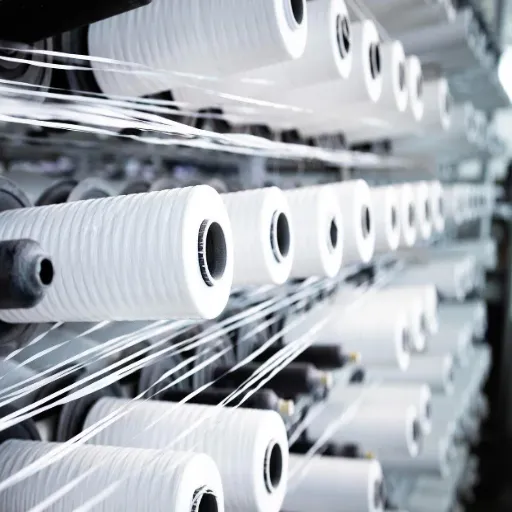
The specification starts with the finished product, not the yarn. A buyer who starts with “I need 1,100 dtex polyester” has skipped the decision that matters. The product standard tells you the load, temperature, fluid and test. The yarn specification follows.
dtex is the mass in grams of 10,000 meters of yarn. A 1,100 dtex yarn weighs 1,100 grams per 10,000 meters. Denier is the mass per 9,000 meters, so 1,100 dtex is about 990 denier.
Ply is the number of yarns twisted together. A cord is made by twisting plied yarns together, usually in the opposite direction, which balances it and keeps it from curling.
Twist, measured in turns per meter (tpm), changes strength, elongation, fatigue and adhesion. More twist gives a more compact cord and better fatigue, but reduces strength efficiency. Less twist gives higher strength but a stiffer, more open cord.
A datasheet can give breaking strength, elongation, shrinkage and adhesion. It can’t tell you whether the cord will survive the minimum pulley diameter, hold adhesion after your cure, or hydrolyze in your fluid. Those need application tests. The datasheet narrows the field; it doesn’t qualify the cord.
Package size, splice-free length and lot traceability matter too. A cord with the right tensile number but a splice every 500 meters will stop a braider or a belt winder. If you are developing a new compound, the custom yarn for industrial use guide explains how sampling and finish changes are handled before bulk production.
Adhesion and Dipping: The Step Buyers Underestimate
Adhesion is the bond between cord and rubber. It turns a bundle of filaments into a composite, and it is the property most often specified badly, because a dry, new-sample test predicts little about service.
Polyester is chemically inert compared with nylon. Its surface has few reactive groups, and it is hydrophobic. A standard resorcinol-formaldehyde latex dip, known as RFL, bonds nylon and rayon well. On untreated polyester, RFL alone gives poor adhesion.
The commercial answer is a two-stage treatment: a blocked isocyanate, an epoxy, or both, followed by RFL. The first layer reacts with the polyester and with the RFL, creating a chemical bridge.
Adhesive-activated (AA) polyester yarn carries the activation chemistry in the finish or in a first treatment at the yarn maker, so the processor can apply a single RFL dip.
Non-activated yarn needs the isocyanate or epoxy pre-dip first. AA is easier to process. Non-activated yarn gives more freedom to tune the dip to the rubber compound. Know which one you are buying.
Ask five questions:
- Is the yarn AA or non-activated?
- What is the dip system: RFL only, RFL plus CR, or RFL plus EPDM?
- What is the pickup, and how is it measured?
- What cure does the dip require?
- Which adhesion test, compound and aging condition will be used?
Adhesion values are not comparable across methods. An H-test result is a force to pull one cord from a rubber block, in newtons. A strip peel result is a force per unit width, in newtons per centimeter. Compound, cure, cord construction and test speed also change the result.
ASTM D4776, the H-test, is the common method for textile cords in rubber. Its own precision note recommends comparative testing between buyer and supplier before acceptance.
A certificate red flag: If a supplier cites ASTM D4393 as the current peel method, ask for the date. D4393 was withdrawn in 2014 with no replacement. ASTM D4776 or an agreed in-house method is a better basis today.
Heat, Hydrolysis and the Service Limit
Heat and moisture turn a good lab result into a field failure. They matter more in hose than in most V-belt drives, because the reinforcement is exposed to the fluid.
ISO 4079:2020 covers textile-reinforced hydraulic hose in five types, sizes 5 to 100. For oil-based fluids it allows -40 °C to +100 °C. For water-based fluids it allows -40 °C to +70 °C. For water it allows 0 °C to +70 °C.
That 70 °C limit is a hose-level limit, not a yarn datasheet number. A polyester yarn may retain strength in dry air above it, but the hose standard still sets the service limit.
Polyester degrades by hydrolysis. Water attacks the ester bonds in the polymer chain, splitting it into a hydroxyl end and an acidic carboxyl end that can accelerate further breakdown. Heat speeds the reaction, and steam can be more aggressive than liquid water because it carries heat and moisture together.
Standard textile-grade polyester is a poor choice for continuous hot-water or steam service. Tire-cord-grade polyester controls carboxyl end-group content more tightly, which improves resistance. A dry heat-aging test does not predict hydrolysis; the aging condition needs moisture.
A dipped polyester cord is only as good as the dip line that made it, and the dip is only half the bond. The rubber has to cure into the RFL layer, so a cord that passes at the supplier can still fail in a different compound or cure.
Aramid is the right answer when the hose needs high strength, low elongation and heat resistance in a small bend radius. It isn’t a universal upgrade. It can lose strength in hot, humid or chemical service, it is sensitive to some acids and bases, and it costs more. Its low elongation also leaves less strain margin, so the hose design has less room to trade expansion for impulse life.
The same logic applies to V-belts. An aramid belt can carry more load in the same profile, but it changes length with moisture and has a negative thermal coefficient. A drive designed around polyester may need a different tension setting and center-distance range.
For a hose, test layer adhesion per ISO 8033, hydrostatic and burst per ISO 1402, impulse per ISO 6803, and adhesion after exposure to the actual fluid. For a V-belt, test cord tensile, elongation and shrinkage per ASTM D885 and D4974, adhesion after cure per ASTM D4776, and belt fatigue at the minimum pulley. No yarn test replaces the product test.
Testing Industrial Yarn for V-Belts and Hoses: RFQ Checklist
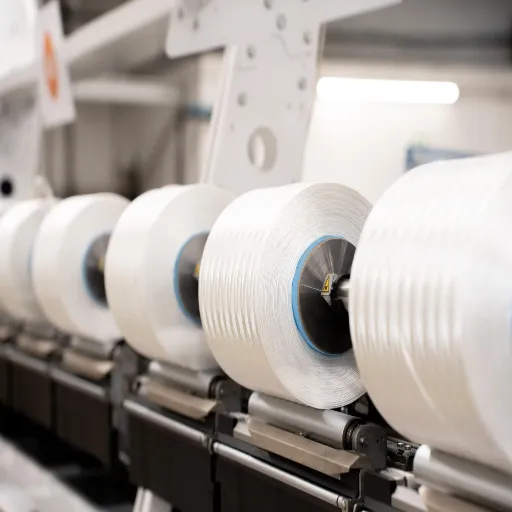
A complete RFQ prevents most disputes. It needs to name the product, fiber, construction and test conditions.
| Test | What it proves | What it does not prove | Method |
|---|---|---|---|
| Tensile and elongation | Breaking force and stretch | Adhesion, fatigue or service life | ASTM D885 |
| Hot-air shrinkage | Stability at a stated temperature and time | Shrinkage under load in rubber | ASTM D4974 |
| H-adhesion | Bond strength after a stated cure | Long-term aging or another compound | ASTM D4776 |
| Humidity or fluid aging plus adhesion | Bond retention in a service-like condition | Field life | Agreed protocol |
| Hose impulse | Pressure-fatigue life of the assembly | Yarn-level property alone | ISO 6803 |
| Hose layer adhesion | Bond between tube, braid and cover | Cord-to-rubber adhesion only | ISO 8033 |
| Belt fatigue | Flex life at a stated pulley diameter | Cord adhesion alone | Belt standard or OEM protocol |
ASTM D885 is a set of test methods, not a product specification. It tells you how to measure tensile strength and elongation, not what value passes. ASTM D4974 covers hot-air shrinkage from 20 to 700 tex, which is 180 to 6,300 denier. It doesn’t measure shrinkage under tension inside a cured belt.
The 11 fields of a complete RFQ are:
| Field | What to state |
|---|---|
| Finished product and standard | V-belt profile and belt standard, or hose type and hose standard |
| Fiber and grade | Polyester HT, HMLS, AA polyester, nylon, aramid or blend |
| Yarn linear density | dtex and filament count |
| Cord construction | Plies, yarns per ply and total dtex |
| Twist | tpm, S or Z, first and second twist |
| Dip and activation | AA or non-AA, RFL or RFL plus CR/EPDM, pickup |
| Tensile and elongation | Values and method |
| Shrinkage | Temperature, time and method |
| Adhesion | Target, method, compound, cure and aging condition |
| Package and traceability | Package form, length, splice policy and lot marking |
| Certificate and sampling | Properties certified, frequency and sampling plan |
A useful certificate gives the property, value, unit, method, test condition and lot number for each result. A certificate that says “passes ASTM D885” without a value or limit isn’t a certificate, because D885 contains no pass or fail limits. The limit comes from your specification.
For a broader checklist on how to verify a manufacturer’s testing claims, see the industrial yarn manufacturing guide.
Frequently Asked Questions
What is industrial yarn for V-belts and hoses?
It is a high-strength textile yarn used as the load-carrying reinforcement in a rubber composite. In a V-belt it is twisted into a cord and wound around the belt. In a hose it is braided or spiral-wound between the tube and the cover. Polyester is the most common fiber, with nylon, aramid and blends used for specific duties.
What is a V-belt cord made of?
Most V-belt cords are high-tenacity or HMLS polyester. Aramid is used for higher loads and smaller pulleys. Nylon is used where fatigue or impact matters more than dimensional stability. Rayon and glass appear in niche designs, and the cord is usually twisted, dipped and heat-set before it enters the belt.
What yarn is used in hydraulic hose?
Textile-reinforced hydraulic hose commonly uses polyester, nylon or aramid. Polyester is the general-purpose choice for oil-based fluids. Nylon is used for flex and impulse duty. Aramid is used for high pressure and high strength; hybrids tune expansion and impulse life.
What is the difference between HT and HMLS polyester?
HT, high tenacity, is optimized for strength. HMLS, high modulus low shrinkage, gives up some strength for lower shrinkage and better dimensional stability. HMLS is common in V-belts and tire cord, where length stability matters. HT is common in webbing, rope and hose, where strength and cost matter more.
Why does polyester cord fail in hot water?
Polyester hydrolyzes. Water attacks the ester bonds in the polymer, and heat accelerates the reaction. The breakdown produces acid end groups that can speed further degradation. That is why polyester-reinforced hose has a lower water limit than oil limit, and why continuous steam service is a poor fit.
What tests should I ask for before ordering?
At minimum, ask for tensile and elongation per ASTM D885, hot-air shrinkage per ASTM D4974, and H-adhesion per ASTM D4776. For hose, add layer adhesion per ISO 8033, hydrostatic and burst per ISO 1402, and impulse per ISO 6803. For both, add adhesion after the actual cure and aging condition.
Industrial Yarn for V-Belts and Hoses: The Specification Is the Order
Industrial yarn for V-belts and hoses is a small part of the finished product and a large part of its fate. The cord or braid carries the load. The dip transfers it. The rubber protects it.
A specification that names only the fiber and dtex leaves the important decisions to the supplier.
The buyers who get consistent belts and hoses start from the product standard. They name the grade and cord construction, specify adhesion after the real cure and aging condition, and ask for a certificate with values, units, methods and lot numbers.
If you are sourcing industrial polyester yarn for a belt or hose program, start with the product standard and the failure mode you cannot tolerate. Send both, and our team will reply with the property, the test method and the dtex band we can match. Request a specification review or read the industrial polyester yarn overview first.