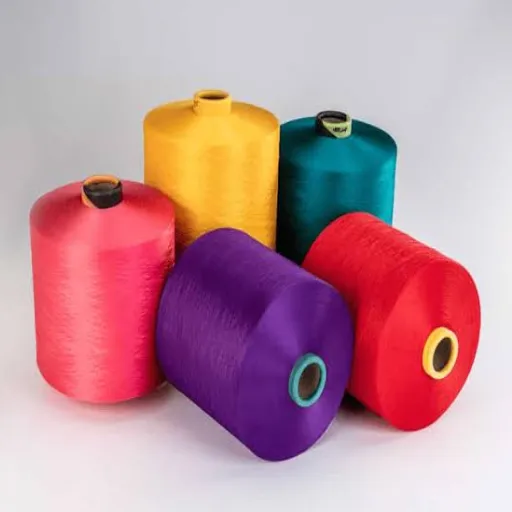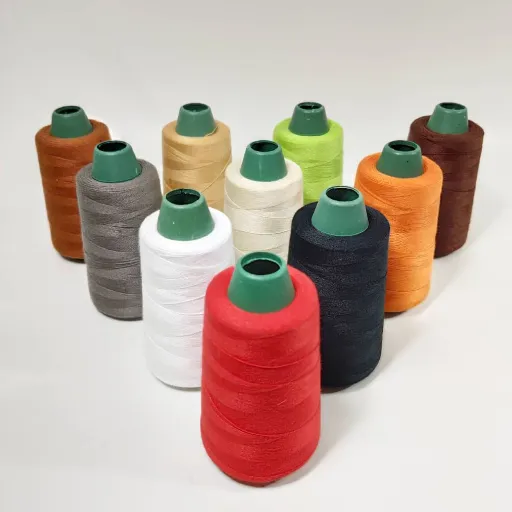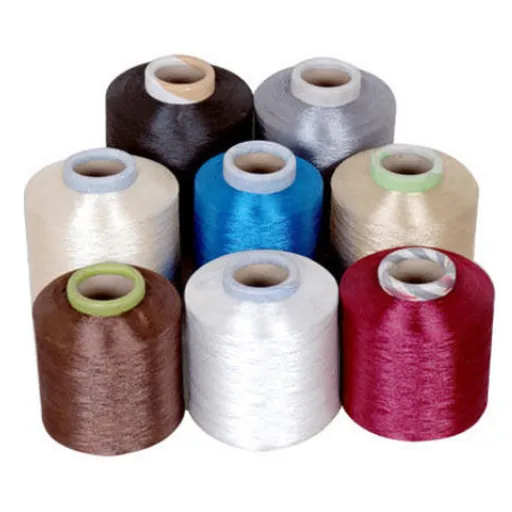
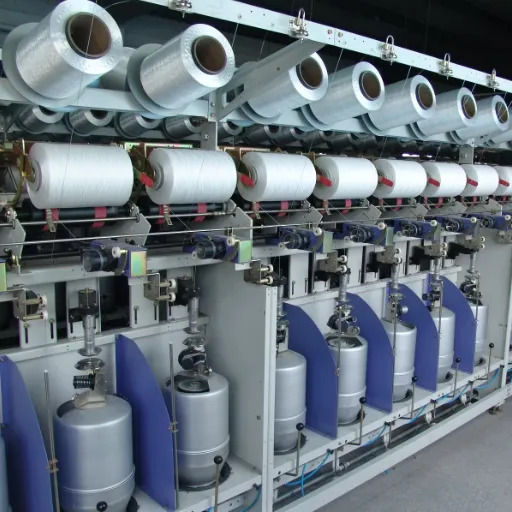
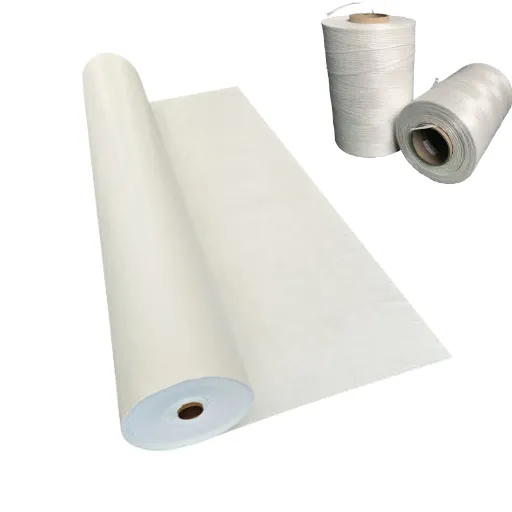



Industrial polyester yarn is high-strength polyethylene terephthalate (PET) filament made for load-bearing use rather than appearance. The working definition in the trade is coarse denier at 550 dtex or above. It’s specified by linear density, tenacity, elongation at break, hot-air shrinkage and finish, not by the word “industrial” on the invoice.
That threshold matters more than it sounds. Below roughly 550 dtex you’re usually looking at apparel or technical textile filament wearing a different label. At and above it, three things change together: the polymer, the draw ratio and the heat-setting. The product becomes something a conveyor belt can be built from.
Here’s a pattern we see often. A buyer holds two quotes for “1000D high tenacity polyester” and picks the cheaper one, because both datasheets say 1000D and both say high tenacity. The two bobbins can differ by 20% in strength and by a factor of three in shrinkage.
The failure doesn’t show up at incoming inspection. It shows up when the belt is running hot three months later.
This guide covers four things. What each commercial grade actually optimizes. How to read the units on a datasheet. Which test verifies which claim. And where polyester is simply the wrong polymer. It’s written for the person holding the datasheet, not for a brochure. If you already have two sheets you can’t reconcile, and we’ll tell you which specification is missing.
Key Takeaways
- Industrial polyester yarn is defined as high-strength PET filament at roughly 550 dtex and coarser, produced from higher-viscosity polymer and drawn harder than apparel polyester.
- HT, HMLS, LS and SLS are four different products. HMLS is not “better HT”; it trades peak strength for dimensional stability under heat.
- Denier = dtex × 0.9, and 1 cN/dtex ≈ 1.13 g/d. Comparing a g/d figure against a cN/dtex figure without converting is the most expensive unit error in the category.
- Shrinkage measured at 177 °C and at 190 °C is not comparable, even for the same bobbin. Always ask for temperature, dwell time and standard.
- Ask for a lot-specific test report, not a generic quality certificate. A certificate proves a factory has a system; a lot report proves your shipment met your limits.
What Is Industrial Polyester Yarn?
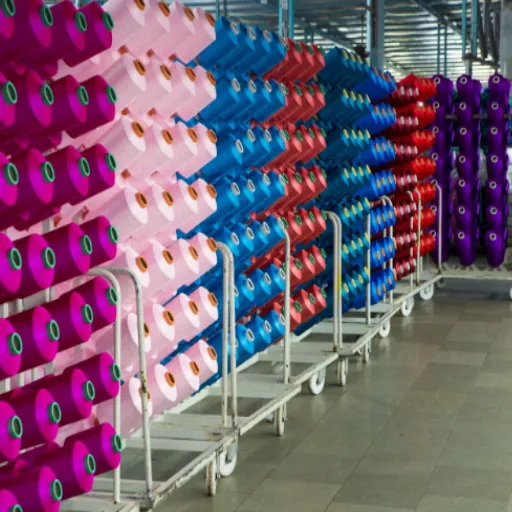
Industrial polyester yarn is PET filament produced for load-bearing service. The polymer is spun at higher intrinsic viscosity and drawn at a higher ratio. It is then heat-set to a specified shrinkage, so the yarn carries load without stretching out of tolerance.
Korean, Chinese and European producers all use the phrase, and “polyester industrial yarn” means the same product with the words reversed. The word order changes nothing in the specification.
The 550 dtex line. Producers and trading houses commonly define polyester industrial yarn as high-strength, coarse-denier filament of not less than 550 dtex. , and the same threshold appears in the specification notes of most Chinese PIY suppliers. It’s a trade convention rather than an ISO definition, so treat it as the line where the category starts rather than a legal boundary. What it tells you is that industrial yarn is a coarse-count product.
The practical difference from apparel polyester is the process window, not the chemistry. Apparel resin typically sits around 0.60 to 0.65 dL/g intrinsic viscosity. Industrial grades run higher, often near 0.90 to 1.00 dL/g. They are also drawn at ratios of 5 to 6 rather than 3 to 4. Every producer’s exact figures differ, so treat those as a starting point for a conversation rather than a standard.
That harder draw aligns the polymer chains. Alignment is what turns a soft textile filament into a yarn that holds a conveyor belt together.
| Property | Apparel / textured polyester | Industrial polyester |
|---|---|---|
| Typical count | Fine to medium | Roughly 550 dtex and above (500D+) |
| Polymer viscosity (IV) | ~0.60–0.65 dL/g | ~0.90–1.00 dL/g |
| Draw ratio | ~3–4 | ~5–6 |
| Tenacity | ~3–5.5 cN/dtex | ~6.5–8.5 cN/dtex, higher for super-HT |
| Elongation at break | Higher, wider range | Lower, tightly controlled |
| Shrinkage | Bulked, variable | Specified to a narrow band |
| Main judgment | Hand, dyeability, bulk | Tenacity, elongation, shrinkage, fatigue |
Why “industrial” is a specification, not a label
A yarn earns the description by meeting numbers, not by being sold to an industrial customer. If a supplier cannot state tenacity, elongation and shrinkage with their test conditions, the product is unspecified, whatever the invoice calls it.
That’s the single most useful test you can apply in a first meeting. A supplier who answers “about 8” when you ask for tenacity has told you they’re quoting from memory. A supplier who answers “7.8 cN/dtex minimum, ASTM D885M, elongation 14% ±1.5” has told you they can be held to something.
The Four Grades Buyers Actually Specify
Almost every commercial industrial polyester yarn falls into one of four grade families. Producers name them slightly differently, but the trade-offs are consistent across the industry.
| Grade | What it optimizes | Typical tenacity | Typical shrinkage | Common use |
|---|---|---|---|---|
| HT (high tenacity) | Strength at moderate cost | ~6.5–8.5 cN/dtex | Medium, often 7–9% at 177 °C | Webbing, slings, ropes, hose, sewing thread |
| Super HT | Maximum strength | Above ~8.5 cN/dtex, some above 9 | Medium | High-load slings, demanding cordage |
| HMLS (high modulus, low shrinkage) | Dimensional stability under heat and load | Similar to HT, sometimes slightly lower | Low, typically 3–5% | Tire cord, conveyor belt, V-belt |
| LS / SLS (low / super-low shrinkage) | Minimum movement during coating and heat exposure | Moderate | Very low, often below 4%, some near 2% | Tarpaulin, awning, coated fabric, billboard |
Published figures show the spread clearly. lists HT grades from about 6.0 to 8.6 gpd and super-HT above 9.0 gpd. Its low-shrinkage grades sit at 3 to 4% hot-air shrinkage at 190 °C. publishes standard HT near 7.2 to 8.5 cN/dtex, with its X-series reaching higher. A European reference, , quotes 1100 dtex at roughly 83.6 cN/tex, equivalent to about 8.4 cN/dtex, with 6.1% shrinkage at 180 °C.
HT versus HMLS: the choice that decides belt life
HT maximizes strength per unit weight. HMLS, however, trades a little of that for dimensional stability, so the yarn resists creep and shrinkage when the belt or tire heats up in service.
Take a conveyor belt or a V-belt running hot. HMLS usually wins on service life, even though its tenacity number is not the highest on the page. For a sling or a lashing that never sees sustained heat, paying the HMLS premium buys nothing.
That premium is real. Market commentary in 2026 put HMLS roughly 500 to 1,000 CNY per tonne above conventional HT, with low-shrinkage grades roughly 300 to 600 CNY above. The figures come from . Treat those as directional, since grade spreads move with the PTA and MEG market.
When low shrinkage matters
Low-shrinkage grades exist for processes that heat the yarn after it is already in the fabric. Coating lines, tentering frames and calendar rolls all apply heat, and a yarn that wants to contract will pull the fabric with it.
Consider the tarpaulin that looks flat at the factory gate and ripples three days later. That’s usually a shrinkage mismatch, not a weaving fault. The yarn moved after the coating cured, and no amount of re-tensioning fixes a fabric whose yarn wants to go back to a shorter length.
Choosing between HT and HMLS right now, with sustained heat in the application? Our goes deeper on that call.
Reading the Spec Sheet: dtex, Denier, Tenacity, Shrinkage
Most purchasing arguments about industrial polyester yarn are arguments about units. Two numbers can look comparable and mean different things.
dtex versus denier
Both units describe linear density, the mass of a fixed length of yarn.
- dtex is grams per 10,000 meters.
- denier is grams per 9,000 meters.
- Denier = dtex × 0.9.
So 1110 dtex is approximately 1000 denier. A supplier quoting “1000D” and one quoting “1110dtex” may be describing the same product. A supplier quoting “1100D” is describing something slightly heavier.
Tenacity: cN/dtex versus g/d
Tenacity is breaking force divided by linear density. Two unit systems are in everyday use, and they are not numerically interchangeable.
- 1 cN/dtex ≈ 1.13 g/d.
- A yarn at 8.0 g/d is about 7.1 cN/dtex.
- A yarn at 8.0 cN/dtex is about 9.1 g/d.
This is exactly where the comparison trap sits. A datasheet reading “8.0” in g/d is a weaker yarn than one reading “8.0” in cN/dtex. The first number just looks familiar to a US buyer. Convert before you compare, or ask the supplier to state both.
Filament count
The number after the slash is the filament count. A 2220dtex/384f yarn has 384 filaments. A 2220dtex/192f yarn has half as many, each twice as thick.
Finer filaments generally give better flex fatigue and a softer hand, at higher spinning cost. Coarser filaments give more stiffness and abrasion resistance per filament. Neither is better in the abstract. The application decides which you want.
Shrinkage is not comparable across test conditions
Hot-air shrinkage depends on temperature, dwell time and the tension applied during measurement. A figure of 7% at 177 °C for two minutes is not the same test as 7% at 190 °C for five minutes.
Suppliers often quote the condition that flatters the product. So before comparing two shrinkage numbers, confirm three things: the temperature, the dwell time, and the standard used. ASTM D4974 is the usual reference for hot-air shrinkage of filament yarns.
If your process runs hotter than the test condition, ask for a shrinkage curve rather than a single number. A single figure at 177 °C tells you very little about behaviour at 200 °C.
Elongation at break
Elongation tells you how far the yarn stretches before it fails. Typical industrial values run from about 10.5% to 16.5%.
Low elongation, near 10 to 12%, suits processes that need dimensional control, such as tire cord and coated fabric. Higher elongation absorbs shock, so it suits slings and dynamic rope. A mismatch here shows up as either a baggy fabric or a product that snaps instead of stretching.
What to confirm on any spec sheet
- Linear density in dtex and the equivalent denier.
- Filament count.
- Tenacity, with the unit stated.
- Elongation at break.
- Hot-air shrinkage, with temperature and dwell time.
- Test standard for each value.
- Finish type and oil pick-up.
- Twist direction and turns per meter, if twisted.
A sheet missing items three through six is a brochure, not a specification. Hold that line in the first conversation and the rest of the negotiation gets easier.
Where Industrial Polyester Yarn Is Used
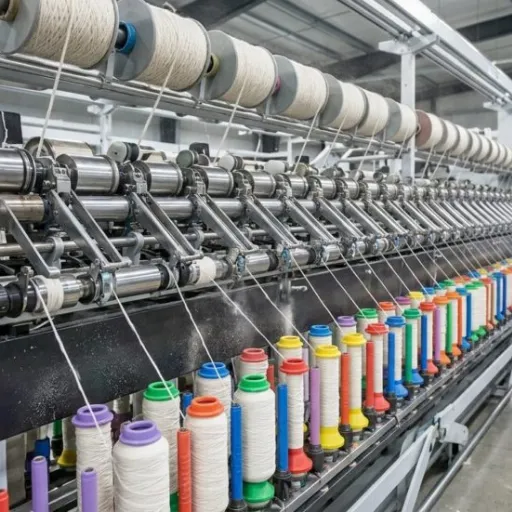
Industrial polyester yarn appears wherever a textile has to carry load. As a result, the grade follows the load path, not the industry name.
| Application | Typical grade | Property that decides it | Test to demand |
|---|---|---|---|
| Tire cord | HMLS | Modulus and shrinkage under heat | Tensile, shrinkage, adhesion |
| Conveyor belt | HMLS or HT | Fatigue resistance, dimensional stability | Tensile, elongation, fatigue |
| V-belt and hose | HT, often adhesive-activated | Adhesion to rubber, strength | Tensile, dip pick-up, adhesion |
| Seat belt and webbing | HT | Strength and controlled elongation | Tensile, elongation |
| Slings and tie-downs | HT or super HT | Strength per unit weight | Tensile, elongation, UV |
| Rope and cordage | HT | Flex fatigue, strength | Tensile, abrasion |
| Geotextile and geogrid | HT PET or PP | Tensile at low strain, chemical resistance | Wide-width tensile |
| Coated fabric and tarpaulin | LS or SLS | Shrinkage during coating | Shrinkage, tensile |
| Sewing thread | HT, often twisted | Strength, loop strength, heat resistance | Tensile, loop strength |
Want the long version? Our guide to covers each end use, the property it demands, and the specification mistakes common to it.
Two adjacent sectors deserve their own note. Automotive textiles add requirements that have nothing to do with strength, including fogging, odor and lightfastness, which our covers separately. Geotextiles often switch to polypropylene for chemical resistance, a trade-off explained in the .
If you are buying a catalogue grade, our covers DTY, FDY, staple and industrial filament. If your requirement is a bespoke construction rather than a catalogue grade, the process differs, and walks through it.
How Industrial Polyester Yarn Is Made
The process explains why the grades behave differently, so it’s worth understanding even if you never run a spinning line.
Polymer. PTA and MEG are polymerized to PET at a viscosity target. Industrial resin is held to a higher target than textile resin, because the final yarn must carry load.
Spinning. Molten polymer is extruded through a spinneret. Filament count is set here.
Drawing. The filaments are stretched, aligning the polymer chains. Draw ratio is the main lever on tenacity, and it is where industrial and apparel production diverge most.
Heat setting. Temperature and tension during setting determine shrinkage and modulus. HMLS and LS grades are made here, not by an additive.
Finish and winding. An oil finish controls friction for downstream processing. Adhesive-activated grades add a treatment that helps the yarn bond to rubber.
Twisting. Twisted yarns are plied and twisted for sewing thread, cord and some webbing. Twist direction and level change strength and elongation, so they belong on the specification.
This is a condensed view. For the full sequence with equipment and quality checkpoints, see .
Polyester Industrial Yarn vs Ordinary Polyester Yarn
The comparison buyers actually need is not polyester against other fibers. It is polyester industrial yarn against the ordinary polyester already in the warehouse.
| Parameter | Ordinary / apparel polyester | Industrial polyester |
|---|---|---|
| Polymer viscosity | Lower | Higher |
| Draw ratio | Lower | Higher |
| Tenacity | Moderate | High, and specified |
| Elongation | Wider range, less controlled | Narrow band, tested |
| Shrinkage | Variable, often bulked | Specified to a target |
| Count range | Fine counts common | 550 dtex and coarser |
| Price | Lower per kilogram | Higher per kilogram |
| Buying basis | Hand, color, consistency | Test data per lot |
The price gap is not a premium for the word “industrial.” It reflects slower spinning, higher polymer cost, tighter process control and more testing. In other words, you are paying for the process, not the label.
A substitution in the other direction is the expensive one. Replacing an industrial yarn with a visually identical apparel yarn usually passes incoming inspection and fails in service. The failure mode is fatigue or creep, not immediate breakage. It surfaces months later on a customer’s line rather than on your receiving dock.
When polyester is the wrong choice
A supplier who only sells polyester will always specify polyester. Four alternatives deserve an honest hearing.
Nylon wins on flex fatigue and abrasion. Ropes, airbags and some belts use nylon because it survives repeated bending that embrittles polyester over time. It loses on UV stability and dimensional stability.
Polypropylene wins on chemical resistance and density. At about 0.91 g/cm³ against polyester’s 1.38, it floats and yields more length per kilogram. Geotextiles and some webbing use it. It loses on UV resistance and creep under sustained load.
Aramid wins on heat resistance and strength-to-weight. It costs several times more and demands different handling.
UHMWPE wins on strength-to-weight for ropes and ballistic fabrics, and loses on creep and temperature ceiling.
The honest test is to state the failure mode first. If the product fails by fatigue, polyester may be wrong. If it fails by creep under heat, HMLS may fix it. If it fails by UV, no grade of polyester fixes that without a protective construction.
Verifying a Supplier’s Spec Sheet
A datasheet is a claim. A test report is evidence. The gap between them is where sourcing risk lives.
Which standard covers which claim
- Tensile strength and elongation: ASTM D885M for industrial filament yarns and tire cord, or ASTM D2256 for single-strand yarn tensile. ISO 2062 is the common European equivalent.
- Hot-air shrinkage: ASTM D4974.
- Linear density: ASTM D1907.
- Adhesion to rubber: producer-specific dip tests, often quoted to a customer standard rather than a public one.
If a supplier cannot name the standard behind a number, the number is unverified.
What a certificate proves, and what it does not
A quality management certificate proves that a factory has a system for controlling quality. It doesn’t prove that the lot in your container met your specification.
The document that matters is a lot-specific test report, ideally from a laboratory you can identify, showing the values against your acceptance limits. Ask for it before bulk, and spot-check it against your own incoming test.
Five questions before an order
- Which grade is this, stated as HT, HMLS, LS or SLS?
- What are the guaranteed minimum tenacity and the elongation range, with units?
- What is the shrinkage, and at what temperature and dwell time?
- Can you supply a lot test report for the shipment, not just a sample?
- What is the acceptance procedure if an incoming test disagrees with your datasheet?
Our broader covers the testing sequence from raw material to finished package.
Ready to test a datasheet against a real shipment? Send us the specification you’re trying to meet. We’ll tell you which grade reaches it, and what to ask the mill for.
Price, MOQ and Lead Time
Industrial polyester yarn is priced from the polymer up. The inputs that move a quote are the PTA and MEG market, the grade, the color route, the count, the twist and the order size.
Grade is the variable buyers underestimate. HMLS and low-shrinkage grades carry a premium over conventional HT. Dope-dyed yarn carries another premium over raw white, because the color is built into the polymer rather than applied later.
Small orders carry a different penalty. Setup, spinneret changes and minimum run lengths are fixed costs. The per-kilogram price rises steeply below a certain volume. That threshold is specific to the mill and the count, which is why published price lists for industrial yarn are rare and quotes are not.
We quote against a specification rather than a product name, because the same “1000D HT” can be built several ways. Have an application and a target count? naming the property that matters most. We’ll tell you which grade reaches it.
Frequently Asked Questions
Is polyester industrial yarn the same as high tenacity polyester yarn?
Not exactly. High tenacity is one grade within industrial polyester yarn. Industrial yarn also includes HMLS, low-shrinkage and super-low-shrinkage grades, which trade strength for dimensional stability.
What is the dtex threshold for industrial polyester yarn?
The trade convention is 550 dtex and above, which is about 500 denier. Below that count polyester filament is usually classified as apparel or technical textile yarn rather than industrial yarn.
What does 1000D mean, and how does it convert to dtex?
1000D means 1000 denier, or 1000 grams per 9,000 meters. Multiply by 1.11 to get dtex, so 1000D is about 1110 dtex. Going the other way, multiply dtex by 0.9.
What tenacity should I ask for?
It depends on the application, but a common industrial HT range is roughly 7 to 8.5 cN/dtex, with super-HT grades above that. State the unit in your enquiry, or you may get a quote for a weaker yarn than you intended.
What is the difference between HMLS and HT?
HT maximizes strength. HMLS keeps more of its modulus and shrinks less when heated, which matters in tire cord and belts that run hot. HMLS usually costs more.
Can industrial polyester yarn be recycled?
Polyester is recyclable, and recycled feedstock is available in some industrial grades. Availability and traceability vary by producer and region, so ask specifically for recycled content and the documentation behind it rather than assuming it.
What is the minimum order quantity?
It depends on count, grade and color route. Dope-dyed and special counts carry higher minimums than raw white standard grades. Ask for the MOQ against your exact specification rather than a general figure.
Specifying Industrial Polyester Yarn With Confidence
Industrial polyester yarn is a specification product. The grade decides the behaviour. The units decide whether you’re comparing like with like. The test report decides whether the lot matches the claim.
Three habits prevent most of the expensive mistakes. State the grade explicitly, in HT, HMLS, LS or SLS. Convert every tenacity and count into the same units before comparing suppliers. Then require a lot-specific test report against your acceptance limits, not a generic certificate.
Everything else, including the count, the twist and the finish, follows from the application. Get those three right and industrial polyester yarn stops being a category you shop in and becomes a line on a purchase order.
For background on how the industrial segment is specified and audited more broadly, see our .
Hebei Lida Textile Co., LTD supplies polyester yarn, including DTY, FDY, staple and industrial filament, from Xingtai in northern China. The company runs five warehouses and a network of more than 80 partner mills. Custom counts, colors and twists run from sample to bulk.
Specifying polyester industrial yarn right now? with the application and the property that matters most. We’ll give you a second opinion on the datasheet in front of you.