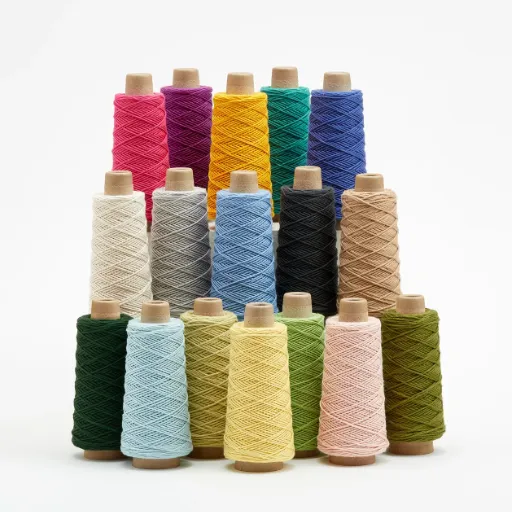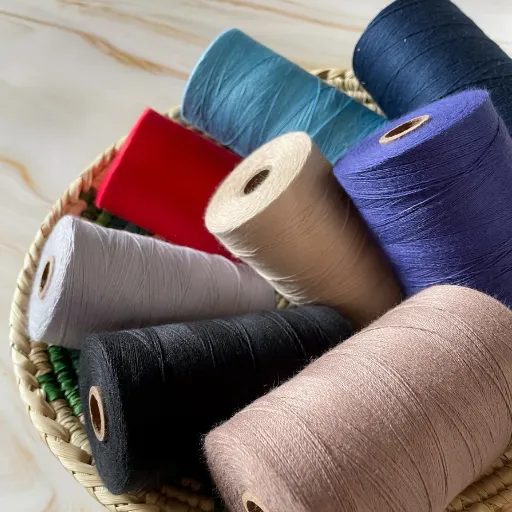
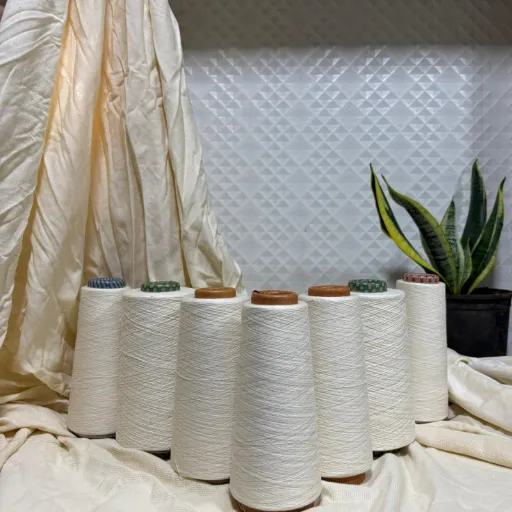



Yarn count is a yarn’s linear density, expressed as either length per unit weight (Ne, Nm) or weight per unit length (tex). Cotton is normally specified in English cotton count, written as Ne, where a higher number means a finer yarn. Organic cotton is typically available from around Ne 10 to Ne 90, and the ceiling is set by the fibre’s staple length rather than by the spinning mill.
That’s the whole idea in three sentences. Everything else on a specification sheet is bookkeeping around those three sentences.
A knitwear buyer named Priya learned this the expensive way. She emailed three organic cotton yarn suppliers in the same week and asked each for a price on “30 count.” She got back three quotes at three different prices.
One quote was for Ne 30/1 ring spun. One was for Ne 30/2, a two-ply yarn roughly twice as heavy. The third was for Nm 30, which converts to about Ne 17.7, a different yarn again.
Nobody was being dishonest. Priya asked an incomplete question, and three mills answered it three different ways.
This guide fixes that. You will learn what organic cotton yarn count actually measures, how to convert between Ne, Nm, and tex, what counts organic cotton can realistically reach and why, how spinning method changes the answer, and the exact fields to put on a purchase order so your next order arrives as specified. Request a quote for organic cotton yarn tailored to your needs.
Key Takeaways
- Yarn count measures linear density, not diameter. Because spun cotton has a variable cross-section, diameter can’t be measured consistently, so the industry counts length per unit weight instead.
- Ne and Nm are indirect systems, where a higher number means a finer yarn. tex is a direct system, where a higher number means a coarser yarn. The two families move in opposite directions, which is the source of most specification errors.
- Organic cotton staple length runs about 20 to 45 mm, which supports roughly Ne 10 to Ne 90. Fine counts above Ne 60 need long or extra-long staple fibre, so origin determines what you can buy.
- Count tolerance is meaningless without its sampling method. Published limits range from about 1.2% to 2.5% depending on the standard, and ISO 16549:2021 bases staple-fibre testing on 10 packages with a minimum 100 m measured length.
- Organic certification says nothing about count quality. GOTS and OCS certify the supply chain, not the yarn’s physical properties.
What Yarn Count Actually Measures
Yarn count is the mass of a yarn per unit length, or its length per unit mass. It describes fineness and weight, and it’s the number a mill uses to set the draft on a spinning frame.
The obvious question is why the industry doesn’t simply measure thickness. The answer is that spun cotton has no consistent diameter.
Fibres lie at different angles, the yarn varies along its length, and a calliper reading at one point tells you very little about the next metre. Weight over a fixed length is repeatable. Diameter isn’t.
This is why the term “count” and the term “linear density” mean the same thing, and why a count specification always has to name the system it uses. A bare number isn’t a specification.
Indirect Systems: Higher Number, Finer Yarn
The indirect family fixes the weight and varies the length. You ask how many fixed lengths of yarn it takes to reach one unit of weight. More lengths means thinner yarn, so a higher number means finer.
Ne and Nm both work this way. So do the older worsted and woollen counts, which is why count numbers aren’t comparable across fibre types without knowing the base length.
Direct Systems: Higher Number, Coarser Yarn
The direct family fixes the length and varies the weight. You ask what a fixed length of yarn weighs. More weight means a thicker yarn, so a higher number means coarser.
tex sits in this family, along with dtex and denier. If you remember nothing else from this section, remember that the two families move in opposite directions. Nearly every count error we see starts there.
| Family | What is fixed | What varies | Higher number means | Systems |
|---|---|---|---|---|
| Indirect | Weight | Length | Finer yarn | Ne, Nm, worsted, woollen |
| Direct | Length | Weight | Coarser yarn | tex, dtex, denier |
The Three Count Systems: Ne, Nm, and Tex
| Ne (English cotton count) | Nm (metric count) | tex |
|---|---|---|
| 10 | 16.9 | 59.1 |
| 16 | 27.1 | 36.9 |
| 20 | 33.9 | 29.5 |
| 24 | 40.6 | 24.6 |
| 30 | 50.8 | 19.7 |
| 40 | 67.7 | 14.8 |
| 60 | 101.6 | 9.8 |
Read the table from left to right and note the pattern: as Ne rises, tex falls. That’s the opposite-directions rule made visible.
Ne: English Cotton Count
Ne is the number of 840-yard hanks in one pound of yarn. Ne 1 is 840 yards per pound. Ne 30 is 30 times that length for the same weight.
Cotton, silk, and lyocell all use the 840-yard base, which is convenient but also a trap. Linen uses a 300-yard base. Worsted wool uses 560, and woollen uses 256. A “30 count” linen yarn and a “30 count” cotton yarn aren’t the same thickness.
Nm: Metric Count
Nm is the number of metres in one gram, or equivalently the number of 1,000-metre hanks in one kilogram. Nm 30 means one gram of yarn measures 30 metres.
Nm is common on European and Turkish specification sheets. If you buy organic cotton from Turkey or Portugal, expect to see it.
tex: The International System
tex is the weight in grams of 1,000 metres of yarn. It’s the direct system, and it was adopted internationally in 1967 as the standard replacement for the older numbering systems.
tex is the least ambiguous way to describe a yarn, which is why testing laboratories prefer it. It’s also used for nearly all filament yarns.
dtex and Denier, in One Line Each
dtex is 10 times tex and is standard for filament yarns. Denier is 9 times tex and is the traditional unit for silk and synthetics. If your yarn is 100% spun organic cotton, you will rarely need either.
Want to compare counts against our own organic range? See the organic cotton yarns we spin and the counts available →
Converting Between Ne, Nm, and Tex
The four conversions you need cover everything in practice.
| Conversion | Formula |
|---|---|
| tex to Ne | Ne = 590.54 ÷ tex |
| Ne to tex | tex = 590.54 ÷ Ne |
| tex to Nm | Nm = 1000 ÷ tex |
| Nm to Ne | Ne = 0.5905 × Nm |
Two more appear occasionally. Denier is 9 × tex. And Ne equals 5315 ÷ denier. For most organic cotton work, the four above are enough.
All of these are approximate. Published constants are sometimes rounded to 590, 591, or 1.69 rather than 590.54 and 0.6934, so allow for a fraction of a percent of drift. Don’t treat a converted figure as exact.
Worked Example: Ne 30/1 Organic Cotton
Take a standard Ne 30/1 organic cotton yarn.
- tex = 590.54 ÷ 30 = 19.7 tex
- Nm = 1.6934 × 30 = 50.8 Nm
So Ne 30/1 is about 19.7 tex and 50.8 Nm. That matches the table above and matches the reference anchors used across the industry, where 20 tex corresponds to roughly 30 Ne.
Reading Ply Notation: 30/2 Isn’t 30
The number after the slash is the ply count, not a decimal. Ne 30/1 is a single 30-count strand. Ne 30/2 is two 30-count strands twisted together.
Here’s the part that surprises buyers. Adding plies makes a yarn heavier, so the resultant count falls.
| Ply notation | Structure | Resultant count | Note |
|---|---|---|---|
| Ne 30/1 | One 30-count strand | Ne 30 | The single-strand baseline |
| Ne 30/2 | Two 30-count strands twisted | Ne 15 | About twice as heavy as Ne 30/1 |
| Ne 20/2 | Two 20-count strands twisted | Ne 10 | Heavier than Ne 30/2 |
| Ne 40/2 | Two 40-count strands twisted | Ne 20 | Lighter than Ne 30/2 |
The rule to remember: a higher top number gives a finer yarn, and a higher bottom number gives a heavier one. Ne 10/2 is thicker than Ne 10/1, and Ne 20/2 is finer than Ne 10/2.
If your specification says “30 count” and nothing else, this is the ambiguity you’re inviting. Write Ne 30/1, or Ne 30/2, and be done with it.
What Counts Can Organic Cotton Actually Reach?
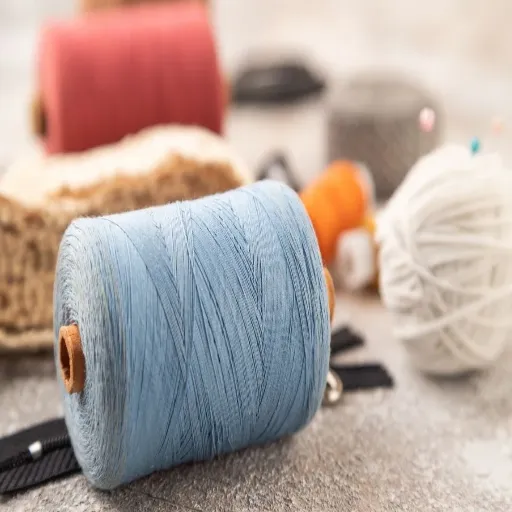
This is where organic cotton diverges from the generic explanations you will find elsewhere. Organic certification changes how cotton is grown. It doesn’t change the fibre’s staple length, and staple length is what sets the count ceiling.
Staple Length Sets the Ceiling
Staple length is the average length of the individual fibres. Longer fibres can be twisted together into a finer, stronger yarn because more fibres overlap along any cross-section of the finished thread.
| Staple length | Category | Approximate Ne | Approximate tex |
|---|---|---|---|
| Under 25 mm | Short | 3 to 16 | about 197 down to 37 |
| 25 to 30 mm | Medium | 17 to 44 | 34.7 down to 13.1 |
| 30 to 35 mm | Long | 45 to 80 | 12.8 down to about 7.2 |
| Over 35 mm | Extra-long | above 80 | under about 4 |
Organic cotton staple typically runs from 20 to 45 mm. That’s the source of the commonly quoted span of roughly Ne 10 to Ne 90. You can’t spin a fine yarn from short fibre, no matter how good the mill is.
Micronaire and Maturity
Micronaire measures fibre fineness and maturity. Lower micronaire means finer fibres, which puts more fibres into a given yarn cross-section and generally produces a stronger fine yarn.
Organic cotton typically sits between 3.5 and 4.5 micronaire. Published ranges stretch wider, from 3.0 to 6.0, with origin-dependent extremes at both ends. Micronaire is influenced by growing conditions such as moisture and temperature, so it varies year to year even from one farm.
Origin Changes the Answer
A buyer named Tomas ran into this at a mill in northern Portugal. His brand wanted an organic cotton jersey in a fine 60s count, and he assumed any certified organic supplier could deliver it. The Indian quote he received couldn’t. The fibre available to that supplier sat in the 40 to 80 Ne band, and pushing to a reliable 60s single would have needed a longer staple than the lot contained.
Different origins grow different cotton. This table shows the achievable count ranges recorded for organic cotton by region.
| Origin | Typical count range (Ne) |
|---|---|
| Tamil Nadu, India | 40 to 120 |
| Karnataka, India | 40 to 90 |
| Andhra Pradesh, India | 40 to 80 |
| Afula, Israel | 50 to 90 |
| Egypt (Fayoum, Elbeheira) | 50 to 80 |
| Aegean, Turkey | 45 to 50 |
| California, USA | 35 to 60 |
| Uganda | 20 to 60 |
Note that these are capability ranges, not a promise. A mill that can reach Ne 80 doesn’t necessarily hold the certified fibre to do it on your delivery date.
What Organic Certification Doesn’t Tell You About Count
Here is the sentence most guides leave out. GOTS and OCS certify the supply chain. They say nothing about the yarn’s physical quality.
A premium long-staple conventional yarn will outperform a short-staple organic yarn at the same nominal count on every measure that affects your fabric, including evenness, strength, and hairiness. Certification is a claim about provenance and processing. Count and quality are separate questions, and you should ask them separately. For the full distinction between organic and conventional fibre, see organic versus conventional cotton fibre.
How Spinning Method Changes the Count
The count tells you how heavy the yarn is. The spinning method tells you how it behaves. Two yarns at Ne 30 can differ substantially in strength, hairiness, and surface appearance depending on how they were made.
| Method | What it does | What you get | Cost |
|---|---|---|---|
| Carded | Opens and aligns fibre, keeps short fibres | Rougher, hairier, wide count range | Lowest |
| Combed | Removes short fibres and noils | More even, stronger, less hairy | Higher |
| Compact | Condenses the fibre bundle | Higher tenacity, lower hairiness, biggest gain at fine counts | Highest |
| Open-end (rotor) | Faster rotor spinning, different structure | Suits coarse and medium counts | Lower than ring |
Carded
Carded yarn goes through carding only, which opens and aligns the fibre. Short fibres stay in. Carded yarn is rougher, more hairy, and less expensive, and it covers a wide count range.
Combed
Combed yarn gets a further step that removes short fibres and impurities. One spinning study reported noil extraction around 18%, which is a meaningful fraction of the input. Removing those short fibres improves evenness, reduces thin and thick places and neps, lowers hairiness, and raises strength.
Combed costs more because you’re discarding material and adding a process. You buy it when surface quality and strength matter.
Compact
Compact spinning condenses the fibre bundle as it leaves the drafting zone, which improves fibre integration in the finished yarn. The result is higher tenacity and lower hairiness than conventional ring spinning.
The gain is larger at finer counts, because condensing works more effectively on a thin fibre bundle. For combed cotton, one comparison recorded tenacity of roughly 24 to 26 cN/tex for compact against 21 to 24 cN/tex for conventional ring, with a hairiness index of about 2.40 to 3.13 against 3.33 to 3.86.
One caution. The tenacity advantage for compact is consistent across the research. The hairiness advantage is reported less consistently, and at least one comparison found carded compact yarns hairier than combed conventional ones at 40s. Treat “compact is less hairy” as a tendency at finer counts on combed stock, not a universal rule.
Open-End (Rotor)
Rotor spinning is faster and cheaper but produces a yarn with a different structure. It suits coarser and medium counts. Ring spinning covers the medium to fine range.
Typical Count Ranges by Method
| Spinning method | Typical range (Ne) |
|---|---|
| Open-end (rotor) | 2/1 to 24/1 |
| Ring, carded | 6/1 to 60/1 |
| Ring, combed | 16/1 to 100/1 |
| Compact | 20/1 to 120/1 |
These ranges are guides, not limits. Mills push the edges of them regularly. How the spinning actually happens is covered in more detail in spinning process explained.
Specifying combed compact organic cotton? Tell us the count, the application, and the certification you need, and we will confirm what is spinnable from our fibre. Request a count sample →
Count Tolerance: What to Accept and How to Test It
Count tolerance defines how far a delivered yarn may drift from the count you ordered. It’s one of the most useful clauses on a purchase order and one of the most commonly left blank.
What Count CV% Actually Means
Yarn count isn’t perfectly uniform along a length or between packages. Count CV% is the coefficient of variation, which expresses that spread as a percentage of the mean. A low CV means a consistent yarn. A high CV means the yarn wanders around the target.
Consistency matters because unstable count shows up downstream. It’s associated with barre, the unwanted shade variation that appears as stripes or bands in finished fabric. It also increases breakage during warping and weaving, which costs you machine time.
Why the Number Is Meaningless Without the Sampling Method
This is the point almost nobody states clearly. A count CV figure depends entirely on how many packages you tested, how many readings you took from each, and where you took them.
ISO 16549:2021 sets the baseline for staple-fibre yarns. It uses 10 packages as the laboratory sample, requires a minimum total measured length of 100 m, and specifies one specimen per package when no material specification exists. Unevenness testers also reference relative count to 100 m or 100 yards.
Total variation combines the within-package and between-package components, so a figure quoted without its sampling plan can’t be compared to anything. If a supplier tells you count CV is 1.5%, ask how many packages and what test length. If they can’t answer, the number doesn’t mean much.
Typical Limits Across Standards
Published limits differ by standard and count band, which is why you should name the standard you’re testing to.
| Standard | Limit |
|---|---|
| CSITC, 40s carded hosiery | under 1.2% |
| CSITC, 40s carded warp | under 1.3% |
| WTO / Uganda TBT specification | 2.00% to 2.50% maximum, by count band |
| BIS, two-fold average resultant count | plus or minus 3% |
A reasonable specification for premium organic cotton knitwear sits around 2.0% or better on a 100 m basis across 10 packages, tested to ISO 16549. Anything above roughly 2.5% warrants a conversation before you accept the delivery.
A Buyer Who Skipped This Clause
Daniel, a home textiles buyer in the Netherlands, accepted a shipment of organic cotton yarn with a count certificate showing only a single average figure. No CV, no sampling detail.
The yarn passed the certificate and failed in the loom. Warping breakages ran high, and the finished fabric showed barre across two of the three colourways.
The root cause was package-to-package count variation that a proper 10-package test would have exposed before shipping.
The fix cost him a re-weave and a delayed season. The clause that would have prevented it takes one line on a purchase order.
Our own approach to measurement is set out in yarn testing and count verification.
Matching Count to Application and Writing the Specification
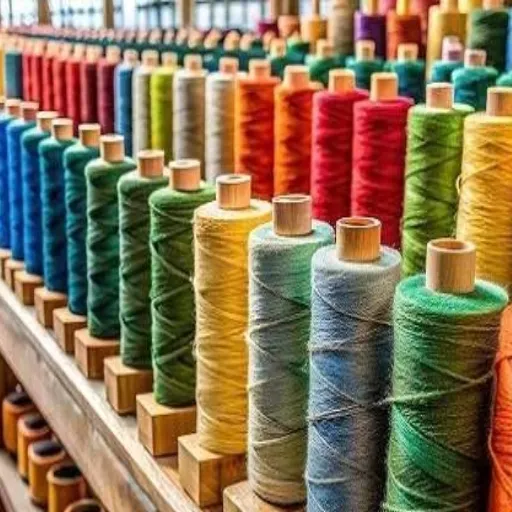
Count selection isn’t a matter of taste. It’s driven by the fabric weight and hand feel the end product needs.
Count to Application
| Application | Typical count (Ne) |
|---|---|
| Denim | 4.0 to 12.5 |
| Chambray | 12.5 to 30.5 |
| Knitwear, jersey | 20 to 40 |
| T-shirts and underwear | 20 to 40 |
| Fine shirting and sheeting | 40 to 100 |
| Baby and next-to-skin | 30 to 60, combed, low hairiness |
The coarse end of that table covers heavy, durable goods. The fine end covers light, smooth fabrics. Cotton yarn above roughly 60 Ne moves into fine sheeting and lawn territory, and that’s precisely where long-staple organic fibre becomes mandatory rather than optional.
For next-to-skin and baby textiles, count matters alongside processing. Finer combed yarn with low hairiness feels better against skin and sheds less fibre. The organic case for baby textiles rests on residue limits rather than count, and the fibre’s own properties are covered in how staple length shapes yarn quality.
How to Write a Yarn Count Specification
A count specification is only complete when every field below is present. Leaving any of them out invites a substitution.
| Field | What to write |
|---|---|
| Count and system | Ne 30/1, not “30 count.” Name the system explicitly. |
| Ply | State the ply count. Ne 30/1 and Ne 30/2 are different yarns at different prices. |
| Spinning method | Combed compact, ring combed, ring carded, or open-end. |
| Fibre composition | 100% organic cotton, or the blend and its certified proportions. |
| Certification | GOTS label grade, or OCS 100 / OCS Blended. See what GOTS and OCS actually certify. |
| Fibre parameters | Staple length band and micronaire range. |
| Count tolerance and test standard | The CV limit plus the standard it’s tested to. |
| Packaging and cone weight | Whether splices are permitted. |
A Worked Specification
Here is a complete line you can adapt.
Ne 30/1, 100% organic cotton, GOTS certified, combed compact spun, long staple 30 mm minimum, micronaire 3.7 to 4.2, count CV not exceeding 2.0% tested to ISO 16549:2021 across 10 packages at 100 m, 1.67 kg cones, spliced permitted.
That single line removes every ambiguity that cost Priya three quotes and a wasted week. A mill can price it without asking a question, and you can reject a delivery that doesn’t meet it.
Five Errors Buyers Make
- Writing “30 count” without naming the system.
- Confusing Nm with Ne, which is a gap of roughly 70% in the delivered weight.
- Omitting the ply and receiving a two-ply yarn at single-ply weight.
- Accepting a count CV figure with no sampling method attached.
- Assuming a fine count will be available because the origin can theoretically produce it.
Frequently Asked Questions
What does 30/1 mean in yarn?
The 30 is the count in Ne, meaning the yarn measures 30,840 yards per pound. The 1 is the ply count, meaning it’s a single strand rather than a plied yarn. Ne 30/1 is approximately 19.7 tex and 50.8 Nm.
Is a higher yarn count better?
Not in itself. A higher count means a finer, lighter yarn, which suits light and smooth fabrics. Coarser counts suit denim, upholstery, and heavy knits. The right count depends on the fabric you’re making.
What is the difference between Ne and tex?
Ne is an indirect count, so a higher number means a finer yarn. tex is a direct count, so a higher number means a coarser yarn. They move in opposite directions. Convert with Ne = 590.54 ÷ tex.
Can organic cotton be spun into fine counts?
Yes, up to roughly Ne 90, but only from long or extra-long staple fibre. Fine counts above Ne 60 depend on origin and lot, so confirm the specific fibre rather than the general capability range.
What is a good count tolerance for cotton yarn?
Around 2.0% CV or better on a 100 m basis across 10 packages, tested to ISO 16549:2021. Published limits across standards range from about 1.2% to 2.5%, so always state which standard you’re testing to.
Does yarn count affect price?
Yes. Finer counts need longer staple fibre, more processing, and slower spinning, so they cost more per kilogram. Combed and compact yarns also carry a premium over carded.
Does organic certification guarantee yarn quality?
No. GOTS and OCS certify the supply chain and the fibre content. Physical properties such as evenness, strength, and count consistency are separate and must be specified and tested independently.
Specifying Organic Cotton Yarn Count Is a Solved Problem
Organic cotton yarn count comes down to five things. Count measures linear density, not diameter. Keep the indirect systems, Ne and Nm, separate from the direct system, tex, because they run in opposite directions.
Staple length caps the counts organic cotton can reach, and origin decides what’s actually available. Spinning method matters too, since combed compact and open-end aren’t interchangeable at the same count. And always attach a tolerance with its test standard.
Do those five things and the ambiguity that produced Priya’s three quotes disappears. Your specification becomes a document a mill can execute rather than interpret.
At Hebei Lida Textile, we spin organic cotton across the count range our fibre supports, and we will tell you plainly when a count isn’t achievable from a given origin instead of quoting around the problem. Send us your application and target count, and we will come back with what’s spinnable, what it costs, and what the tolerance will be. Request a count sample and a quote to start, or see our pure cotton yarn range for what we hold in stock.