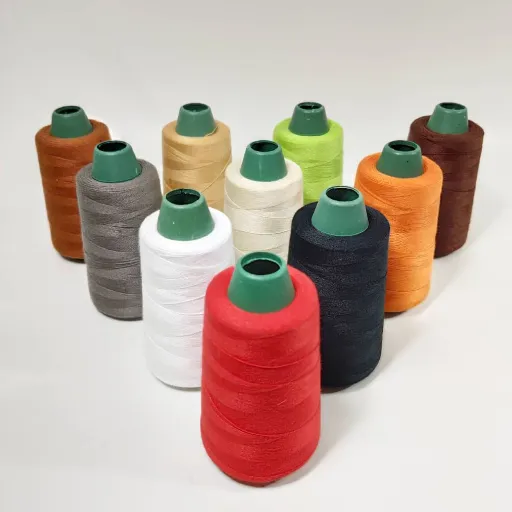



Yarn for automotive textiles is not one product. The application picks the fiber: nylon 6.6 for airbags, high-tenacity polyester for seat belts and tire cord, and polyester or polypropylene for seat covers, headliners, and carpets.
There is no such thing as “automotive yarn.” There is only yarn that has been qualified for a vehicle application. That distinction matters because two yarns can share the same fiber name, the same dtex, and nearly the same data sheet, yet only one survives the customer’s process and the OEM’s validation.
If you have ever compared two yarn data sheets and found them almost identical, you already know the problem. The difference is rarely on the sheet. It shows up later, in fogging, shrinkage, shade drift, or a failed adhesion test.
This guide maps each major vehicle textile to the yarn behind it, the test that decides acceptance, and the questions to ask before you approve a lot. We will cover safety systems, interior trim, reinforcement, the test matrix, recycled content, and a sourcing checklist. Specifying yarn for automotive textiles starts with the failure mode, not the fiber. Contact Hebei Lida Textile Co., LTD for application-specific yarn.
Key Takeaways
- Automotive yarn is qualified by application and test data, not by fiber name alone.
- Nylon 6.6 dominates airbag fabrics; high-tenacity polyester dominates seat belts and tire cord.
- Interior yarns are judged on abrasion, lightfastness, fogging, odor, and VOC, not just strength.
- FMVSS 302 caps interior burn rate at 102 mm/min, and FMVSS 209 governs seat-belt assemblies.
- Recycled content is viable, but it must be re-qualified for tenacity, color, odor, and fogging.
The scenarios below are composite examples of common qualification failures, not named customer accounts.
What Counts as Automotive Textile Yarn?
Automotive textile yarn is a yarn engineered and qualified for a vehicle application, from seat covers and headliners to airbags, seat belts, and tire cord. It is specified by measured performance, including tenacity, shrinkage, heat aging, flammability, fogging, and odor, rather than by fiber name.
The global automotive textiles market was valued at USD 32.8 billion in 2025 and is forecast to reach USD 42.4 billion by 2033, according to Grand View Research. Upholstery accounted for 55.7% of 2025 revenue. Safety devices are the fastest-growing application.
Four application families cover most automotive textile applications:
| Application family | Examples | Typical yarn | Property that decides |
|---|---|---|---|
| Interior | Seat covers, headliners, carpets, door trim | Polyester filament or spun, polypropylene | Abrasion, lightfastness, fogging, odor |
| Safety | Airbags, seat belts, child seats | Nylon 6.6, high-tenacity polyester | Tenacity, elongation, heat aging, packability |
| Reinforcement | Tire cord, hose, belts | Polyester, nylon, rayon, aramid | Retained strength, adhesion, fatigue |
| Structural and composite | Underbody shields, battery enclosures | Polypropylene, glass fiber, composites | Stiffness, impact, thermal resistance |
Not sure which family your part belongs to? Our guide to yarn applications by fiber and end use maps the full set.
The common thread is qualification, not chemistry. A yarn becomes automotive-grade after the customer approves the specification, the process, the traceability, and the change-control system.
Mei, a sourcing engineer at a Tier 2 trim supplier in Ningbo, approved a lower-cost polyester on a door-panel program because its tenacity and elongation matched the incumbent’s sheet. The yarn wove without trouble.
After thermoforming, the panels failed fogging. The cause was a change in fiber finish, not polymer. Re-qualification cost six weeks and a full production run.
That is the pattern to watch. The data sheet describes the yarn. The qualification describes the system.
Airbag Yarn and Safety Systems: Seat Belts and Tire Cord
Safety and reinforcement yarns are judged on what they retain after heat, stress, and time. Appearance matters far less than the ability to hold a load or contain a gas.
Airbag yarn
Nylon 6.6 high-tenacity filament is the standard airbag yarn. Common counts include 470 dtex (about 420 denier) and 630 denier (about 700 dtex), though the exact count depends on the module and the OEM specification. The fabric is usually a tight plain weave, coated with silicone or TPU, or left uncoated where the construction can control permeability on its own.
Nylon 6.6 wins for three reasons. It has high tensile strength and toughness, it resists the hot gases released during inflation, and it packs into a small module. A driver airbag must deploy in roughly 30 milliseconds. The fabric has to unfold without tearing, then hold pressure long enough to protect the occupant.
The properties that matter are tenacity, elongation, hot-air shrinkage, heat aging, flex resistance, and packability. Shrinkage is the quiet one. A yarn can meet its breaking-force target and still change the fold pattern if it shrinks differently from the approved lot. The bag may still pass a static burst test and fail a dynamic deployment test.
Daniel, a materials engineer at a converter in Portugal, tried a polyester airbag yarn on a lower-temperature application to reduce cost. The first samples passed tensile and burst testing. During heat aging, the polyester lost more strength than the nylon baseline.
The team kept nylon for that module and used polyester only where the thermal profile allowed it. The lesson was not that polyester is bad. It was that the thermal margin, not the price, sets the limit.
Seat belt webbing yarn
Seat belt webbing uses high-tenacity polyester filament. The yarn needs controlled elongation at a specified load, plus resistance to UV and heat aging.
FMVSS 209 governs the assembly, not the yarn alone. A yarn that passes a tenacity specification can still fail if the weave, finishing, or sewing changes the elongation behavior.
Tire cord and under-hood reinforcement
Tire cord uses polyester, nylon, or rayon, dipped and heat-set. The cord is judged on retained strength, adhesion, and fatigue after the cure cycle. A cord can hit its strength target and still fail if its shrinkage is wrong.
Hose and belt reinforcement use polyester, nylon, or aramid. Adhesion to rubber is often the limiting property.
Our guide to tire cord and seat belt yarn performance covers the mechanics in more detail.
Automotive Interior Fabric: Seats, Headliners, Carpets, and Trim
Interior yarns live in a closed cabin. They are judged on how they look after years of abrasion and sunlight, and on what they emit when the cabin heats up.
Seat fabric
Seat covers use polyester filament or spun yarn, often in the 150 to 600 dtex range, in woven, circular-knit, or warp-knit constructions. Dobby and jacquard weaves create pattern. Dope-dyed yarn is common where lightfastness and lot-to-lot color consistency matter.
The test list is longer than most buyers expect. Martindale abrasion, lightfastness, colorfastness to rubbing, fogging, VOC, odor, and flammability all apply. A fabric that passes abrasion can still fail fogging. A fabric that passes fogging can still fail lightfastness after 300 to 500 hours of xenon exposure.
Defect sensitivity is also different from apparel or home textiles. A slub that reads as character in drapery is a visual reject in a car seat. Barré, shade variation, and seam slippage are rejection criteria, not styling notes. Our guide to lightfastness and crocking explains the test methods in more detail.
Headliners and trim
Headliners are usually a nonwoven face, a polyurethane foam core, and a glass-fiber scrim, thermoformed into the roof shape. The yarn is a fine polyester or polypropylene filament, sometimes a bicomponent fiber that bonds during heating.
The requirements are moldability, dimensional stability, acoustics, low fogging, low odor, and flammability. Head impact performance may also apply. A headliner that looks perfect on the roll can sag or delaminate after a few summers if the fiber and foam are not matched.
Carpets and trunk liners
Automotive carpets use polypropylene bulk continuous filament or polyester, needle-punched or tufted, often in the 400 to 800 gsm range. Trunk liners may use needle-punched nonwovens with a molded backing.
The key properties are abrasion resistance, stain resistance, UV stability, odor, moldability, and sound absorption. Recycled polyester is common in these parts because the performance bar is lower than in a visible seat cover and the volume is high.
Coated fabric backings
Synthetic leather for seats and trim uses a polyester knit or woven backing coated with PU or PVC. The backing provides dimensional stability, tear strength, and adhesion. Low shrinkage matters because the coated sheet is often thermoformed or embossed.
A backing that is “close enough” on weight can still cause visible puckering after coating. The interaction between the backing, the coating, and the forming temperature is the real specification.
The Tests That Decide Acceptance
Automotive buyers do not approve a yarn because it is strong. They approve it because it passes a defined test matrix. For yarn for automotive textiles, the exact limits are OEM-specific, but the test families are consistent.
| Test | Standard | What it catches | Typical target |
|---|---|---|---|
| Flammability | FMVSS 302 / GB 8410 | Burn rate in the occupant compartment | ≤102 mm/min |
| Seat-belt assembly | FMVSS 209 | Webbing width, breaking strength, elongation | Per assembly type |
| Abrasion | Martindale, ISO 12947 / ASTM D4966 | Fiber break, pilling, surface wear | 50,000–100,000+ cycles |
| Lightfastness | ISO 105-B06 | Fading under heat and light | Often grade 4–5 at 300–500 h |
| Colorfastness to rubbing | ISO 105-X12 | Crocking onto other surfaces | Grade 4+ |
| Fogging | DIN 75201 / ISO 6452 | Volatile deposits on glass | OEM-specific |
| VOC and odor | VDA 278 / VDA 270 | Cabin emissions and smell | OEM-specific |
| Heat aging | OEM specification | Strength loss, shrinkage, embrittlement | OEM-specific |
| Adhesion | ASTM D4393 | Cord or fabric separation from rubber | OEM-specific |
FMVSS 302 is the one number worth memorizing. It limits the horizontal burn rate of interior materials to 102 mm per minute. China’s GB 8410 applies a similar principle. The standard applies to the material or assembly, not to the yarn by itself, so a yarn supplier cannot claim “FMVSS 302 approval” in isolation.
Martindale and the other physical tests are covered in more depth in our guide to Martindale and ISO abrasion testing. For automotive work, the important addition is the emissions package: fogging, VOC, and odor. These tests catch problems that strength testing never will.
A practical rule: ask for the test report, not the certificate. A certificate says a system exists. A report gives the values, the method, the date, and the lab. The values are what your customer will compare.
Recycled Polyester Automotive Yarn and ELV Pressure
Recycled content in yarn for automotive textiles is moving from a marketing claim to a procurement requirement. The regulatory pressure is real, but it is often described inaccurately.
The EU End-of-Life Vehicles Regulation (EU) 2026/1738 enters into force in August 2026 and applies from September 2028. It sets a mandatory target of 15% recycled plastic content from 2032, rising to 25% from 2036, according to the European Commission. The regulation does not set a textile-specific recycled-content quota. Textile decisions are driven by OEM targets and design-for-circularity rules, not by a separate fabric percentage.
That matters for how you read supplier claims. A yarn can be 100% recycled and still fail an automotive specification. Recycled polyester automotive yarn is available in fiber-grade and higher grades, but feedstock quality varies. Tenacity, shrinkage, color, odor, and fogging can all shift.
A buyer at a seat-cover plant in Jiangsu switched to recycled polyester to meet a sustainability target. It passed tenacity and abrasion but failed the odor panel after lamination.
The cause was feedstock contamination, not the recycling ratio. A tighter feedstock specification and a post-condensation step fixed it.
The lesson is not to avoid recycled yarn. Qualify it the same way as virgin yarn, with the same test matrix and change-control discipline.
Three practical levers:
- Dope dyeing saves water and energy and improves lightfastness, but it raises minimum order quantities and limits color flexibility.
- Mono-material design makes an all-polyester seat or headliner easier to recycle than a polyester, polypropylene, and foam laminate.
- Feedstock control matters more than the recycling percentage on the label.
Our guide to recycled polyester yarn grades covers the difference between mechanical and chemical recycling, and why the same percentage can behave differently in a woven versus a knit construction.
Sourcing Automotive Yarn: A Buyer’s Checklist
Most sourcing problems with yarn for automotive textiles start before the purchase order. They start when the specification is written around a fiber name instead of a failure mode.
Use this checklist before you approve a supplier:
- Define the application and the failure mode. Is the part visible, structural, or safety-critical? What test is most likely to reject it?
- Specify yarn properties, not just fiber. Include dtex, tenacity, elongation, shrinkage, twist, interlace, oil finish, and colorfastness.
- Ask for test reports with values. A certificate is not a report. Check the method, the lab, the date, and the sample condition.
- Require lot traceability and color consistency. Ask for the Delta E tolerance and how shade is approved.
- Confirm PPAP and APQP capability. If you supply a Tier 1, you will also need IATF 16949. Our guide to industrial yarn quality standards explains what the audit covers.
- Validate samples in your own process. Weaving, coating, thermoforming, and dyeing can change the result. A yarn that passes in the lab can fail on your line.
- Check capacity and lead time. Automotive schedules are unforgiving. A qualified yarn that arrives late still stops the line.
- Audit change control. Any fiber, finish, or process change should trigger notification and re-qualification. If the supplier cannot describe that process, assume it does not exist.
Five red flags:
- “Automotive grade” with no test data.
- No fogging or odor data for an interior yarn.
- No heat-shrinkage data for an airbag or tire-cord yarn.
- Color approval by eye rather than spectrophotometer.
- No written change-notification process.
China produced 34.531 million vehicles in 2025, up 10.4% year on year, according to CAAM data reported by People’s Daily. That scale is why Chinese yarn suppliers are part of so many automotive supply chains. It is also why buyers need a qualification process that travels across languages and factory audits.
Frequently Asked Questions
What yarn is used for car seats?
Car seats usually use polyester filament or spun yarn in the 150 to 600 dtex range. The choice is driven by abrasion, lightfastness, fogging, odor, and color consistency. A yarn that passes strength tests can still fail if it fogs the windshield or fades in sunlight.
Are airbags made of nylon or polyester?
Most airbags use nylon 6.6 high-tenacity filament because it combines strength, heat resistance, and packability. Polyester is used in some lower-thermal-load applications, but it is not a universal drop-in. The module’s thermal profile and the OEM specification decide.
What is the strongest yarn for seat belts?
High-tenacity polyester filament, typically 1,100 to 1,670 dtex, is the standard. The webbing is tested as an assembly under FMVSS 209, so the yarn’s tenacity is only one part of the result. Weave, finishing, and sewing all change the elongation.
Can recycled polyester be used in automotive textiles?
Yes, but it must be qualified for the application. Recycled content can change tenacity, shrinkage, color, odor, and fogging. A recycling certificate is not an approval. Ask for test values from the same feedstock and process you will use.
What is the difference between automotive yarn and upholstery yarn?
Yarn for automotive textiles is qualified against vehicle-specific tests, including flammability, fogging, VOC, heat aging, and lightfastness. It is also controlled by an automotive change-management system. Upholstery yarn is not held to the same standard.
Do I need IATF 16949 to supply automotive yarn?
Tier 1 suppliers generally require it. Tier 2 requirements vary by customer and part, and some buyers accept a documented quality system without full certification. Confirm the requirement before you quote, not after.
The Specification Is the Product
Automotive textile yarn is not a commodity with a fiber label. It is a qualified system of polymer, construction, finish, test data, and change control. The fiber name tells you very little. The test report tells you what the yarn will do.
Five points to carry into your next program:
- Start with the application and the failure mode.
- Specify measured properties, not just fiber type.
- Test the assembly, not only the yarn.
- Treat recycled content as a new material that needs qualification.
- Make change control a condition of approval.
If you are sourcing yarn for automotive textiles, send your specification and target application to our team. We will review the construction, confirm what we can test, and tell you honestly whether it fits our capability. Start with a specification review.
The suppliers who win automotive programs are not the ones with the longest fiber list. They are the ones who can document performance, lot after lot, and tell you what will fail before it does.