

Upholstery fabric testing standards are the published methods that turn a performance claim into a number two suppliers can be compared on. The two abrasion tests you’ll meet most often are Martindale (ISO 12947) and Wyzenbeek (ASTM D4157), and the most important thing to know about them is that their results can’t be converted into each other.
Elena buys upholstery for a mid-market furniture brand, and in the spring of 2025 she received two spec sheets for what she believed was the same fabric. One read “40,000 Martindale.” The other read “30,000 Wyzenbeek.”
She ranked them, priced them, and nearly signed. Both numbers were real. Neither one meant what she assumed it meant.
That gap is what this guide closes. You’ll learn what each upholstery test actually measures, which standards body governs which market, how to read a real test report line by line, and how to write testing requirements into a yarn order so that two quotes finally become comparable.
Key Takeaways
- Upholstery fabric testing standards make results comparable between labs, lots, and suppliers. They don’t predict how long a fabric will last, and ACT says so directly.
- Martindale (ISO 12947) and Wyzenbeek (ASTM D4157) can’t be converted into one another. They use a different motion, a different abradant, and a different unit.
- Real spec sheets print an ISO column and an ASTM column. The two numbers differ because the methods differ, not because one lab made a mistake.
- A rub count with no method name behind it is unenforceable. “30,000 rubs” defaults to Martindale in the UK and to Wyzenbeek in the US, which are two separate claims.
- Abrasion is one property out of eight. Pilling, seam slippage, crocking, and flammability fail upholstery just as often, and flammability is the one that can stop a project outright.
Why Upholstery Fabric Testing Standards Exist (and What They Cannot Tell You)
Standards exist to make results comparable. That’s the whole job. When two labs run ISO 12947-2 on the same fabric in the same way, their numbers can be laid side by side and argued about. Without a named method, two test numbers are just two opinions.
They can’t do more than that. A test is a comparison tool, not a lifespan forecast. The Association for Contract Textiles (ACT) is explicit on the point in its abrasion disclaimer: “Abrasion test results exceeding ACT Performance Guidelines are not an indicator of product lifespan.”
The variability is larger than most buyers expect. ACT’s own Wyzenbeek study found the same fabric can vary by at least 60%, or roughly 25,000 double rubs, and the spread widens above 50,000. A result of 40,000 and one of 55,000 on the same construction aren’t necessarily different fabrics.
So the honest frame is this: standards tell you whether a fabric clears a defined bar for a defined use. They don’t tell you how a sofa will look after five years in a particular room. A supplier who claims otherwise is selling, not specifying.
That distinction matters most at the fiber stage, before a single test is run. Our guide to how to choose yarn for upholstery covers the selection framework; this article covers how the upholstery yarn testing standards behind that fabric are actually run.
Want a second opinion on your spec? Send us a spec sheet and we’ll tell you which tests it names, which it omits, and which standards apply in your market. Request a spec review.
Upholstery Fabric Testing Standards: The Complete Test Menu
A published spec sheet rarely reports a single number. It reports a property set, and the tests in that set answer different questions about different failure modes. The table below is the one to keep open when you read a report.
| Property | European / ISO method | US method | Unit | What it protects |
|---|---|---|---|---|
| Abrasion resistance | ISO 12947-2, BS EN ISO 12947 | ASTM D4966 (Martindale), ASTM D4157 (Wyzenbeek) | rubs or cycles (Martindale); double rubs (Wyzenbeek) | Seat and arm surfaces wearing through |
| Pilling | ISO 12945-2 | ASTM D3511 (brush pill), ASTM D4970 (Martindale) | grade 1 to 5 | Surface fuzz and fiber balls |
| Seam slippage | ISO 13936-2, ISO 13936-3 | ASTM D4034 | mm (ISO); lbf (ASTM) | Seams opening under load |
| Tensile (breaking) strength | ISO 13934-1 | ASTM D5034 (grab test) | N (ISO); lbf (ASTM) | Fabric splitting under tension |
| Tear strength | ISO 13937 | ASTM D1424, ASTM D2261 (tongue tear) | N (ISO); lbf (ASTM) | Tearing from a nick or a staple |
| Crocking, dry and wet | ISO 105-X12 | AATCC 8 | grade 1 to 5 | Dye transferring to clothes and skin |
| Lightfastness | ISO 105-B02 | AATCC 16, AATCC 169 | Blue Wool 1 to 8; Class 1 to 5 | Color fading near windows |
| Flammability | BS 5852, BS 7176, EN 1021-1 and -2 | CAL TB 117-2013, CAL TB 133, NFPA 260/701 | pass or fail by ignition source | Fire behavior in the finished unit |
One line per property is deliberate. The depth behind each row lives in the linked articles, not here, because what trips buyers up isn’t one test in isolation. It’s how the eight fit together on one page.
Two columns carry ISO numbers and two carry US numbers, and for a single fabric they won’t agree. That’s expected, not suspicious: the ISO 12947-2 and ASTM D4157 abrasion figures measure the same property by different routes, and the next section explains why those routes never converge.
The two color columns, crocking and lightfastness, follow their own logic. If you need those scales decoded, our guide to colorfastness and lightfastness ratings covers the Blue Wool and Grey scales.
Martindale vs Wyzenbeek: The Two Abrasion Tests Explained
Abrasion is the property buyers ask about first, and it’s the one most often misread. Two methods dominate, one European and one American, and they aren’t interchangeable.
The Martindale Test (ISO 12947, BS EN ISO 12947, ASTM D4966)
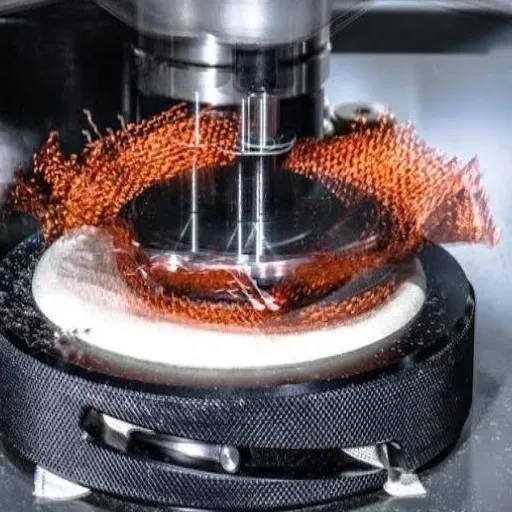
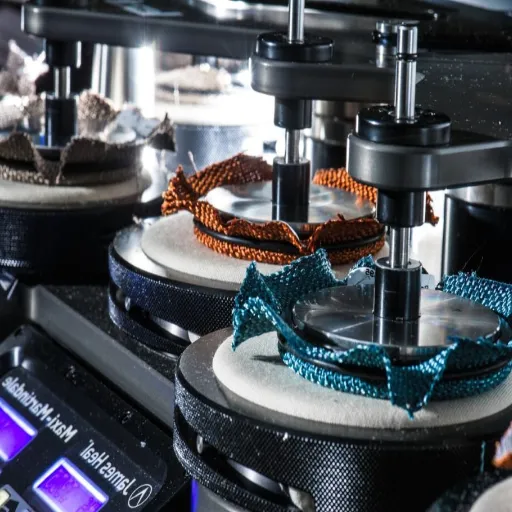
Martindale rubs a circular specimen against an abradant under a controlled load. The specimen holder traces a widening figure-of-eight, called a Lissajous pattern, so the fabric is rubbed in every direction in turn rather than back and forth. The abradant is a standard worsted wool cloth.
Direction is the whole point. Every fiber in the specimen meets the abradant from a different angle as the pattern widens.
ACT specifies a downward pressure of 12 kPa for the contract version of the test. Results are reported in rubs, also called cycles, and the run usually stops at 100,000. The endpoint is a failure criterion rather than a clock: two broken threads in a woven fabric, a broken thread plus a visible hole in a knit, or the pile worn away on a pile fabric.
The standard is published in parts, and knowing which part a lab used matters:
- ISO 12947-1 defines the apparatus.
- ISO 12947-2 determines abrasion resistance to breakdown, and is the part quoted on upholstery spec sheets.
- ISO 12947-3 determines mass loss.
- ISO 12947-4 assesses change in appearance.
Martindale is the reference method across the UK, Europe, Australia, and New Zealand, and it’s the default the reader assumes when a British or European spec sheet says “rubs” without qualification. The Kothea Martindale worksheet is a useful designer-facing version of the same method.
The Wyzenbeek Test (ASTM D4157)
Wyzenbeek pulls a rectangular specimen back and forth in a straight line against an abradant drum. The test runs in one direction first, the warp, then resets and runs in the other, the weft, and reports the harder of the two. The abradant is a standard #10 cotton duck, and ACT specifies 3 lb of pressure with 4 lb of tension.
Straight lines only. That one detail separates it from Martindale more than any other.
Results are reported in double rubs, a single back-and-forth motion counting as one. This is the unit the US market reads, and it’s why an American spec sheet showing “30,000” and a European one showing “30,000” are describing different amounts of wear.
Coated fabrics and low-melting fibers such as olefin use a wire screen abradant instead of cotton duck, which is a separate variation worth confirming when you read the report.
Why the Numbers Cannot Be Converted
There’s no formula that turns Martindale rubs into Wyzenbeek double rubs. ACT states plainly that no correlation exists between the two, and the reason is structural: the tests differ in motion, abradant, load, and failure criterion, so they’re not measuring the same thing in different units. They’re measuring related things in unrelated ways.
The pairs you see quoted together, such as 15,000 Wyzenbeek alongside 20,000 Martindale, are specification conventions, not a conversion table. They represent two independently chosen thresholds for the same end use, not one number translated into the other. Treating them as a ratio is the single most common error in this topic, and it leads directly to the mistake Elena nearly made. American Leather’s plain-language rub-test guide makes the same point from a furniture maker’s side of the table.
ISO vs ASTM vs EN vs BS vs AATCC vs ACT: Which Standard Applies Where
Six acronyms appear on upholstery documents, and buyers often assume they’re competing opinions on the same test. They aren’t. Each body has a different job and a different geography.
- ISO / IEC publishes international standards that most markets accept as a baseline. The ISO 12947, ISO 13936, and ISO 105 families all sit here.
- EN and BS EN are the European harmonized adoptions of ISO standards, sometimes with small national additions. A number written as BS EN ISO 12947-2 is the British adoption of the ISO text.
- BS on its own, with no EN or ISO behind it, is a purely British standard. BS 5852 and BS 7176, both flammability documents, are the classic examples.
- ASTM International publishes US technical standards, identified by a letter and number such as D4157. The D prefix marks textile methods.
- AATCC publishes US textile-specific methods, mainly for colorfastness and lightfastness. AATCC 8 and AATCC 16 are the two you’ll see most.
- ACT, the Association for Contract Textiles, is a US trade association, not a standards body. It publishes voluntary minimums that US contract buyers write into specifications, which is why ACT numbers appear on spec sheets next to ASTM and ISO results.
The practical rule follows from that. Specify Martindale for EU, UK, and Australian projects. Specify Wyzenbeek for US projects. Specify both when the market is mixed or when the same fabric ships into more than one region, and label each number with its method so nobody downstream merges them.
How to Read an Upholstery Fabric Test Report
Most explanations of upholstery yarn testing standards tell you what the tests are. Almost none show you what a report looks like, which is where the real problems surface.
Daniel found that out in 2024. Daniel develops product for an office furniture manufacturer, and he approved a mid-back task chair fabric on the strength of a supplier sheet reading simply “30,000 rubs.” No method, no standard, no unit beyond the word “rubs.” He read it as Wyzenbeek, because he was buying in the US.
The lab report, requested later during a contract review, said Martindale. That’s a different claim at a different threshold, and by the time the discrepancy surfaced the chair was already tooled. The number hadn’t been wrong. The missing method name had made it unreadable.
A complete report reads in a fixed order, and the useful skill is knowing which fields to check before you look at the headline figure at all.
- Report header. The testing laboratory, the report date, and an accreditation reference. An unaccredited lab result is a data point, not a certification.
- Specimen identification. The fabric or yarn reference and, critically, the specific colorway tested. A grade earned by one colorway doesn’t transfer to the rest of the card.
- Method, in full. The complete standard number, including the part. “ISO 12947” is ambiguous; “ISO 12947-2” isn’t.
- Result and unit. The number plus the unit appropriate to that method. Rubs for Martindale, double rubs for Wyzenbeek, mm for ISO seam slippage, lbf for the ASTM version.
- Pass or fail basis. The threshold the result was judged against, and the source of that threshold, whether ACT, a national classification, or a client specification.
- Remarks. Conditioning, number of specimens, and any treatment applied to the fabric before testing. This field quietly hides the most re-tests.
Four of those fields decide most outcomes, and they’re the ones to check before you look at the headline number: is the method named in full, is the unit correct for that method, which colorway was tested, and was anything applied to the fabric after the test. Most weak submissions fail on one of those four.
If the number itself is the thing you’re trying to interpret, that’s a different question, and our guide to what actually makes upholstery yarn durable covers how far a rub count can be trusted by traffic level.
Pilling and Seam Slippage: The Two Tests Buyers Forget to Request
Abrasion gets the attention. Pilling and seam slippage cause a large share of the field complaints, and both are routinely missing from a specification.
Pilling Test Methods for Upholstery
Pilling is the formation of small fiber balls on the fabric surface through friction. Three methods cover it: ISO 12945-2, which uses the Martindale apparatus; ASTM D3511, the brush pill method; and ASTM D4970, a Martindale face-to-face variant. All three grade on a scale of 1 to 5 where 5 means no pilling.
ACT sets the contract minimum at Class 3, and 4 to 5 is the safer target for high-traffic seating. The trap is that pilling is an aesthetic failure, not a structural one. A fabric can post an excellent abrasion result and still pill visibly within a year, because the two properties depend on different things. Fiber blend and yarn structure decide pilling behavior, and our guide to which fiber blends hold up best in upholstery covers that pairing.
Seam Slippage Test Methods
Seam slippage is a seam opening when the fabric is pulled across it. ISO 13936-2 and ISO 13936-3 cover the European method, and ASTM D4034 the US equivalent. Results are reported in millimeters under the ISO method and in pounds-force under ASTM, which is a second place where a unit mismatch can make two reports look incomparable when they aren’t.
ACT sets the contract minimum at 25 lbf in both warp and weft. A slippage failure usually comes down to construction: slick filament yarns such as nylon in the weft in a low-density weave give threads room to shift, so the cause sits with yarn and weave selection rather than with the test itself.
Upholstery Flammability Standards: Crib 5, CAL TB 117, and CAL TB 133
Flammability is the one test on the list that can halt a project after the fabric is approved. It’s also the least explained, on this site and across the search results, so it gets its own section.
Marcus ran into that in early 2025. Marcus manages a fit-out for a hospitality group and had selected a beautiful wool-blend for a bar refurbishment. The spec sheet listed CAL TB 117-2013, and the fabric was approved on that basis.
What the sheet didn’t say is that CAL TB 117-2013 tests individual components, the fabric and the foam separately. His project required CAL TB 133, which tests the complete assembled seating unit. The gap wasn’t a paperwork problem. It was a re-test of a finished chair, and the delay pushed his installation into the following quarter.
In the UK and Europe, BS 5852 is the common contract requirement, and “Crib 5” refers to the ignition source 5 test within it, which models a burning wooden crib. BS 7176 sets hazard categories by end use, and EN 1021-1 and EN 1021-2 cover the smoldering cigarette and match-flame equivalents.
In the US, CAL TB 117-2013 tests components and is the baseline for residential upholstery. CAL TB 133 tests the complete assembled unit and is the contract standard for high-occupancy seating. The two aren’t substitutes for each other, which is exactly the distinction that cost Marcus a quarter.
In marine and transport, IMO FTPC Part 8 applies, and outdoor or commercial projects may also meet NFPA 260 or NFPA 701. European variants such as DIN 4102 B1 and NF P 92-501 M1 appear on regional spec sheets.
One link back to the yarn matters here. Flame-retardant back-coating is the usual route to Crib 5 compliance, and as our colorfastness guide notes, heat-intensive treatments can shift dye. Ask for lightfastness and crocking to be retested after finishing. For seating that also faces weather, outdoor and marine seating stacks further requirements on top of the fire standard.
Which Tests to Specify for Your Application
This is where upholstery fabric testing standards stop being theory and turn into a purchase decision. The thresholds below combine ACT’s performance guidelines with the Möbelfakta specification used across Nordic procurement. Use them as a starting frame and confirm against the standard your market actually enforces.
| Application | Abrasion (Martindale / Wyzenbeek) | Pilling | Seam slippage | Tensile | Flammability |
|---|---|---|---|---|---|
| Residential, light use | 20,000 rubs / 15,000 double rubs | Grade 3 min | 25 lbf min | Not usually specified | CAL TB 117-2013 (US) |
| Residential, heavy use | 30,000 rubs / 30,000 double rubs | Grade 4 preferred | 25 lbf min | Often specified | CAL TB 117-2013 (US) |
| Contract, general | 20,000 rubs / 15,000 double rubs | Grade 3 min | 25 lbf min | 1,000 N (EN ISO 13934-1) | BS 5852 Crib 5; CAL TB 133 |
| Contract, heavy duty | 40,000 rubs / 30,000 double rubs | Grade 4 preferred | 25 lbf min | 1,000 N | BS 5852 Crib 5; CAL TB 133 |
| Healthcare, transport, lobby | 40,000+ rubs / 30,000+ double rubs | Grade 4 to 5 | 25 lbf min | 1,000 N | CAL TB 133; IMO FTPC Part 8 (marine) |
Möbelfakta sets its EN ISO 12947-2 endpoints at 35,000 cycles for domestic furniture and 40,000 for non-domestic, with tensile at 1,000 N or above in warp and weft. Those numbers sit in the same band as the ACT contract figures, a useful cross-check when you’re specifying for a market that recognizes both.
Two cautions on that table. The abrasion pairs in the left column are separate thresholds, not conversions, so specify the one that matches your market’s method. And higher abrasion numbers don’t buy proportionally longer service life. Matching the tier to the actual traffic is what matters.
Ready to make your spec comparable? Tell us your application and market and we’ll return the test set and thresholds it needs. Send us your requirements.
How to Write Testing Requirements Into a Yarn Order
Everything above becomes useful at the moment you place a yarn order. A testing requirement is only enforceable if it names the property, the standard, the threshold, the unit, and the colorway it applies to. Put this block on your next purchase order in place of any looser language.
Testing Requirement
- Fiber and blend: [e.g. 100% solution-dyed polyester, or 60/40 wool-nylon]
- Colorway reference: [Pantone TCX number or approved physical swatch]
- Abrasion: [X] rubs to ISO 12947-2, or [X] double rubs to ASTM D4157, per target market
- Pilling: Grade [X] to ISO 12945-2
- Seam slippage: [X] mm to ISO 13936-2, or [X] lbf to ASTM D4034
- Tensile strength: [X] N to ISO 13934-1
- Crocking, dry and wet: Grade [X] to AATCC 8
- Lightfastness: Grade [X] to ISO 105-B02, tested at [X] hours
- Flammability: [standard], tested on the [component or assembled unit]
- Approved testing laboratory: [name]
- Report required per colorway, not per fabric range
- Retest color properties after any finishing treatment
Three habits make that block work.
- Name the standard, not just the number. “Grade 5” is unverifiable. “Grade 5 to ISO 105-B02” is a claim a supplier can be held to.
- Match the method to the market. Write ISO 12947-2 for Europe and ASTM D4157 for the US, and both when the same order ships to both.
- Ask for a report per colorway. A result earned by a mid-tone beige says nothing about the deep teal two rows down the same card, and color-driven properties genuinely shift between dye lots.
Once the requirement block is agreed, the manufacturing side is a sampling and approval process. Our guide to how a specification becomes a production order walks through lab dips, sample approval, and the per-colorway reporting that makes the block enforceable.
Frequently Asked Questions
What is the Martindale test for upholstery?
The Martindale test measures abrasion resistance by rubbing a circular specimen against a worsted wool abradant in a figure-of-eight pattern under a controlled load. Results are reported in rubs, ending at a defined failure point such as two broken threads. The upholstery method is ISO 12947-2, with ASTM D4966 as the US equivalent.
What is the difference between Martindale and Wyzenbeek?
Martindale rubs a round specimen in a figure-of-eight against wool and reports rubs. Wyzenbeek pulls a rectangular specimen in a straight line against cotton duck and reports double rubs. Different motion, different abradant, different unit, and different markets: Martindale for Europe, the UK, and Australia, Wyzenbeek for the US.
Can you convert Wyzenbeek double rubs to Martindale cycles?
No. ACT states there’s no correlation between the two methods, because they differ in motion, abradant, load, and failure criterion. The paired figures often quoted, such as 15,000 Wyzenbeek and 20,000 Martindale, are two separately chosen thresholds for the same end use, not a conversion formula.
What is ISO 12947?
ISO 12947 is the international standard family for abrasion resistance of textiles using the Martindale method. Part 1 defines the apparatus, Part 2 determines abrasion resistance to breakdown, Part 3 determines mass loss, and Part 4 assesses change in appearance. Upholstery spec sheets almost always quote Part 2.
What is a good Martindale result for upholstery?
For general contract use, 20,000 rubs is the common minimum. Heavy-duty contract seating sits at 40,000 rubs, and Nordic specifications such as Möbelfakta set 35,000 cycles for domestic furniture and 40,000 for non-domestic. Higher figures help only when they match the traffic the seating will actually see.
What is a pilling grade and what is a good one?
Pilling is graded 1 to 5, where 5 means no pilling and 1 means heavy pilling. ACT sets the contract minimum at Class 3, and 4 to 5 is preferred for high-traffic seating. Pilling is an aesthetic failure, so a fabric can pass abrasion comfortably and still pill.
What is the Crib 5 test?
Crib 5 is ignition source 5 under BS 5852, the British flammability standard. It models a burning wooden crib placed against the furniture and is the common fire requirement for UK contract upholstery. BS 7176 then sets hazard categories according to the end use.
What is the difference between CAL TB 117 and CAL TB 133?
CAL TB 117-2013 tests individual upholstery components, such as the fabric and the foam, and is the US residential baseline. CAL TB 133 tests the complete assembled seating unit and applies to contract and high-occupancy seating. A fabric compliant with the first isn’t automatically compliant with the second.
How do I read an upholstery fabric test report?
Check four fields before the headline number: whether the method is named in full with its standard number, whether the unit matches that method, which colorway was tested, and whether any finish was applied after testing. Then read the result against the stated pass or fail threshold.
Which tests should be on an upholstery fabric spec sheet?
At minimum: abrasion, pilling, seam slippage, tensile strength, tear strength, crocking dry and wet, lightfastness, and flammability. The last two are most often omitted, and flammability is the one that can stop a project if the wrong standard was specified.
Making Two Quotes Comparable
Upholstery fabric testing standards do one job well: they make performance claims comparable between labs, suppliers, and production lots. They were never designed to forecast how long a sofa will last, and a rub count quoted without a method name isn’t a specification at all.
Martindale and Wyzenbeek measure related properties by unrelated routes, and no formula converts one into the other. The paired thresholds you see on spec sheets are two separate decisions, not one translated figure. Abrasion, meanwhile, is one property out of eight, and pilling, seam slippage, and flammability all end projects that abrasion alone would have passed.
The report matters more than the headline number. Name the standard beside every grade, confirm the result for your exact colorway, and check whether anything was applied to the fabric after testing. Those habits are what separate a usable set of upholstery yarn testing standards from a stack of numbers.
That’s the difference between a fabric that passes a test and a fabric that passes the room it sits in. Send us your spec sheet or an existing test report, and we’ll tell you which tests it is missing before the order goes out.