


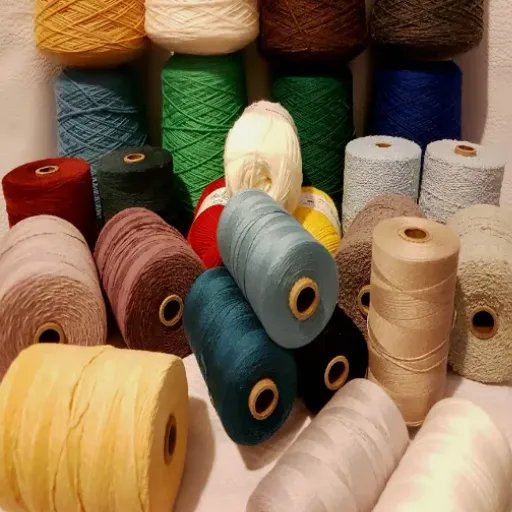
Wool is the natural fiber that performs best in upholstery, because it is the only one that self-extinguishes and it reaches contract-grade abrasion in a blend. Cotton and linen are comfortable and beautiful but burn readily and need flame-retardant treatment. Hemp is strong and durable but coarse. The right choice depends on which of those limits your project can tolerate.
That’s the short answer. The useful answer is what each fiber actually does when a sofa meets a test report.
A specifier picks cotton for a hotel lobby because “natural” reads as premium and sustainable. The design is approved, the sampling is booked, and three weeks later the flame test fails.
The fix is a topical treatment that dulls the hand and weakens the fiber. The fiber was never the problem. The assumption was.
If you have watched a natural fiber upholstery yarn clear an abrasion test and then stumble on fire performance, you already know that “natural” describes where a fiber came from, not how it behaves.
Key Takeaways
- Wool is the strongest natural choice for upholstery: it self-extinguishes, chars instead of melting, and reaches 50,000 to 200,000 Martindale cycles in wool/flax and wool/polyamide blends.
- Cotton and linen are the two most combustible fiber options in this group, so both usually need flame-retardant treatment or an FR interliner to pass contract fire tests.
- Martindale cycles and Wyzenbeek double rubs are not interchangeable. A rub count means nothing without a named test method.
- “Natural” does not mean PFAS-free. Stain repellents are chemical finishes applied regardless of fiber, and the EU now regulates the finish rather than the fiber.
- The fibers that reach 100,000 Martindale are always blends. No 100% natural fiber gets there alone.
Comparing natural options for a live project? Request natural fiber upholstery yarn samples and test each candidate against your own abrasion, flame, and lightfastness requirements before you commit to bulk.
What Is Natural Fiber Upholstery Yarn?
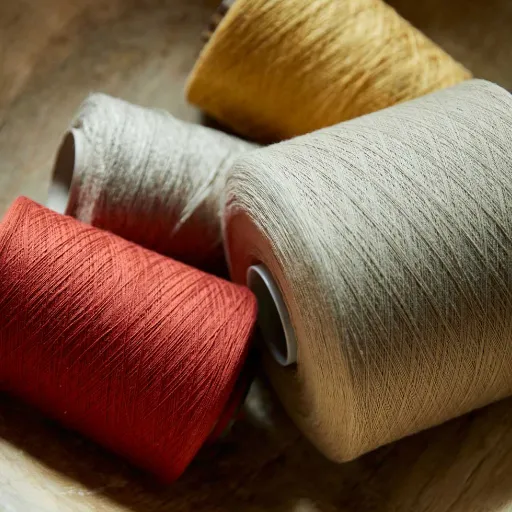
Natural fiber upholstery yarn is yarn spun from animal, plant, or regenerated-cellulosic fiber and used in furniture upholstery. It’s specified by abrasion class, flame behaviour, lightfastness, and stain resistance rather than by fiber name, because identical fiber can pass or fail depending on how it is spun and woven.
The definition has three parts, and buyers routinely merge them. Origin is where the fiber comes from: animal, plant, or regenerated. Construction is how it is spun, twisted, plied, and woven. Chemistry is what was added during dyeing and finishing.
Origin is the marketing part. Construction and chemistry decide whether the yarn survives.
Animal, Plant, and Regenerated-Cellulosic Fibers
Natural fiber upholstery yarn falls into three groups.
- Animal: wool, mohair, alpaca, silk
- Plant: cotton, linen (flax), hemp, jute
- Regenerated cellulose: viscose, modal, Lyocell, bamboo
Regenerated cellulose is the one that causes the most confusion, because viscose is made from wood pulp but processed chemically. If you are unsure where it belongs on a spec sheet, our guide to what viscose rayon actually is settles the question. In upholstery terms, treat it as its own category rather than as either natural or synthetic.
Why “Natural” Is Not a Specification
Fiber name predicts less about durability than most buyers expect. A Martindale result depends on three things working together: fiber strength, yarn construction and twist, and weave structure. Change the twist and the same fiber behaves differently.
This is the single most important idea in this article. Two 100% wool yarns can be rated 30,000 cycles apart because one was spun tighter or plied differently. So when a supplier quotes a rub count for “wool,” ask which yarn, at what count, in what weave.
For the full fiber landscape beyond natural options, the complete yarn for upholstery selection guide covers synthetics alongside these.
Natural Fiber Upholstery Yarn, Fiber by Fiber
Four fibers carry most of the commercial weight in natural fiber upholstery yarn. Each has a real strength and a real failure mode.
Wool: The Only Natural Fiber That Self-Extinguishes
Wool is the strongest natural starting point for upholstery, and the reason is chemistry rather than marketing. Wool fiber chars rather than melts, and it self-extinguishes when the flame source is removed. That gives it inherent fire performance no other natural fiber in this group matches.
Wool also holds moisture well, with a regain around 15% to 18%, and recovers its shape after compression better than any other natural fiber, as the comparative fibre property data in this textile science review sets out. Those properties explain why wool is comfortable and why it resists flattening in seat cushions.
Contract fabrics built on wool upholstery yarn reach high abrasion numbers. Wool and polyamide blends sit at 70,000 to 80,000 Martindale cycles. A wool and flax blend used in office and conference seating is rated above 50,000 Martindale with a 10-year abrasion guarantee, and heavier constructions reach 100,000. The practical lesson is that the blend does the work.
Polyamide is nylon, so the nylon yarn used for upholstery is the partner doing much of that work.
The failure modes are real. Wool is vulnerable to moths, particularly on soiled upholstery, and it degrades in alkaline conditions. Heat and agitation during cleaning cause felting and shrinkage, which is why wool upholstery is dry-clean only.
Cotton: Comfortable, Breathable, and Hardest to Make Fire-Safe
Cotton is soft, breathable, and takes dye across a wide range. Its tensile strength is high and actually increases when the fiber is wet, which is unusual and useful.
The problem is fire. Cotton is the most combustible fiber in this group, and untreated cotton needs flame-retardant treatment or an FR interliner to pass contract fire standards. That treatment is where the trade-offs stack up. FR finishes can stiffen the hand and reduce softness, and resin-based crease-resistant finishes can weaken the fiber over time.
Cotton also wrinkles, because it has low elastic recovery. It soils easily, and untreated cotton kept stains roughly 80% of the time after washing in published research. Bleach weakens the cellulose, so it isn’t a cleaning option.
Mercerisation, a caustic soda treatment, improves cotton’s strength, lustre, and dye affinity, so ask whether the yarn has been mercerised. Pre-shrinking matters too, since cotton shrinks significantly when washed unless it has been treated.
Linen (Flax): Stronger Than Cotton, Weakest Under Repeated Flex
Linen is a bast fiber from the flax plant. It is stronger than cotton, wicks moisture quickly, and has a crisp hand that softens and improves with age. Nothing else in the group ages as gracefully.
Its weakness is flex resistance. Linen has very low elasticity, so it wrinkles severely and breaks along fold lines where it is repeatedly creased. That makes it a poor choice for tight upholstery curves and hard-wearing edges.
A heavyweight 100% linen at 410 gsm is rated around 30,000 Martindale cycles, passing EN 1021-1 cigarette, BS 5852 cigarette, NFPA 260 and UFAC Class 1, and CAL 117. For UK and Ireland upholstery, an FR interliner or FR treatment is required. Between the creasing and the treatment requirement, linen suits premium residential and casual collections more than heavy contract work.
Hemp and Hemp/Lyocell Blends
Hemp is strong, durable, and naturally resistant to UV and mildew, and it grows with minimal water and no pesticides. Hemp upholstery yarn handles abrasion well and suits heavy-use seating and cushions.
The honest caveat is hand feel. Hemp starts coarse and rope-like and softens with use. That texture is a design decision as much as a specification. Most commercial hemp upholstery is therefore a blend, typically hemp with Lyocell for a softer hand and a silky sheen.
Check availability and lead time before specifying hemp at volume. The certified supply base is smaller than for cotton or wool, and that affects both cost and scheduling.
Reconstituted Cellulosics: Viscose, Modal, Lyocell, and Bamboo
Viscose, modal, Lyocell, and bamboo are regenerated from wood pulp. Lyocell production is closed-loop and recovers most of its solvent, which makes it the strongest environmental story in the group. Our Tencel and Lyocell yarn guide covers how that process works and where the fibre fits.
These fibers give drape and lustre that staple naturals struggle to match, but they have lower abrasion ceilings than wool and they lose strength when wet. Treat them as accent and drape options rather than load-bearing upholstery surfaces.
Natural Fiber Upholstery Yarn Compared
The table below puts the four main fibers side by side on the criteria that decide which natural fibers for upholstery you should shortlist.
| Fiber | Inherent flame resistance | Typical Martindale reach | Main failure mode | Best application | Blend partners |
|---|---|---|---|---|---|
| Wool | High, self-extinguishing | 70,000 to 100,000 in blend | Moths, felting, alkaline damage | Contract seating, premium residential | Polyamide, flax, viscose |
| Cotton | Low, needs treatment | Low to moderate alone | Combustibility, wrinkling, soiling | Cushions, accents, light residential | Linen, polyester, FR fibers |
| Linen (flax) | Low, needs interliner | Around 30,000 at heavyweight | Creasing and flex fatigue | Casual and premium residential | Wool, cotton |
| Hemp | Moderate | Moderate, blend-dependent | Coarse hand, tight availability | Heavy residential seating, cushions | Lyocell |
| Silk | Low | Low | UV degradation, cost | Decorative accents only | Viscose, wool |
The pattern is clear once it is laid out. Wool is the only fiber with inherent fire performance, and it is the only one that reaches contract abrasion on its own reputation. Everything else either needs a blend, a treatment, or a more forgiving application.
Do Natural Fibers Pass Contract-Grade Abrasion Tests?
Yes, when the fiber, the blend, and the construction are matched to the application. Wool-led blends clear contract thresholds today. The claims only mean something when the test method is named, and that is where most spec sheets get vague.
Martindale and Wyzenbeek Are Not Interchangeable
Martindale is measured in cycles and is the standard across the UK and Europe under BS EN ISO 12947. Wyzenbeek is measured in double rubs and is the standard in the US. Different machines, different motions, no reliable conversion between them.
As a specification guide only, heavy contract use is often expressed as roughly 30,000 Wyzenbeek double rubs or 40,000 Martindale cycles. Martindale runs about a third higher for equivalent duty. That’s a rule of thumb for planning, not a formula for a test report.
See the abrasion test run before you read another number on a spec sheet.
The ACT performance guidelines at contracttextiles.org are also worth bookmarking if you review test reports regularly. For a worked example of how to read the numbers, this Martindale rub test worksheet for designers maps rub counts onto real seating duty.
Duty Classes, and Which Ones Natural Fibers Reach
Abrasion requirements are usually expressed as a class. The bands used in practice are these.
- General domestic: 15,000 to 25,000 cycles
- Heavy domestic / light contract: 25,000 to 40,000 cycles
- Contract: 40,000 cycles and above
- Severe contract: 50,000 cycles and above
Wool-led blends reach the contract and severe contract bands. Linen at heavyweight reaches the domestic band. Cotton alone rarely goes past light domestic without a synthetic partner. This is why the fibers that reach 100,000 cycles are always blends and never a single natural fiber.
Pilling on Natural Fibers
Pilling is the most common objection raised against natural fiber upholstery yarn, and wool is the fiber people worry about most. Pilling on wool is normal and it reduces over time as loose fiber works free. It can be managed with vacuuming or a fabric shaver rather than replacing the piece.
The controllable variables are fiber length, twist, and spinning quality. Short staple fibers with low twist pill more. Ask for pilling results on the exact yarn, not on the fiber category.
Lightfastness and Colour Fastness
Lightfastness is often the reason a natural fiber is rejected late in a project. Natural dyes and fibers can shift in strong sunlight. A Blue Scale rating of 4 to 5 is the recommended target for sun-exposed settings.
Colour fastness to rubbing matters too, especially on seating that takes friction at the arms and edges. Ask for wet and dry rub results together, because a yarn that passes dry rub can still fail wet.
Stain Behaviour and Aftercare
Natural fibers are porous, which means liquid wets them faster and penetrates deeper than on a synthetic. The porous structure is the mechanism and weave tightness is the control. Tighter weaves give spills less room to enter.
Untreated cotton retained stains roughly 80% of the time after washing in published research, which is the clearest argument for treating stain management as a specification decision rather than a care instruction. Practical controls include tighter weaves, darker melange yarns that hide marks, and removable covers.
Aftercare follows the fiber. Wool is dry-clean only, with moth control and no heat or agitation. Cotton and linen take a gentle 30°C wash, no bleach, no tumble dry, and a cool iron.
Flame Retardancy, PFAS, and the 2026 Formaldehyde Cap
Fire performance and chemical compliance are two separate conversations, and conflating them is the most expensive mistake in this category. Both decide whether a natural fiber upholstery yarn can be specified at all.
The Cotton and Linen Fire Gap
Wool handles fire on its own. Cotton and linen do not. Both are the most likely fibers in this group to burn, and both normally need a commercial FR finish or an FR interliner in the cushion build to pass contract standards.
Relevant test standards include EN 1021 parts 1 and 2, BS 5852, BS 7176 for hazard classification, CAL TB 117, and NFPA 260 or UFAC Class 1. Ask which one your project requires before choosing a fiber, because the answer can eliminate cotton from the shortlist immediately.
“Natural” Does Not Mean PFAS-Free
PFAS and PFAS-free are chemical claims, not fiber claims. Stain and water repellents are applied as finishes, and they can be applied to natural fiber just as easily as to polyester.
The evidence on whether they help is mixed at best. One cited study found PFAS treatment improved stain resistance on polyester and cotton blends by about 60%, but the coatings can turn stiff, cut breathability, and wash out after a few cleaning cycles. Treated fabric can therefore perform worse over time than untreated fabric.
This is where the argument that natural fiber is automatically the safer choice breaks down. A cotton upholstery yarn with a conventional stain-repellent finish carries the same chemistry question as a synthetic one. Ask whether both the yarn and the finish are PFAS-free, and ask for the tested method behind the declaration.
The EU Formaldehyde Cap Changes the Question
From 6 August 2026, the EU applies a formaldehyde emission cap of 0.080 mg/m³ under EN 16516 to indoor articles, listed as entry 77 of REACH Annex XVII. Textiles fall inside it.
The detail that matters is that the cap regulates the treatment, not the fiber. A linen finished with a formaldehyde-based resin can exceed the threshold just as readily as a cheap synthetic. Fiber origin gives you no protection here.
What it does change is the appeal of untreated and wool-led options. Fibers that perform without a heavy chemistry layer carry less regulatory risk, and that is a durable advantage as restrictions tighten.
FR Routes for Natural Upholstery Yarn
There are four routes to fire performance, and they differ in cost and in how much they change the hand.
- Inherent FR from the fiber itself, which is the wool advantage
- Blending with a flame-retardant fiber
- Topical treatment applied to the yarn or fabric, which is the most common and the most likely to alter hand feel
- An FR interliner or barrier in the cushion build, which leaves the visible fabric untouched
Route four is often the cleanest answer for cotton and linen, because it protects the hand and the surface appearance while meeting the standard.
Natural vs Synthetic Upholstery Yarn: When Natural Wins
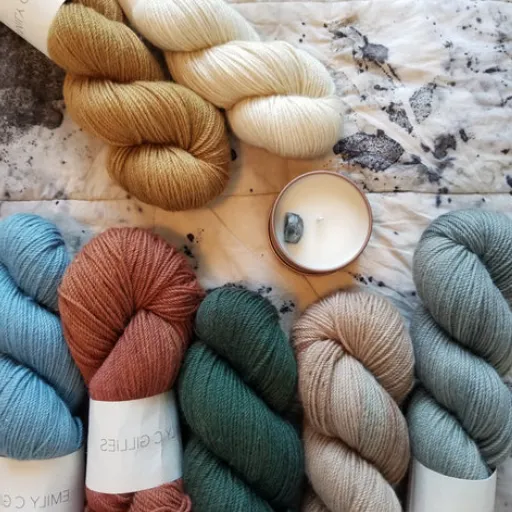
Natural fiber does not win on every criterion, and pretending otherwise is how projects get specified badly. Here is the honest split.
Natural fiber wins on: hand feel, breathability, how the piece ages, wool’s inherent fire performance, and regulatory positioning as finish restrictions tighten.
Synthetic wins on: peak abrasion resistance, stain release, colour stability under UV, and the lowest cost at the lowest minimum order.
Consider the counterpoint seriously. A polyester yarn for upholstery will out-abrade most natural options, resist staining more readily, and hold a saturated colour longer in sunlight. For a high-traffic family sofa on a tight budget, polyester is frequently the better engineering answer.
The same trade-off shows up in commercial specification. An independent review of what performance fabrics are actually made of makes the point that the fibre name on the label rarely predicts the test result.
The Hybrid Answer: Natural Face, Performance Backing
The compromise emerging across the market is hybrid construction. A natural-faced fabric carries the wool, linen, or hemp surface that the design calls for, while a recycled performance backing and a PFAS-free finish handle the durability and the stain resistance underneath.
That approach satisfies a tactile brief and an abrasion brief at the same time. It’s also a reasonable way to reach a lower minimum order, because the performance layer can come from a standard construction.
How to Specify Natural Fiber Upholstery Yarn
Work through the sequence in order. Skipping to fiber selection first is what causes late-stage failures, because the requirements eliminate options before the aesthetics matter.
- Set the abrasion class from the traffic zone and the named test method
- Set the fire standard the project must meet, and confirm whether an interliner is acceptable
- Set the lightfastness target for the exposure the piece will see
- Choose the stain strategy before choosing the finish chemistry
- Select the blend ratio that reaches the abrasion class
- Lock the denier and twist for the hand you want at that construction
- Confirm the certifications the claim requires
- Agree the care regime and make sure it is realistic for the end user
Steps one and two decide more than everything after them. If your fire standard requires an interliner anyway, cotton and linen stop being risky choices.
Blend ratios are worth naming explicitly. Wool and polyamide at 95/5 reaches 70,000 to 80,000 Martindale. Wool and flax at 75/25 clears 50,000 with inherent flame resistance.
Wool and viscose at 70/30 reaches 100,000 in some constructions. Higher wool content isn’t automatically stronger, which is the same lesson as elsewhere in this group.
Certifications map to specific claims rather than to quality overall. GOTS covers organic fiber, OEKO-TEX STANDARD 100 covers chemical safety in the finished product, RWS and ZQ cover responsible wool, and the EU Ecolabel covers broader environmental criteria. Ask for the certificate number and check it, because a logo without a verifiable number is not evidence.
If your project needs a construction that does not exist off the shelf, a custom upholstery yarn specification lets you set the blend, count, and colour to the tests you have to pass.
One more thing on this. As the eco pages put it, if your brief starts from a sustainability mandate rather than a performance requirement, start with eco-friendly upholstery yarn instead. The two questions overlap, but they lead to different shortlists.
Frequently Asked Questions
Can you use cotton yarn for upholstery?
Yes, with limits. Cotton is soft, breathable, and takes dye well, so it suits cushions, accents, and lighter residential pieces. Its abrasion ceiling is low and it is the most combustible fiber in this group, so it normally needs FR treatment or an interliner to pass contract fire standards. Treat cotton as a surface and hand choice rather than a heavy-traffic workhorse.
Is wool good for upholstery?
Wool is the strongest natural fiber for upholstery. It self-extinguishes, chars rather than melts, recovers its shape after compression, and reaches 70,000 to 100,000 Martindale cycles in blends with polyamide, flax, or viscose. Its weaknesses are moths, alkaline damage, and felting under heat, so wool upholstery is dry-clean only.
Is linen strong enough for upholstery?
Linen is stronger than cotton in tensile terms, but it has very low flex resistance and breaks along repeated fold lines. A heavyweight 100% linen is rated around 30,000 Martindale cycles, which covers domestic use. It also needs an FR interliner for UK and Ireland upholstery. Linen suits premium residential and casual collections better than heavy contract seating.
Do natural fiber upholstery yarns pill?
They can, and wool pilling is the most common complaint. Pilling depends on fiber length, twist, and spinning quality rather than on the fiber type. Wool pilling usually reduces over time as loose fiber works free. Ask for pilling test results on the exact yarn, not on the fiber category.
What is the best natural fiber for upholstery?
Wool, and it is not close on fire performance. It’s the only fiber in this group that self-extinguishes, and wool-led blends reach the contract and severe contract abrasion bands. For texture and drape where abrasion is not the binding constraint, hemp, linen, and Lyocell all have a place. The best choice is the one that meets the tests your application requires.
Is viscose a natural fiber?
Viscose is regenerated cellulose, not a natural fiber in the strict sense. It is made from wood pulp, which is a natural raw material, but the pulp is dissolved and chemically reconstituted into fiber. That places it between natural and synthetic on a spec sheet. Our guide to viscose rayon explains the process in detail.
Are natural fibers PFAS-free?
Not necessarily. PFAS appears in stain and water-repellent finishes, which can be applied to natural fiber as readily as to polyester. A cotton or linen upholstery yarn carrying a conventional repellent finish has the same chemistry question as a synthetic one. Ask whether both the yarn and the finish are PFAS-free, and ask for the tested method.
Are natural fiber upholstery yarns more expensive than polyester?
Generally yes, and the premium varies by fiber. Cotton and linen sit closer to polyester, while certified wool carries a larger premium because the certified supply base is smaller. Certification, FR treatment, and PFAS-free finishing each add cost. Ask for the cost broken down by element rather than as a single bundled price.
Conclusion
Natural fiber upholstery yarn is a specification choice, not a values claim, and the two are easy to confuse. Four ideas carry the decision.
Wool is the natural fiber that performs best, because it self-extinguishes and it reaches contract abrasion in a blend. Cotton and linen are the most combustible options here, so both usually need an FR finish or an interliner. Martindale cycles and Wyzenbeek double rubs measure different things, so a rub count without a method tells you nothing. And “natural” says nothing about PFAS, because that is a chemistry question decided by the finish.
Set your abrasion class and fire standard first. Then pick the blend ratio that reaches them. Then verify the certification by number rather than by logo. That order protects the launch and gets you the hand you wanted in the first place.
If you would like help matching natural fiber upholstery yarn to a specific traffic class, fire standard, or chemistry requirement, our team can review your specification and recommend yarns that meet it. Request natural fiber upholstery yarn samples from Hebei Lida Textile and start your next collection on a specification you can defend.