

Organic cotton yarn for home textiles is an excellent choice for bedding, a good choice for curtains, and a compromised choice for upholstery. Those three verdicts come from the same fibre, and the difference is not marketing. It comes down to how each application stresses the yarn, and to test data you can check before you commit to a production run.
“Organic” tells you how the cotton was grown. It says nothing about whether the yarn will survive a sofa.
That gap is where money gets spent badly. A home textile brand can specify a GOTS-certified organic cotton, feel good about the sustainability story, and still watch a commercial seating contract fail on abrasion. The certification was real. The fibre choice was simply wrong for the job.
This guide answers the question most home textile content avoids: not “is organic cotton good” but “is organic cotton good for this application.” You’ll get the per-application verdict, the yarn counts and spinning systems behind it, and the performance tests that decide whether a fabric holds up. If you’re specifying for bedding, curtains, or upholstery, the answer is different in each case, and it matters.
Key Takeaways
- Organic cotton yarn is a flagship choice for bedding and a solid choice for curtains, but a compromised choice for upholstery because of abrasion and flammability.
- Cotton reaches 15,000 to 30,000 Martindale rub cycles, against 30,000 to 100,000+ for polyester. Contract upholstery usually starts at 30,000.
- Cotton is cellulosic, so it ignites readily and has no inherent BS 5852 Crib 5 pass. It needs topical FR back-coating that can be lost in the water-soak test.
- Organic certification changes safety, traceability, and cost (20 to 35% premium). It does not change abrasion, light fastness, or flammability.
- Match the count to the job: bedding Ne 40 to 100, curtains Ne 6 to 22, upholstery Ne 12 to 32.
What “Organic Cotton Yarn for Home Textiles” Actually Means
Organic cotton yarn for home textiles is yarn spun from cotton grown without synthetic pesticides or fertilisers, certified across the supply chain by a recognised standard, and engineered to the counts and constructions that furnishing, drapery, and bedding fabrics require. The word “organic” describes cultivation and processing. It does not describe performance.
This distinction matters because the two axes get confused constantly. Certification is an ethics and traceability question. Application fit is a construction question. A yarn can be perfectly certified and completely wrong for the job. For a full breakdown of how the certification scales work, see what GOTS and OCS actually certify.
Two standards do most of the work in home textiles. GOTS (Global Organic Textile Standard) covers the entire chain, from fibre to finished fabric, including dyeing, finishing, and labour conditions. OCS (Organic Content Standard) verifies fibre content only. A product labelled “organic” with no named standard is unverifiable. If you want to confirm a claim rather than trust it, our guide to how to verify an organic cotton claim walks through the four checks that separate a genuine certification from a label that just says so.
Now, the part that decides whether the yarn performs.
One Fibre, Three Very Different Jobs
Bedding, curtains, and upholstery each stress a yarn in a different way. Bedding is about skin contact, softness, and wash durability. Curtains are about drape, weight, and colour permanence under light. Upholstery is about abrasion and fire. Cotton handles the first two well and struggles with the third.
Ready to compare organic cotton against your current specification? Request a yarn sample in the count you actually run.
Keep that framework in mind as we work through each application, because the honest answer changes at every step.
Organic Cotton Yarn for Bedding and Bed Linen
Bedding is where organic cotton earns its premium most clearly.
You spend roughly a third of your life against bedding, which makes certification more than a marketing angle. GOTS-certified organic cotton avoids formaldehyde-based wrinkle finishes and many allergenic dyes, and it is a natural, breathable fibre that regulates temperature and breaks down when unblended. For skin-contact textiles, this is the application where “organic” carries the most weight.
Counts and Construction for Bedding
Bedding spans a wide count range, and the count determines the hand feel. Fine combed or compact ring-spun yarns in the Ne 40 to Ne 100 range produce smooth, high-quality sheeting and fine bed linen. Heavier bed sheeting sits around Ne 12 to Ne 22. Combing removes short fibres for a stronger, smoother, less pilling yarn, which is why combed counts dominate premium bedding. Our guide to how yarn count is specified covers the Ne, Nm, and Tex systems in detail.
Consider the practical effect. A bedding brand moving from a carded Ne 20 to a combed Ne 40 on the same organic fibre gets a noticeably softer, smoother sheet without changing the fibre at all. The fibre was already excellent. The construction was the lever.
What Organic Changes Here
Organic changes safety, traceability, and cost. Bedding is the flagship organic category for that reason, with the organic cotton home textiles segment valued at roughly USD 1 billion by 2025. For baby bedding and sleepwear, the safety case is strongest, and we cover the specifics in organic cotton for baby bedding. The cost side is real too, and you can see the full picture in what the organic premium costs.
Organic Cotton Yarn for Curtains and Drapes
Cotton is a natural fit for drapery. It dyes easily, drapes softly, and washes well, which is why it has furnished curtains for generations. Organic cotton changes the source of the fibre, not its ability to hang.
Where Cotton Works for Drapery
Curtain fabrics range across three weight bands. Sheers sit at 55 to 110 g/m², standard curtains around 290 to 380 g/m², and heavy, structured hangings reach 460 g/m² and above. Cotton carries all three. A mid-weight organic cotton at 380 g/m² delivers the soft, natural drape that heavier synthetic drapery often lacks.
The Curtain Caveat: Light Fastness
Organic cotton curtain light fastness is the one place buyers get caught. Light fastness is measured on the ISO 105-B02 scale from 1 to 8, and organic cotton drapery typically spans 3 to 7. That spread is wide enough to matter, and the maths is unforgiving: according to drapery manufacturer Kvadrat, one point on the scale corresponds to a doubling of the time before the same amount of fading appears. A fabric rated 6 to 7, such as Kvadrat’s Kenya II, holds colour more than twice as long as one rated 3 to 4.
Sun-exposed windows need a rating of 5 or above. Interior and shaded windows give you more room. This is a specification decision, not a fibre limitation, and it is the kind of detail that separates a curtain still looking right after five summers from one that is not.
Counts for Curtain Fabric
Drapery uses coarser counts than bedding, typically Ne 6 to Ne 22. Open-end and rotor spinning handle the coarse end, and shrinkage is modest, generally 1 to 4%. One trap: confirm whether a quoted weight is per square metre or per linear metre. The units are not interchangeable, and comparing across them will mislead you. For more on coordinating yarn with drapery production, see eco-friendly yarns for curtains.
Organic Cotton Yarn for Upholstery
Now the honest answer. Organic cotton yarn is a beautiful residential upholstery fibre and a compromised contract fibre, and the reasons are abrasion and flammability, not sustainability.
If you’re weighing cotton against synthetics for seating, our guide to choosing a furniture-grade yarn covers the full selection process. Here, the focus is what is specific to cotton.
Abrasion: The First Problem
Abrasion resistance is measured in Martindale cycles, and the Martindale rub count cotton reaches is lower than most buyers assume. Cotton typically reaches 15,000 to 30,000 Martindale cycles. Polyester reaches 30,000 to 100,000+. The rub-count bands make the consequence clear:
| Martindale cycles | Classification | Typical use |
|---|---|---|
| 15,000 | Light domestic | Occasional-use residential furniture |
| 25,000 | Heavy domestic | Everyday family sofas, motion furniture |
| 30,000 | Contract entry | Light commercial, busy public areas |
| 40,000 to 50,000+ | Severe contract | Hotels, restaurants, schools |
A 100% cotton fabric on a hotel chair sits below the contract threshold unless it’s a heavy construction with a protective finish. One caveat worth stating plainly: rub count measures abrasion only. It doesn’t predict pilling, colour fading, or fire performance, and a higher number doesn’t make a fabric indestructible.
Flammability: The Harder Problem
Cotton is cellulosic, which means it ignites readily. Unlike wool or inherently flame-retardant fibres, cotton has no inherent BS 5852 Crib 5 pass. Contract upholstery in the UK requires Crib 5 regardless of fibre, so cotton must be topically back-coated with flame retardants to comply.
That treatment isn’t permanent. Full BS 5852 certification includes a water-soak test that simulates cleaning, and in practice many fabrics that pass the dry Crib 5 test fail after the soak. Cleaning with an incompatible method can strip the coating and require re-treatment.
The treatment can also flatten pile and stiffen the handle, which is why pile fabrics like velvet are especially exposed. You can read the full detail in Kothea’s BS 5852 Crib 5 specification guide.
For domestic furniture, the rules are gentler. Under UK fire safety regulations, a fabric of at least 75% exempt fibre, which includes cotton, does not require match-test treatment when used with a flame-retardant Schedule 3 interliner. It must still pass the cigarette test. A fire barrier helps, but it doesn’t stop the upholstery fabric itself from becoming involved.
Where Upholstery Cotton Still Wins
None of this makes cotton a bad choice. It makes it a choice with a clear boundary.
Residential, light-duty, and decorative pieces are where cotton shines: cushions, accent chairs, headboards, and any application where hand feel and aesthetics carry the decision. If you need more durability than pure cotton offers, a cotton-polyester blend is the pragmatic middle path, and it is a common specification for exactly this reason.
Specifying for a seating range? Talk to our team about the counts, blends, and finishes that match your traffic level.
Specifying Home Textile Cotton Yarn: Counts, Spinning, Construction
The application decides the count, and the count decides the spinning system. This is the reference most guides skip.
| Application | Typical Ne count | Spinning system | What it suits |
|---|---|---|---|
| Heavy bed sheeting | Ne 12 to 22 | Ring or rotor | Durable everyday sheets |
| Fine sheeting and bed linen | Ne 40 to 100 | Combed ring, compact | Smooth premium bedding |
| Curtain cloth | Ne 6 to 22 | Rotor (coarse), ring | Drapery, table linen |
| Upholstery | Ne 12 to 32 | Ring, rotor | Seating, cushions |
Three spinning systems cover the range. Open-end and rotor spinning handles coarse counts, roughly Ne 2 to 30. Ring spinning covers Ne 15 to 60 and is preferred for medium and fine wovens. Compact spinning takes the finest end, above Ne 50.
Construction choices matter as much as counts. Combed yarn is stronger, smoother, and less prone to pilling than carded yarn because the short fibres have been removed. For a bedding programme where hand feel is the selling point, combing is often the single highest-impact specification call.
The Performance Tests Behind the Verdicts
The verdicts in this guide rest on four tests. Knowing them helps you read a specification sheet and ask the right questions of any supplier.
- Martindale measures abrasion, in cycles. The bands above apply.
- ISO 105-B02 measures light fastness, on a scale of 1 to 8. Each point doubles the fade time.
- BS 5852 Crib 5 measures flammability, and is a common contract requirement.
- Pilling tests (ASTM D3511 or D4970) measure surface fuzz. Here cotton has an edge: 100% cotton generally resists pilling, and any pills that form tend to break away. Cotton blended with synthetics pills differently, because the strong synthetic fibre anchors the pill while cotton lint accumulates.
Pilling deserves one honest note. It’s largely cosmetic. It doesn’t reduce the durability or service life of a fabric, and many mills don’t cover it under warranty. Judge a fabric on the tests that match its application, not on a single headline number. For more on how mills verify these results, see how yarn quality is tested.
What Organic Certification Does and Doesn’t Change at Home
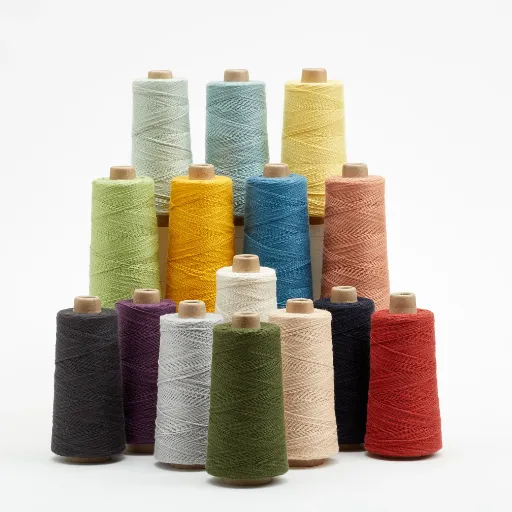
This is the crux for a specifier, so let us be precise.
Here’s the split:
- What organic changes: skin safety, traceability, and price. GOTS-certified yarn avoids certain chemical finishes and gives you documentary proof of the supply chain. The premium over conventional cotton runs 20 to 35%, driven by raw-material cost, certification and audit fees, and lower organic yields.
- What organic doesn’t change: abrasion, light fastness, and flammability. These are properties of the fibre type and the construction, not the farming method.
An organic cotton upholstery fabric wears and burns the same way a conventional cotton one does. If it appears twice on this page, that’s because the point is worth repeating: certification is one axis, performance is another.
If you’re comparing organic against recycled cotton, our breakdown of recycled versus organic cotton covers where each wins.
Cost, MOQ, and Sourcing for Home Textile Volumes
Home textile programmes buy at volume, so sourcing discipline matters as much as fibre choice.
Expect a 20 to 35% premium for certified organic cotton, and budget for the certification overhead on top. When vetting a supplier, ask for a verifiable current GOTS licence, a Transaction Certificate for every lot, Uster test data comparing organic against conventional quality, and documented separation between organic and conventional production lines to prevent cross-contamination.
Organic yarn is not lower quality than conventional yarn. Quality standards are identical, and a good mill will show you the test numbers to prove it. If you only do one thing before you commit, verify the paperwork rather than the label. Our organic cotton yarn guide explains how to separate a real certification from a claim.
Home Textile Care: Washing and Shrinkage
Care for organic cotton follows the fibre, not the certification. Wash at 30 to 40 °C, use no bleach, and avoid or minimise tumble drying.
Shrinkage is modest but real. Curtain fabrics typically shrink 1 to 4%, and organic cotton can shrink slightly more than conventional cotton on the first wash. Two rules prevent most problems. First, wash and dry a sample exactly as the finished article will be washed. Second, if the fabric carries an FR treatment, confirm that your cleaning method is compatible with it, because an incompatible method can strip the coating.
Frequently Asked Questions
Is organic cotton good for upholstery?
For residential and decorative use, yes. For contract and heavy-traffic use, it is compromised. Cotton reaches 15,000 to 30,000 Martindale cycles and has no inherent Crib 5 pass, so it needs a protective finish and often an FR treatment.
Is organic cotton yarn good for curtains?
Yes, usually. Cotton drapes naturally, dyes easily, and washes well. Check the light fastness rating, and favour 5 or above for sun-exposed windows.
What yarn count is best for bedding?
Fine combed or compact ring-spun yarns in the Ne 40 to Ne 100 range suit premium sheeting and fine bed linen. Heavier bed sheeting uses Ne 12 to Ne 22.
Does organic cotton upholstery need FR treatment?
For contract use, generally yes. Cotton is cellulosic and has no inherent Crib 5 performance, so it requires topical back-coating. The treatment can be lost in the water-soak test, so plan for re-treatment.
Is organic cotton worth it for home textiles?
For bedding, the safety and traceability case is strong. For curtains, it depends on the light-fastness rating. For upholstery, weigh the premium against the performance limits.
How do I wash organic cotton home textiles?
Wash at 30 to 40 °C, avoid bleach, and dry flat or on low heat. Check compatibility with any FR treatment first.
Does organic cotton pill on furniture?
100% cotton generally resists pilling, and any pills tend to break away. Cotton blended with synthetics pills more heavily because the synthetic fibre holds the pill in place. Pilling is largely cosmetic and doesn’t cut service life.
Source Organic Cotton Yarn for Home Textiles
Hebei Lida Textile runs organic cotton in the counts home textile programmes actually use, from coarse drapery and upholstery yarns up to fine combed bedding counts, with the certifications and test data to support a GOTS or OCS claim. If you’re comparing specifications, we’ll tell you honestly where cotton fits your application and where it doesn’t.
Request an organic cotton yarn sample → Tell us your application, count, and target certification, and we will send relevant samples with test data.
Conclusion
Organic cotton yarn works brilliantly in some home textile applications and fights you in others, and the difference is testable. Bedding is its strongest home application, curtains are a reliable fit once you check light fastness, and upholstery demands an honest conversation about abrasion and fire before you specify it.
The three takeaways worth carrying forward: cotton reaches 15,000 to 30,000 Martindale cycles, well below polyester’s 30,000 to 100,000+; cotton is cellulosic and has no inherent Crib 5 pass, so contract use needs a treatment that can be lost in cleaning; and organic certification changes safety, traceability, and cost, but not performance. Match the count to the job, verify the certification, and let the test data make the decision.